For years, organisations have been told that the answer to growth is finding better talent. But in 2026, that challenge has changed to accessing capability and building skills at scale.
Top HR executives have concluded that recruitment in today’s workforce extends beyond attracting talent.
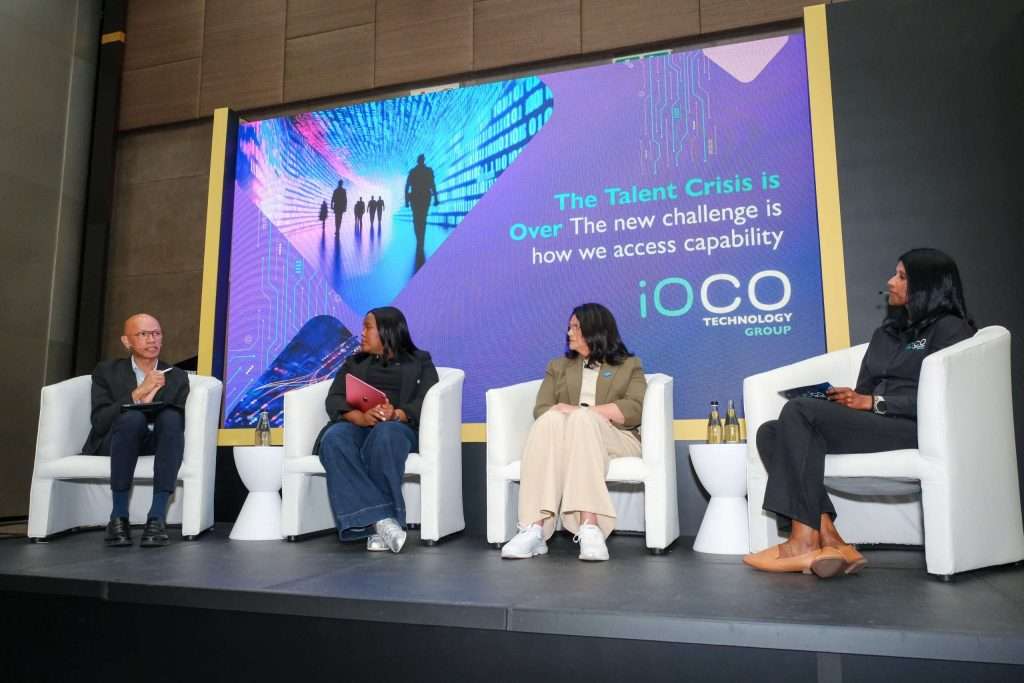
In a panel discussion titled The talent crisis is over: The new challenge, iOCO’s top talent recruiters Hein Weyers, managing director of people; Liby Mukondeleli, business development manager and Prabashni Munsami, business unit manager teamed up with Saleforce’s senior talent strategist Ursula Fear to discuss accessing and building skills for South Africa’s work force.
Prabashni set the tone for the discussion by citing figures from the World Economic Forum’s Future of Jobs Report 2025. At least 39 percent of workers’ current skills are expected to change or become outdated by 2030.
She also cited other research that shows 63 percent of surveyed employers in South Africa see skills gaps as a major barrier to business transformation. Prabashni added that 83 percent plan to reskill and upskill the existing workforce to work more effectively alongside AI.
For workers, the message was clear: learning can no longer be treated as an occasional training event. “You need to change as the environment changes. That’s the kind of future you’re going to be looking for. Somebody who’s going to change and be adaptable as the environment requires of them. So if you’re somebody who’s stagnant and is very resistant to change or learning, you’re going to struggle out there with them,” added Liby.
The “I choose me” mindset
Liby went on to add that the millennial adage “I choose me” must be the dominant mindset of employees. “We are often referred to as the generation that chooses themselves and I think it’s quite important in terms of context. Learning, developing and self-empowerment is about you. It’s not about the company. It’s not about impressing your line manager. It’s not about just being out of the office. It’s truly a self-development initiative that you have to take on,” Liby emphasised.
As AI and other technologies alter how work is done, maintaining employability means taking an active role in developing relevant skills. “Every single one of us in this room should be spending five to 10 hours a week, just keeping our skills current and worthy of what is required here,” said Ursula.
Panellists also stressed that learning should happen in the flow of work, not only in formal courses. These should include stretch assignments, opportunities to work across teams and time to experiment which can help people build experience as roles evolve. “The organisation that wins in the future is not the one with the best talent, but it’s the one with the fastest learning workforce,” said Hein.
The era of augmentation
The modern day chief people officer is also responsible for value creation on the income statement. “Now it is the era of the augmentation of a person and AI, whether it’s an AI agent or whether it’s automation platforms that actually assist us to do our work,” said Hein.
He adds that subscriptions to services like ChatGPT and tokenisation of Microsoft licences for Copilot have become a serious material income statement entry for companies.
For Hein, the question is no longer simply what AI tools cost, but whether those tools help the organisation create value while strengthening how people do their work.
He ended by saying that the era of “swim in your own lane” has also ended, adding that HR needs to be curious about what is happening in IT and finance to create value and understand where the organisation is going.
“You thought you were coming here to speak about the workforce, but you actually came here for a masterclass on your own personal learning journey. You need to actually focus on yourself,” he concluded.