

South Africa’s frontline is breaking under the weight of a cost-of-living crisis that shows no sign of easing.
These are the people who keep our shops stocked, our cities secure and our workplaces clean – the 75 percent of our national workforce who can’t work from behind a screen.
They are the backbone of the economy. Yet, as reported in the Deskless Worker Pulse 2025, half have no savings at all.
The study, conducted by Jem, draws on 4,600 interviews and surveys with employees in sectors like security, retail, sanitation, logistics and manufacturing.
It paints a stark picture of the daily financial strain endured by South Africa’s deskless workers and the extraordinary resolve that keeps them going.
“These are people earning between R4,000 and R10,000 a month,” says Nonsuku Mthimkhulu, head of customer at Jem. “They’re the backbone of South Africa’s economy and they are not coping. With transport and food costs rising relentlessly, saving is a luxury most simply can’t afford.”
A crisis we can no longer normalise
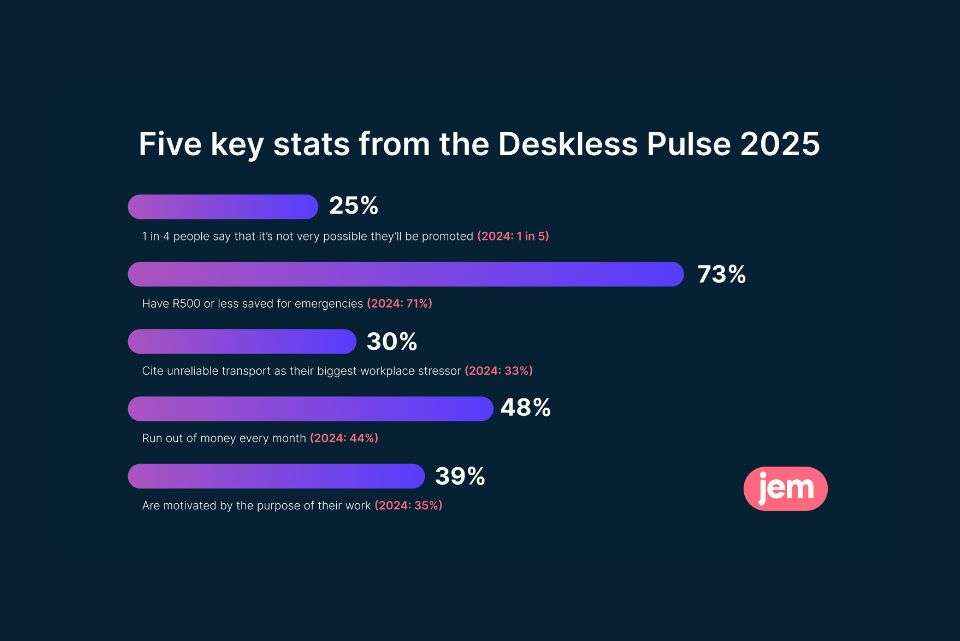
Nearly 51 percent of respondents said they have no savings, up from 44 percent last year. Nearly three-quarters have less than R500 set aside for emergencies, and almost half run out of money before payday every single month.
It’s a cycle that traps working people in perpetual anxiety, forcing them to choose between getting to work, putting food on the table or sending children to school.
Yet 97 percent of those same workers say they enjoy their jobs, down just one percent from last year’s report.
That contradiction of pride and purpose amid hardship is one of the most striking findings. Forty percent of workers said they are motivated by the meaning they find in their work, not just the paycheque. One retail employee put it simply: “When I help a customer and they leave with a smile, it makes the work I do worthwhile.”
This resilience is admirable, but it should not be romanticised. It is evidence of people holding the country together despite conditions that would break many office workers.
The conversation needs to evolve from a place of praising frontline resilience, to whether business and government will finally match that resilience with action.
The crushing cost of getting to work
Nowhere is the strain more visible than when discussing transport. 30 percent of respondents cited transport as their top stressor. For many, the day begins hours before sunrise with long, unsafe commutes that drain both income and morale.
“Many workers are exhausted before they even arrive at work,” says Nonsuku. “Unreliable or unsafe transport chips away at their energy, their productivity, their income.”
It’s an invisible tax on those who can least afford it, directly impacting attendance, performance and retention. The data suggests that financial fragility is not a personal failure but a structural issue. Without intervention, the country risks further entrenching inequality among the very people who keep its wheels turning.
Data that demands action
For the 2025 edition, Jem introduced the Deskless Pulse Score. A composite index measuring savings, income stability, debt reliance and financial stress. It’s designed to track the fluctuation of financial resilience and wellbeing over time, and help employers move from ad-hoc interventions to long-term strategies.
“Frontline employees can’t work themselves out of financial vulnerability,” says Caroline van der Merwe, Jem’s co-founder and chief operations officer. “It will take structured, sustained action. Fairer transport allowances, payroll-linked savings, earned wage access, more affordable data. These are all tangible levers that employers can pull.”
While painting a sobering picture in many regards, the Deskless Pulse 2025 also highlights progress. This year, more employers have begun experimenting with flexible pay models, providing workers access to earned wages before payday. Which, according Caroline, “can be the difference between getting to work or going into debt”.
Others are introducing financial-literacy workshops or subsidising transport and airtime. The best-performing employers see higher retention, stronger morale and fewer payroll queries. It’s proof that empathy and efficiency can co-exist.
The humans behind the numbers
“If you work behind a laptop, chances are, a payslip is a formality. For the majority of working South Africans, it’s a lifeline.” says Simon Ellis, Jem co-founder and CEO.
“The Deskless Pulse exists to make sure that lifeline is recognised and strengthened. I believe that with a more financially resilient workforce, we’ll nurture a more confident and productive country.”
That sentiment captures the spirit of the report. It’s an important piece of research, but it’s also a mirror. One that reflects the country’s economic divide and the humans behind boom gates and bin day that too often go unseen. Behind every percentage point is a person with a name, a family and a hope for something better.
The data is credible, the sample robust and the message clear. South Africa’s frontline workers are proud, capable and vital. But pride doesn’t pay bills.
A path towards shared responsibility
The onus is on employers, policymakers and the public to translate awareness into impact.
That means embedding financial wellness into HR strategy and treating it as essential infrastructure rather than a perk. It means listening. Not just to survey results, but to the lived experiences of the people who mop floors, guard gates, deliver goods and stock shelves.
Progress is possible, but only if we stop talking about “them” and start working for them. The future of work cannot be inclusive if the majority of workers remain excluded from stability and opportunity.
The 2025 Deskless Worker Pulse is both a warning and a roadmap: a call for empathy, urgency and partnership. Because when the people who hold up the economy can no longer stand, the whole system falls.
Read the full report at desklesspulse.jemhr.com