
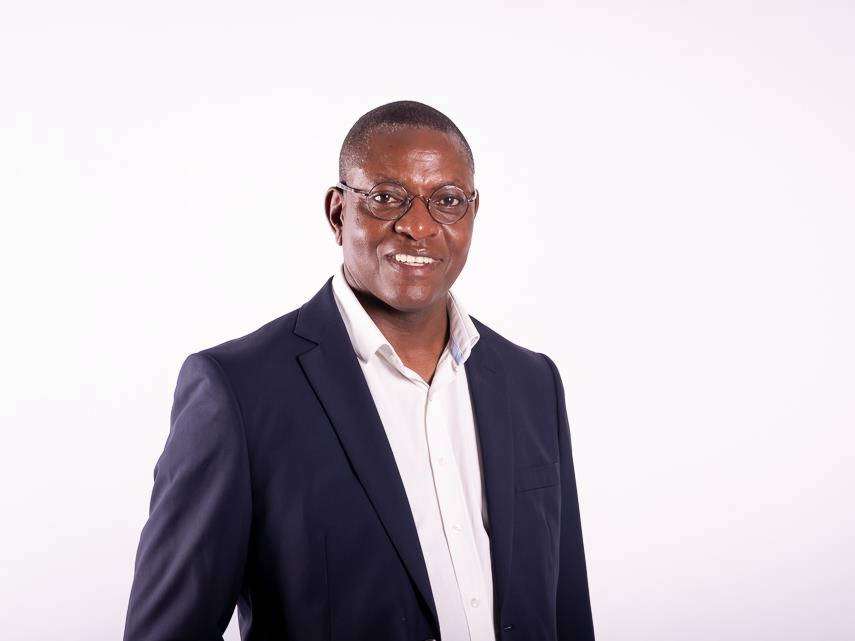
Jonathan Muthige, chief human capital and transformation officer and CEO for the Growth Markets division at Alexander Forbes, had spent much of his career looking after people. Then a stage-three prostate cancer diagnosis forced him to confront what happens when the person who has spent most of his career responsible for caring for others suddenly finds himself needing care too.
Speaking at the 2026 Executive Day, Jonathan shared how he was suddenly navigating his own health crisis while leading an organisation, forcing him to confront mortality, vulnerability, and what it really means to keep showing up when the person behind the executive title is struggling too.
“It was probably one of the most traumatic days that I will never forget, obviously for good reason. My father had died of prostate cancer four years earlier, and I used to screen. I started at 40 because when you are in these executive jobs, we encourage you to do this. I used to check, except that during Covid I couldn’t do it. For three years, I hadn’t done this,” he reflected.
Three years without a screening had passed almost unnoticed. Then, while on holiday in Knysna, something as ordinary as a round of golf suddenly felt very different.
“I was on the golf course. I tee off on hole number one. I don’t hit the ball more than 80 metres. It had never happened before. Then I had a terrible pain in my shoulder, so I didn’t finish the round. Long story short, while I was taking pain medication on that holiday, we ended up with a doctor. I asked the doctor to check my PSA (prostate-specific antigen) because I had missed it for three years,” he shared.
What he thought would be another routine check instead became the moment that sent him back to Johannesburg, and into a series of tests that would change the course of the next year and a half.
“The doctor called and told me I better see her immediately, so I rushed to the room. She was not a doctor I normally use because I was in Durban. She told me I better get to Joburg the next morning at the latest. I asked why and what was going on, and she told me my reading was 24.5. It was meant to be between 0 and 4 for men.”
The number meant little to him at first. The search for an explanation sent him to Google, where he found an answer that was far more frightening than useful. “I didn’t understand what 24.5 meant, so I did what everybody does. I went to Google and it basically said I was going to die. Google is not the best uncle when you have stuff like this,” he said.
Vulnerability and strength get a seat at the table
The tests that followed gave the number a much more serious meaning. Jonathan was diagnosed with stage-three prostate cancer, with doctors describing it as super aggressive. It was also the beginning of a steep learning curve about a health challenge he had assumed he knew enough about, particularly after losing his father to it.
“I learnt for the first time that prostate cancer has different grades. I didn’t know this. I learnt for the first time that black men are the most affected in our nation. I didn’t know this. I also learnt that when you’re from a vulnerable group, which means if you have had prostate cancer in your family or anyone in your family has had cancer, you’re more prone to this.”
His doctors gave him two options: continue with the usual treatment for 12 months and see where it went, or undergo robotic surgery. Jonathan said he chose the surgery, followed by radiation.
The treatment itself was only one part of what made the period so difficult. There was the fear of what might happen, the memories of losing his father and the uncertainty of what his own diagnosis meant for his family. His wife however became his strongest source of reassurance.
“She was my hero. She said to me that we’ll pray about this, come home tomorrow, we got this. And I needed those words.”
The words helped, but they could not make the fear disappear. That night, alone in a hotel room, the weight of the diagnosis finally caught up with him.
“I cried like a baby. I didn’t know where I was going. I had flashbacks of closing my father’s eyes. My biggest fear was my son. My son was younger then, and I wondered whether he was going to be the one to close my eyes.”
And yet, even with surgery approaching, another part of his life was still demanding his attention. Jonathan was head of HR at the time, and there was a major remuneration exercise that needed to be completed. His instinct was to finish the work before going into hospital.
The executive instinct to carry on
“When I was about to go into surgery, I was working on the most crucial RemCo because I was head of HR. I finished at midnight with my boss and told him that the next morning at 7am I was checking in. My boss asked if I was insane. In the afternoon, I was sending him another document, and he told me to please stop or else he was coming to get the laptop.”
The exchange is almost funny in hindsight, but it also captures how difficult it can be for executives to step away. Jonathan was dealing with something life-changing, yet part of him was still thinking about the work that would continue without him.
Jonathan said he had been open about what was happening, which meant his boss could explain his absence to the board rather than leaving people to wonder where he was or what had happened.
“When I opened my eyes, my boss was standing there with his wife and a gift, and the first thing I asked him was how the RemCo had gone. He said the RemCo was fine and everything had been approved. Maybe it was just as well I was not there because then everyone was sympathetic to my case.”
His boss wanted to take everything away from him so that he could concentrate on recovering. Jonathan understood the intention, but did not want cancer to determine how much of his normal life he was allowed to keep.
“My appeal to him was not to, because if he did, he would be giving prostate cancer victory over me, and he couldn’t do that. I asked him to allow me to manage this my own way. When I needed him to lessen some things, I would be the first one to tell him.”
The diagnosis also changed the way he thought about being seen. He described himself as someone who is usually calm and composed. His children had never seen him cry until he called the family together to tell them about the cancer.
“I’ve lived by a principle that says nothing in your life deserves the honour of taking your joy away. So don’t give anything that honour.”
But there was something else pushing him towards openness. After his father's death and his own diagnosis, Jonathan realised how little conversation there had been around prostate cancer.
“If I don’t speak out, then I’m giving silence around prostate cancer a voice. I have to speak out.”
Breaking a very familiar silence
What began as a personal decision gradually became something he wanted to carry into the rooms where he had spent his career talking about people, leadership and organisations.
“Part of what I’m dedicating my life to now is speaking to executives, especially. It’s about encouraging other men who have gone through this to join the movement of speaking about it because, if we don’t, there’s going to be a generation of men who are going to die at a rate of 1 to 4, which is what the statistics are telling us. It’s unnecessary. It just takes a voice, and a voice that must be constant.”
“I say to men who fear these things, listen, this thing called prostate cancer is the size of a walnut, but you’re scared of that finger. Think about when you can’t pass urine and when this thing becomes a problem. Think about when you’ve got bladder issues. It’s not worth it. Let’s speak about this.”
Speaking about the diagnosis did not mean that everyone around him received the same information. Jonathan made deliberate choices about what his wife, his children and his colleagues needed to know.
Treatment affected his everyday life in ways that colleagues could see, and he did not want his team trying to work out what was happening on their own. There was a practical reason for that openness. After having his prostate removed, there were periods when even sitting through a meeting was difficult.
“Instead of having people second-guess, give people the information that they need.”
He said that approach opened up conversations he had not expected. “With most of the senior executives, the men, I felt I needed to walk them through it. Most of them kept saying, but you, I didn’t think I could ask you this. I was amazed that every time I opened up, there was a big relief that now people could ask the questions.”
For Jonathan, that relief is part of the reason vulnerability has become such an important part of how he thinks about leadership.
“Sometimes we are not as vulnerable because of fear of the unknown. Just be vulnerable and see what happens. Often, not a lot happens other than appreciation.”