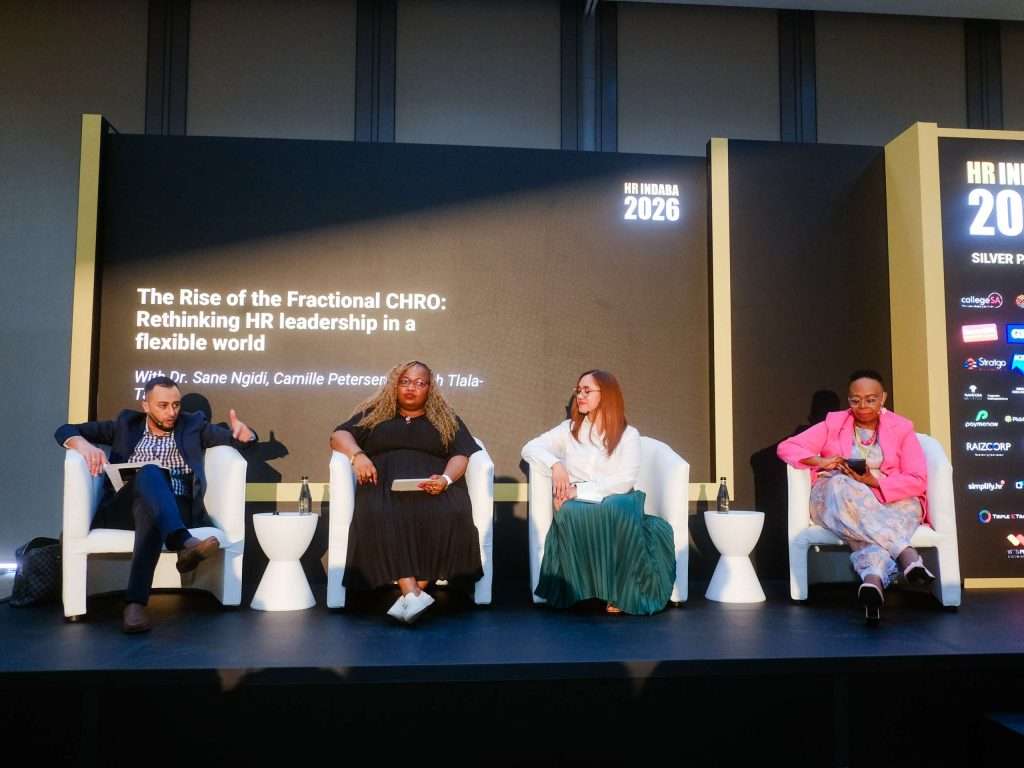
At the 2026 HR Indaba, attendees explored how to access specialised expertise without the full-time overheads, but this needs a mindset shift
Facilitated by global strategist Abdullah Verachia, the jam-packed session entitled The Rise of the Fractional CHRO: Rethinking HR leadership in a Flexible World, kicked off by highlighting how the fractional concept has only entered the HR space in the last 18 months, but it’s not something new.
“Flexibility in leadership has existed for decades but it has become more of an option [in HR],” said panellist Dr Sane Ngidi, executive head of people at Imagine Worldwide. “We think of our [CHRO] function based on high trust and stakeholder relationships, not like in the CFO space that sometimes needs more subject matter expertise – we’re about behavioural science. But we shouldn’t use fractional roles just as a ‘gap filler’, rather if the business is going through a transition and needs expertise.”
When preparing organisations for AI transitions, transformation and capabilities for the future, Dr Sane added that HR leaders need to consider whether these objectives could be achieved through a fractional role. “If we’re able to overcome trust hurdles in the board and the organisation, there are tremendous opportunities. We’re not used to roles with high accountability that are not fully embedded in the organisation. Fractional roles require a mindset transition.”
When considering a fractional role, Dr Sane noted that this shift in thinking extends to an individual’s capability set, not just position filling. Coupled with this, they need to be empowered with a mandate with teeth, otherwise they can’t perform their function. “The mandate must come with authority and decision-making capabilities.”
What fractional CHRO success looks like
For panellist Camille Petersen, head of talent management and people lead for enabling functions in sub-Saharan Africa at Mondelez International, CHROs don’t always immediately see the opportunities that fractional roles can bring to their organisations.
She shared a case study where her organisation brought in a fractional CHRO, with great success. According to Camille, the executive was used to dealing with complexity across markets. She had exceptional senior managers supporting her, where execution became their responsibility, which allowed her to operate at a “strategic apex”.
“The key to success is trusting that the person can deliver. Often, as CHROs, we’re expected to stretch ourselves [to understand every aspect of the business], which is all good and well. But having operated under an effective fractional CHRO, this experience genuinely accelerated the organisation’s capabilities.”
A mindset shift not leveraged just yet
To manage complexity, Camille reiterated the need for a mindset change, and that with a fractional role, it’s important to know how you’ll measure impact. “A fractional role means the business doesn’t have to carry overhead costs. However, it all comes back to data and how HR leaders articulate insights. Research shows us the benefits of a hybrid workforce over and over, yet many businesses have shifted back to full-time on-site work models. How are we leveraging the power we have, where the chief strategy officer can trust us? We can redesign our organisational work models to have higher engagement and retention rates, but as HR professionals, we’re not telling that story just yet.”
Evaluating the opportunity costs of work flexibility
For Dorah Tlala-Tanor, group chief HR and corporate affairs officer at Proconics, CHROs must weigh up different work models, based on equity versus equality. She highlighted that when an employee enters an organisation and they hear ‘we’re kind of flexible’ it’s important to look at the opportunity costs of work flexibility on the employer and an individual’s growth.
“For example, an employee should evaluate what it costs them to work from their kitchen table versus what it takes to build a leader. As the HR professional, you need to map it out beyond output; perhaps the employee needs to be visible to occupy a certain level. In my organisation, every Tuesday, every exco member is in-office. We talk and discuss strategy. For an employee who has growth aspirations, they need to be in-office every Tuesday – that’s opportunity cost. There’s a lot to look at when designing a [fractional] role based on flexibility. We need to be guiding the business.”
The discussion also highlighted how a fractional CHRO’s success depends on whether trust exists.
“You can put the right person in a fractional role, but if they don’t develop organisational trust, they can’t do anything,” responded Dr Sane. She cited Steven Covey’s idea that the ‘speed of trust is a multiplier’. “Whether the fractional role is external or internal, trust is core. And when working with human systems and not just a balance sheet, trust is a critical starting point,” she concluded.