


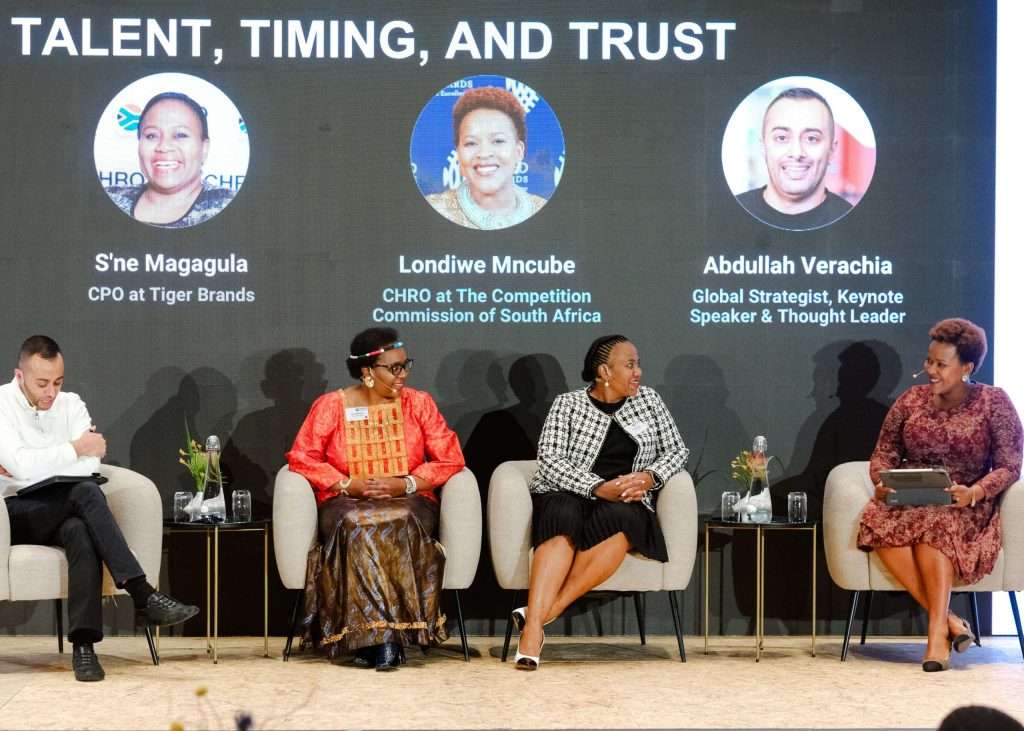
Panellists at 2025 CHRO Day discussed the processes their organisations use to embed succession planning into everyday talent management, ensuring a steady pipeline of capable leaders.
Setting the tone for the discussion, S’ne Magagula, CPO at Tiger Brands, opened the panel saying, “We think about succession in the longer term and throughout the lifecycle of someone’s career with us. Traditionally, a lot of organisations think about succession when they’re thinking about the executive team and the board. What we have really focused on is growing talent throughout the organisation so that when opportunities arise, or we have a crisis in senior leadership, we have someone ready to take over.”
This vision is embedded in what she calls the ‘growing our own timber’ philosophy – a strategy that starts right from recruitment.
“When we recruit bursary holders or graduates, we’re looking for very specific potential. We’re looking for people who have the potential not only to grow in different functions and businesses within our organisation, but also people who can grow into leaders in the organisation,” she added.
“It's a very structured assessment process that we go through when we recruit graduates. We ensure that they get diverse exposure across the business, especially in the first two years, so they learn the business thoroughly.”
She illustrated this with a practical example: “Two years ago we changed our operating model and structure, and we were able to appoint five of the MDs into the exco from within the organisation. Those are people that we deliberately developed, giving them different opportunities, taking them from a function to a business and back into a function to give them the exposure that they needed.”
One of the standout initiatives designed to strengthen these internal leadership pipelines she notes is the WINGS programme, aimed at deliberately moving emerging leaders from junior to middle-level leaders.
“They go in, get moved from their business or category and go into another category, a very different role, and they are in a real job. So, it’s a real vacancy in the organisation. They’re not shadowing anyone, they’re not theoretically learning the job, they’re actually delivering on the job.”
Typically, each rotation within the programme lasts about 18 to 24 months, after which the participant is deliberately moved again to another area of the business. “By the time they emerge out of the programme, in two to five years, they can go into a senior leadership role. It's a very deliberate way of building a successional pipeline. It’s not just about what you can do, but it’s also how you do it and whether you’re aligned to the culture that we’re trying to drive and you are able to lead that culture.”
According to her, the results of WINGS is already visible across the business, with several alumni now occupying senior leadership roles. “Talent management and succession today is no longer about thinking about hypers and leaders. It’s about growing talent from farm to fork, to use the language of our business throughout the life cycle of the individual who’s in the organisation.”
Describing the succession plan at MTN, Bess Skhosana, the group HRD: regional talent leader highlighted how transformation into a tech-driven enterprise demanded new capabilities and a repositioned approach to sourcing and growing leaders.
“We’re focusing a lot on business resources and infrastructure platforms, fintech businesses, and all this comes with new skill sets. So we do a lot of in-house training where we develop people in terms of skills in fintech, data science, UIX programming and blockchain.”
However, she acknowledged the limitations of local talent supply. As a result, MTN has had to extend its search beyond borders. “We buy some skills from outside because it’s not all the skills that you will find within the country. So we spent a lot of money buying skills overseas.”
“We allow them to work as what we call virtual commutes and work through an employer of record, and they work from anywhere in the world. We’ve got people in the Netherlands, Canada, in the UK and all over the world.”
She also spotlighted gender equity as a critical layer of the strategy. “We aligned ourselves to the UN principles of supporting gender growth and parity, and we have committed to having 50 percent of women by 2030. I can proudly say we’re currently sitting at around 45 percent, which is five percent away from our target.”
The company has adopted in-house leadership programmes, women in technology initiatives, rising leaders programmes and headhunting senior women. “It's a deliberate plan and deliberate action that we put in place in order to achieve those targets.”
Another voice in the conversation came from the public sector, where Londiwe Mncube, CHRO at the Competition Commission, shared insights from a very different yet equally strategic approach due to how succession planning in the public sector faces unique structural and regulatory hurdles.
“One of the greatest challenges is the bureaucracy, the rigidity of structures. You can’t just wake up and change your organisational configuration without going through the necessary processes because you are in an environment where you can’t reserve a position. You must embrace equal access and equal opportunity at any given time, so you are in a scenario where you can’t groom one winner, you have to have multiple winners at any given time. You must embrace equal access and equal opportunity which makes it quite unpredictable.”
This, she says, means that planning becomes less about picking a successor and more about developing a pool of potential leaders.
“The advantage of the private sector is that you can really focus your energy on a particular individual to know that this person is going to succeed, but we’ve not embraced that as a public sector.”
To adapt in response to these challenges, she said the commission has adopted a proactive and inclusive talent management strategy through purpose-driven work.
“As the Commission, we manage our talent holistically. We’re able to retain employees because our mandate fulfils their sense of purpose, and we see tangible results and impact. As HR, we’ve built various pathways with depth in knowledge, and we’ve empowered an entire level, so anybody at that level should be able to take on the next role.”
Recognising that retention is closely tied to career development, she added how the organisation had made significant investments in employee growth.
“As a knowledge-based institution, we've invested a lot of money in our academy. This is where the principal effect of competency across the organisation of leading someone is very important. A graduate, for this practical example, someone who would be labelled a junior or a graduate in the organisation, can sit in an interrogation with a C-suite, comfortably so, and interrogate. Some people who may have had some experience or encounter with the competition commission would leave that space thinking this person is a senior within the organisation.”
Acknowledging that they cannot compete with the private sector on financial rewards however, she said the commission instead doubles down on intellectual and personal growth.
“The mantra in terms of our academy is that knowledge is our currency. We cannot give you some of the attractive, open structure that the private sector can give you. But certainly, we can give you something that you will stay with forever, which is knowledge – and nobody else can take that away from you.”














