
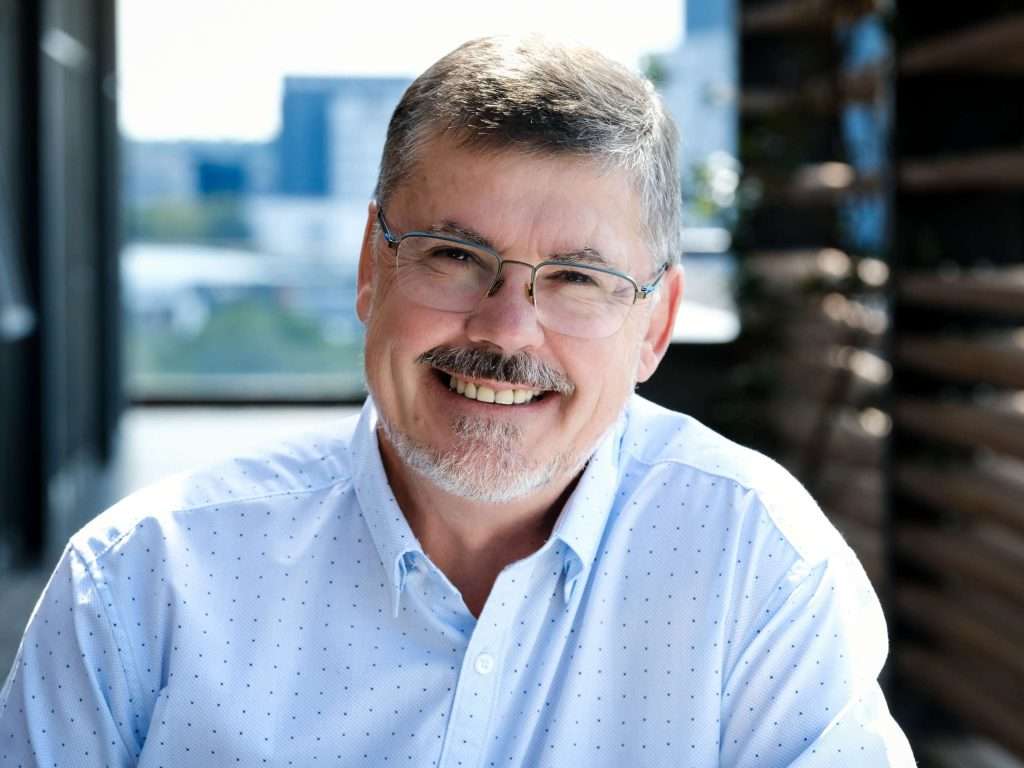
In the world of business, leadership often boils down to numbers and strategies – but Peter Champion, group HR executive at Cashbuild, knows that people are needed for a strong business foundation.
Peter Champion’s path to HR wasn’t planned, in fact, the group HR executive at Cashbuild admits it happened “by default, not by design”. However, that unexpected part of the plan turned into a career that has been defined by innovation, impact and the reshaping of HR at one of South Africa’s leading building materials retailers.
Peter’s career began in 1987, far from any corporate office. “I was doing industrial engineering as a learner official, and I was underground,” he recalls. “One day, rocks started falling from the ceiling. I went back to the training manager and said, ‘I’m not going back’.”
He had noticed a department that caught his interest – industrial relations. “I said I quite like that one and was sent to study labour law and other HR fields.”
What followed was a step into people management, starting as a labour specialist on tea plantations, where he helped negotiate the first recognition agreement in agriculture with the Food and Allied Workers Union.
Finally, he found his long-term home at Cashbuild, joining as the HR executive 17 years ago.
“When I joined Cashbuild, excluding payroll, our HR department consisted of two people. It was me and a clerk. At that time, the company had around 150 stores and approximately 2,500 employees,” he explains.
“The brief given to me was, ‘We’re doubling in five years, we need a robust management pipeline’. I’ve been able to innovate and play for the past 17 years because we started from scratch.”
A proactive approach
Key initiatives, he says, have included developing a management competency model and implementing a company-wide talent management framework.
“Every three years, I sit with the executive team and ask, ‘What’s your strategy, where are we going, and what kind of people do we need?’ Then we go back to our talent management framework and ask if this framework is going to give us the people we need for the next three-five years and innovate and adapt if required.”
This proactive approach has allowed Cashbuild to adapt to changing circumstances, such as the introduction of a blended learning model used to develop future management and leadership competencies. “This model is what I based my studies on,” Peter says, referring to his doctoral studies.
Some of the most significant changes he highlights was the implementation of a competency-based model for the attraction, development and retention of staff and the introduction of e-learning. Peter also spearheaded the overhaul of the performance appraisal process.
“We removed the annual appraisal based on KPIs. Those are now measured continuously through operational processes,” he says. In its place, Peter introduced a behaviourally anchored rating scale (Bars) approach.
“With the Bars approach, you measure individual behaviour against predetermined behavioural requirements. If you get an individual’s behaviours right, people become motivated, and they deliver results.”
The new Bars evaluation is being relaunched with a focus on embedding it into company culture. “It’ll take two to three years to implement this strategy, but when the next generation comes in, it’ll already be there.”
This focus on behaviour is important for Peter’s HR philosophy.
Facing challenges
Speaking about recruitment at Cashbuild, Peter describes it as a line function, with managers empowered to choose their own teams, supported by psychometric assessments to ensure both role and cultural fit.
“The psychometric assessment ensures the approach that new employees fit the position and that there is a cultural fit, whilst the approach of having line management make the final decision drives a sense of ownership. My team of HR managers focuses on empowering line management, as long as I can continue to empower our managers to look after human resources.”
When asked about challenges, Peter acknowledges that “the hardest time was probably the first five years, because I had to come and change and create a learning culture in the business”.
“There was no HR department. They didn’t have training and development that took place, so getting buy-in for these changes was a process.”
Despite the challenges, Peter continuously maintains a positive outlook, whilst also acknowledging the challenges facing the retail industry, particularly in attracting and retaining talent. “Retail is hard. It’s seven days a week, and it’s long hours,” he admits.
To address these challenges, Cashbuild focuses on training for employability. “We train people not just to do the job but to be employable. Whether they stay with us or leave, they should walk away better.”
Calm and grounded
People often remark that his job is difficult and must be stressful. But he doesn’t see it that way at all. “If you’re doing what you enjoy, it's not stressful at all.”
After decades in the field, Peter says he remains grounded by a simple principle: “Our job in HR is to make sure people are in the right job. If they are, they’ll enjoy their work, and they’ll perform.”
His approach to life and work is characterised by a calm and grounded demeanour. “ It gets worse with age,” he says when asked about his chilled-out personality. “I’ve just always believed that as long as you do what you’re supposed to do and manage for output, not for input, you’ll be happy.”
Peter’s doctoral research drew from his own work, specifically the blended learning model used to train future leaders at Cashbuild, and his PhD journey was not without challenges.
“When my kids graduated, I saw the red doctoral hat and said, ‘I want one of those’. But family came first.” Years later, post-divorce, he finally made the time. “I had time on my hands, so I thought let me go get a red cap. But it was hard,” he acknowledges.
Beyond his professional achievements, Peter is a family man with a passion for the outdoors. He is married with four children and three grandchildren, with another on the way.
“My wife and I do everything together. We do a lot of fly fishing, mountain biking, golfing, and camping,” he says. “We were in Namibia and Botswana last year on a three-and-a-half-week safari.”
Their journeys have also taken them to Spain, France and Dubai, with more destinations on the horizon.