
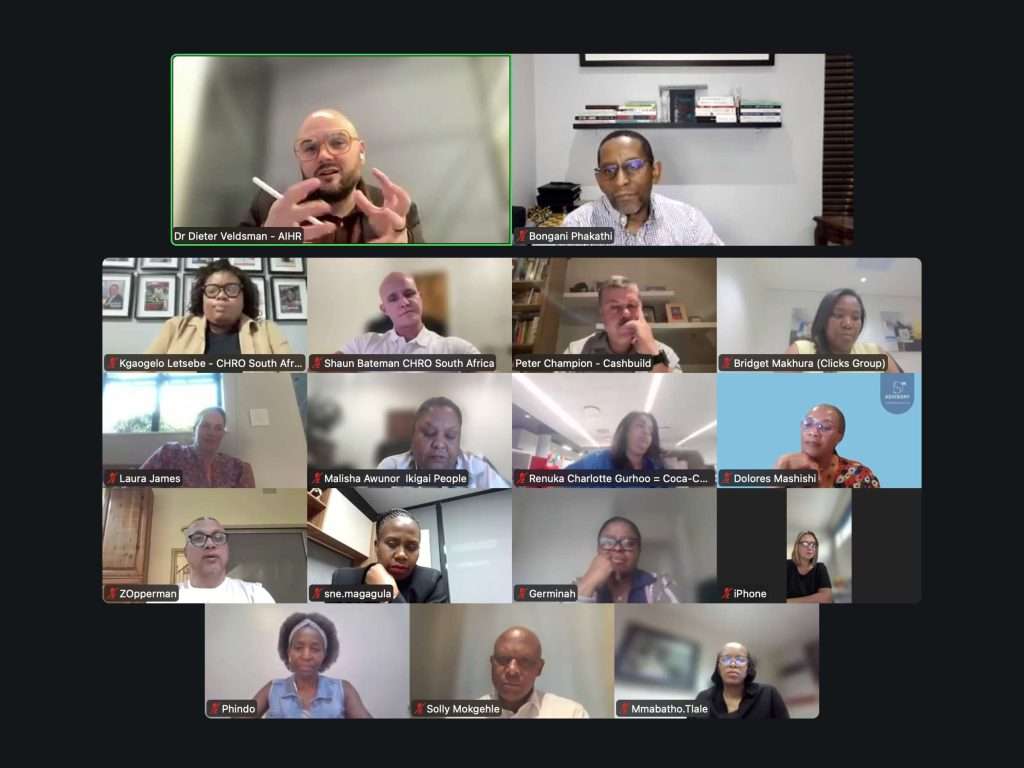
The recent Community Conversation hosted by Dr Dieter Veldsman, chief scientist at AIHR, brought together top HR executives to confront the execution gap in HR, the space between great intent and actual impact.
Dieter began the session by inviting HR leaders to think differently about HR, not just as a function, but as an asset that could be invested in.
To provoke reflection, he asked a challenging question, stating that if HR were a listed company, leaders should consider whether they would buy its stock with their own money. The question was designed to reveal perceptions of HR’s current value, its potential, and the degree of confidence professionals had in the profession’s future.
Peter Champion, group HR executive at Cashbuild, responded thoughtfully, weighing the potential of HR against its current state. “I probably would as long as it’s at the right price,” he said. “HR is on the cusp of doing great things. If you look at how the world is changing and if we can get the HR profession to truly buy into it and understand business, not just see HR as handling administrative work, but actually support the business through that work, then I believe HR stock would take off,” he said.
Bongani Phakathi, founder & director of JBP Advisory, shared a similar sentiment, pointing to HR’s untapped potential impact and unrealised self-value. “I would also buy because I think we haven’t really understood the true value and the price can actually only go up. On both sides from organisations and from ourselves as HR professionals, we probably haven’t done justice, so that price can only increase.”
Dieter invited further thoughts, and Bridget Makhura, CPO at Clicks Group, offered a nuanced take, noting initial hesitation. “When Dieter first asked the question, I immediately said no, because I was thinking about how HR is seen by our stakeholders who don’t always recognise the value we bring,” she reflected.
Persistent issues
“Peter put it quite well, and Bongani echoed the same sentiment that there is so much potential for the future if we can reintegrate into the business and show the value HR can deliver. I’m now leaning more towards what Peter said that if the price is right and low enough, I would invest because I can personally see the potential,” Bridget added.
With that as a foundation, Dieter then turned to the underlying limiting beliefs that continue to shape HR’s perception. He pointed to a few persistent issues: the view of HR as a cost centre, the difficulty in demonstrating measurable value, and the perception that HR exists primarily as a people service provider.
“Whether these things are true or not, they do exist in a lot of organisations. There is still a perception around HR as a cost centre and it immediately puts us in a defensive position whenever we have to start talking about the investments that you need to make in your people’s side of the business,” he said.
He noted that despite these challenges, HR has historically reinvented itself successfully. “As a profession, if you think about the last 120 years or so, we’ve done two things really well. One of them is always reinventing ourselves based on what was happening in the external environment. If you think about our roots in things like labour relations during the first and second industrial revolutions, right up to the point where we find ourselves today on this cusp around strategic partnership, we have continuously adapted,” he explained.
Dieter then explored the macro trends shaping the future of HR. He emphasised the turbulent global environment, rapid technological acceleration and shifting employee expectations.
“We know uncertainty is the new normal. Ever since the Second World War, where we are today is actually the most turbulent time in terms of global conflict that we’ve ever faced,” he said.
Creating long-term value
He added that HR’s role in this context involves guiding leaders through difficult decisions with less information and supporting workforce stability amid economic and social instability.
“If you think back to three years ago, when we said the words generative AI, ChatGPT, Claude, Microsoft Copilot, it wasn’t necessarily something in our general language, yet that has already started to shift quite significantly. As HR, we need to guide our organisations to make the right capacity decisions and focus on creating long-term value rather than just achieving short-term goals.”
He however also highlighted the challenge of preparing the next generation for AI-driven workplaces while ensuring they develop essential emotional and leadership skills.
Posing a reflective statement, he stated, “If you look at the behaviour of employees today and how they react, they are acting a lot more like consumers of products. If your employees were consumers that had to buy HR with their own money, similar to the question asked at the beginning, they would need to consider whether they would buy it and buy it again, and if not, why the experiences provided to employees are not necessarily at the same consumer grade.”
He stated that leveraging design thinking, data and market segmentation allows HR to create tailored experiences that meet employees’ evolving expectations in this regard.
Circling back to the original question about investing in HR, he concluded with highlighting that while challenges remain, the potential is enormous.
“There’s so much opportunity for us to reposition the role that we play within HR around leveraging value whilst there’s all of these different things that are starting to happen, but to do so I think there has to be a couple of things that we reframe.”
He concluded by urging leaders to recognise that HR is no longer just a support function but a value-generating force, one whose full potential, if realised, could transform the profession for decades to come.