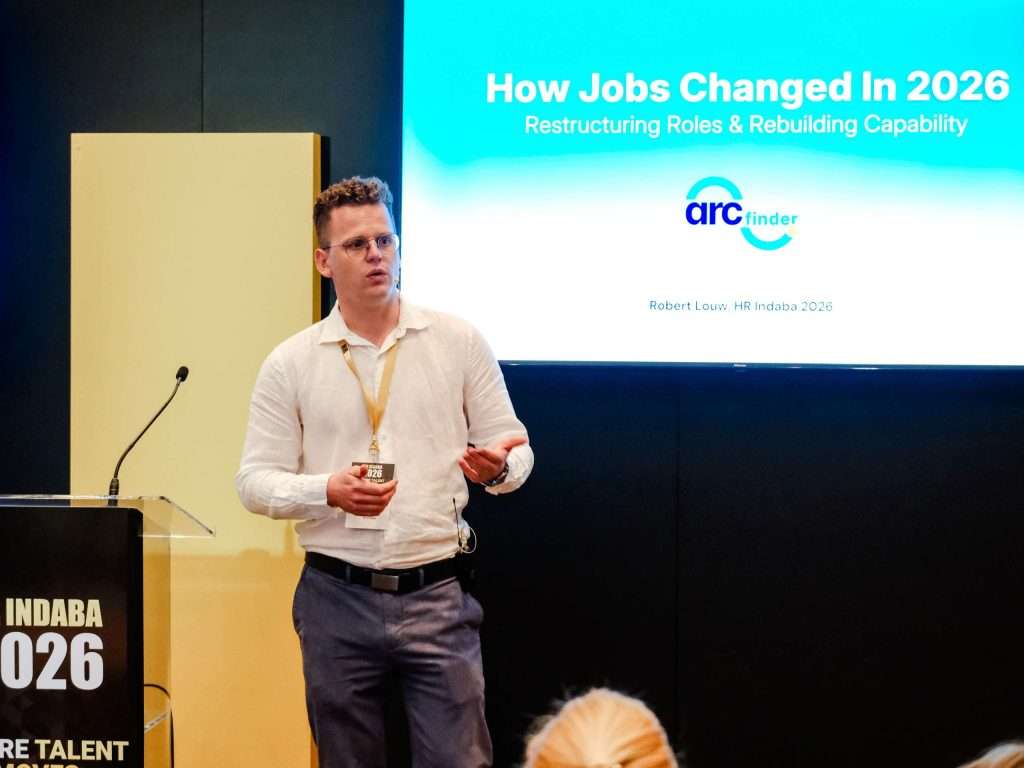
Attendees at the 2026 HR Indaba got to hear how AI is rewriting jobs. But are HR leaders ready to lead the change?
In a thought-provoking session entitled How jobs changed in 2026: Restructuring Roles and Rebuilding Capability, Robert Louw, co-founder and solutions architect at ArcFinder – a data-driven diagnostic solution for organisations seeking to assess and enhance their workplace culture – shared how AI is challenging HR leaders to make more informed, data-driven decisions.
Robert kicked off the session by asking attendees to raise their hands if AI has changed how they work. All hands shot up. “It’s a wave of change continuing to impact everyone,” elaborated Robert. He then asked attendees if they could imagine doing a PhD, spending years to solve a mathematical problem. Only for OpenAI to publish hundreds of solved mathematical problems, as a side project.
“People are asking, ‘What is my worth?’ And this is coming to HR,” he cautioned.
HR can play a leading role to minimise AI disruption
Robert explained that he’s spent the last decade working at the intersection of IT and business, in Stockholm and at Harvard. Now, he’s spending his time exploring how people and businesses are using data to help them make better decisions around using AI.
He notes there has recently been a shift: AI is a bigger business problem, constraints lie in people and processes, and HR is expected to have answers to questions like ‘Is my job safe?’, ‘What are we doing about AI?’, and ‘What is blocking AI adoption?’. Many attendees’ heads nodded in agreement.
“There’s a shift from AI being an IT problem to an organisation’s problem. I believe that the leading role HR needs to play is supporting organisations through this AI revolution to minimise disruption,” said Robert.
From uncertainty to evidence: Understanding how jobs are changing
To help HR leaders navigate this shift and remove the guesswork, ArcFinder spent weeks pulling jobs data from OpenAI, the 2026 Anthropic Economic Index, and the International Labor Organisation, to create a searchable AI jobs data framework. This framework helps determine which job tasks are currently being automated, and how job descriptions and competency models are changing as a result.
“AI is already changing jobs, and HR leaders need to make data supported decisions so there’s less disruption and they’re more empowered to lead through this change,” added Robert.
Robert conceded there is huge pressure on HR leaders – from outside and at the bottom of organisations, and it can seem chaotic. At the top, CEOs feel like the company is not doing enough; at the bottom, employees are using AI on the down-low. “According to a 2026 PwC Global CEO Survey, 56 percent of CEOs feel they’re left behind as they haven’t seen significant financial benefit from AI thus far, while a 2026 Deloitte survey found that three in 10 AI users don’t tell their managers they’re using AI at work. Many tasks are completed faster with AI, but HR leaders must ask what will be done with that time, and what organisational effectiveness can come from this.”
Turning AI jobs data into practical HR decisions
This is where ArcFinder’s 2026 AI job data tool comes in. Combining several data sources – 2023 OpenAI data tracking, a 2025 ILO study, and extensive 2026 Anthropic data covering job tasks that people are using AI to complete. The analysis results in a searchable framework organised by occupation that HR leaders can use to check their assumptions and see how AI is changing the jobs they manage. Using the digital search tool, users can search for specific job titles and view:
- How the job is being restructured due to AI
- Which future skills it will need
- What this all means for HR leaders.
The tool uses a task ranking structure, depending on how often a task is done, and how AI is now reducing time spent on each task (with the data showing that most professions are automating tasks.
HR professionals can drill down and see how AI will change a job description. Users can select an individual, and the corresponding task ranking contrasts with assessment results to see how ready someone is to fill their role as it’s changing. The tool also highlights areas for development, training, and support.
“As AI takes over some work, it makes sense to train people as their jobs change, as well as matching changes in tasks with individual capacity required,” notes Robert.
Leading the change
To illustrate the dilemma HR leaders face, Robert shared a case study of individual task data analysis involving John, a software developer. He has already automated his job and didn’t tell his boss. But his HR file says he was hired because he showed great initiative at his previous job.
The dilemma: John’s skills could be used to automate other tasks but now there’s a major safety risk. What to do? “Look at the data,” said Robert. “It shows that John is good at getting things done, but instead of directing daily department operations and analysing workflows he’s outsourcing this AI. However, the data also shows he can build relationships, influence people, and communicate well. It’s clear that human skills and attitudes have tremendous value, and HR leaders who leverage this data-led knowledge can be proactive in leading the change.”
An ongoing and multifaceted process
According to Robert, there are many trade-offs and nuances involved in the AI journey. It’s also an ongoing, multifaceted process – which is why it’s critical to have access to the right data analysis to support your decisions.
“HR leaders need to consider what their organisation’s business model is and what problems need to be solved. I believe that we need to fight fire with fire – and the rate of change means that more data-driven, high-quality decisions are needed. Every HR leader is being asked how AI will affect their people; here’s to taking out some of the guesswork.”