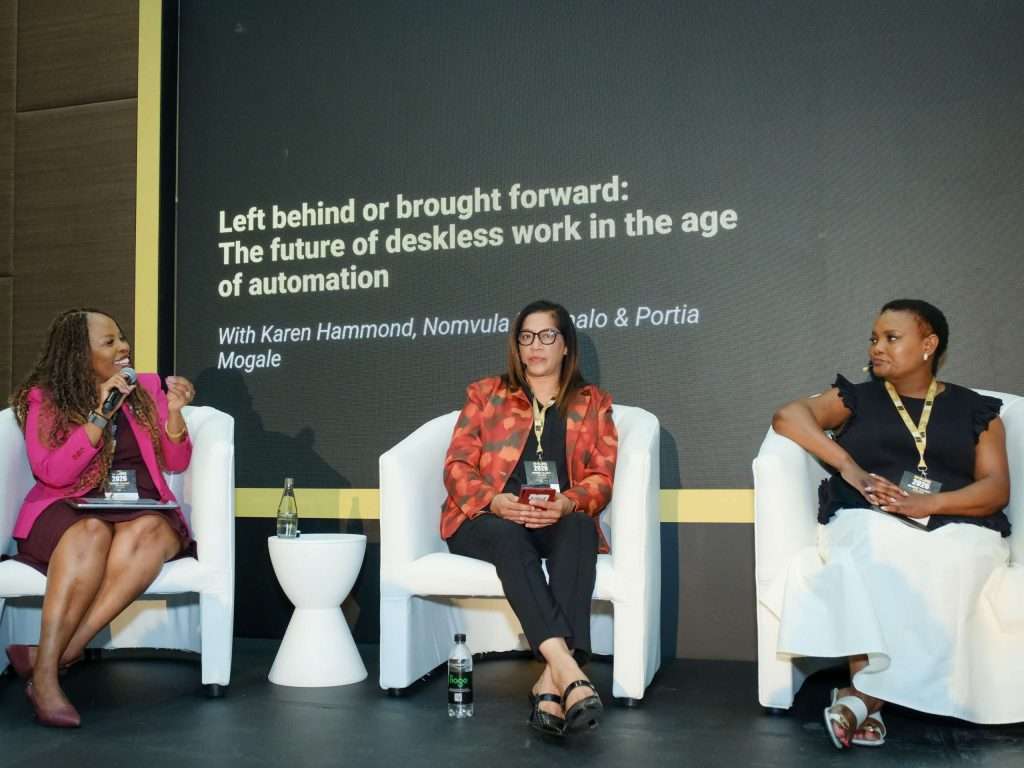
The future of deskless work in the age of automation was at the heart of an insightful discussion at the 2026 HR Indaba, where Portia Mogale, executive head of HR at Santam Corporate; Karen Hammond, group CHRO at Meridian Group; and Nomvula Nxumalo, executive head of people and transformation at MiWay Insurance, explored how organisations can ensure deskless workers also benefit from automation.
The session, titled Left behind or brought forward: The future of deskless work in the age of automation, challenged HR leaders to rethink who benefits from technological progress and how organisations can bring frontline employees along as AI reshapes the world of work.
Portia Mogale, executive head of HR at Santam Corporate drew attention to the scale of the task facing HR as organisations introduce new technology while navigating other business changes.
“We are standing between the organisation and its ability to transform its people to be ready for change that is happening at a much faster pace than anything we have experienced before,” she said.
“When we talk about job redesign, I want to share an experience we are going through. We realised that we needed to adopt AI while optimising processes, which introduces compounded change into the business. Many of us have experienced significant organisational change, and our instinct is often to implement quick solutions and change management initiatives to keep things moving. However, one of the fundamental things we have realised is that change happens at a task level rather than a job level,” explained Portia.
Redesigning jobs, unlocking skills
She further noted why HR leaders need to understand what someone does at a task level to redesign their job and determine what they need to do going forward.
“If 20 percent of someone’s tasks have changed or become redundant, we need to identify the other tasks they must be reskilled to perform. We are going back to the basics of job design. We need to understand the tasks that make up each role and how they are affected, whether they can be augmented by combining AI with employees’ skills, automated entirely by technology or remain human-centred tasks performed by employees,” she continued.
“It is a challenge because we have not had to redesign jobs at this scale for a very long time. I imagine that when steam trains were introduced, people responsible for designing jobs had to think about similar questions. However, we have not had to do this for generations, and suddenly we are redesigning jobs at a very granular level to understand the true impact of these changes.” Portia added.
At Meridian Group, the group CHRO Karen Hammond described an approach to automation that recognises the breadth of work carried out by employees beyond the traditional office environment.
“We introduced a project called Project ARC, which stands for AI automation, rethinking and invention, and creating growth. When you look at a merchandiser, you might think they simply pack shelves, but in our industry and business, their role involves much more than that. We also communicate with our deskless workers in real time. The platform allows our people to receive important communications and access resources such as payslips and on-the-go training,” explained Karen.
“Project ARC has been valuable for Meridian because it has taught employees the basics of AI while helping to alleviate their fear of losing their jobs. Instead, technology helps them learn, develop and grow. Tasks that previously took two hours can now be completed in 30 minutes, freeing up time to learn new skills and understand other areas of the business. There is undoubtedly a great deal of fear surrounding AI, but if we continue to reinforce that fear, our people will never grow,” she added.
Never underestimate the frontline
Karen expressed that she is particularly proud of Meridian’s deskless workers, who have embraced automation and demonstrated how it can support their work rather than put their jobs at risk. She also reflected on the opportunities employers could be missing when they underestimate the potential of workers in roles that require less formal education.
“An earlier speaker mentioned the employee who wakes up very early to get everything sorted at home before going to work because executives expect everything to be clean when they arrive in the boardroom. Have we thought about how we empower that person, who might have a matric qualification or might have completed Grade 10 or 11? Through innovation and AI, we can empower them. I encourage companies not to assume that people in lower-level positions cannot learn AI. They are already using technology every day,” stated Karen.
“When employees learn new skills and go home to teach their children about what they have learnt, we have empowered them beyond the workplace. We have given them a platform for learning and growth. By allowing them to use smart, innovative and automated platforms at work, we can free up their time so they can provide better customer service,” she noted.
Turning to the importance of employee input, Nomvula Nxumalo, executive head of people and transformation at MiWay Insurance stressed that those doing the work often have the clearest understanding of what needs to change.
“If there is anything we need to reflect on when we return to our businesses, it is that we should not undertake this journey alone. It is about co-creating and bringing people along with us. Employees know their work better than we do, and they understand where the blind spots are. They can tell us how to redesign the work, and I think that is the critical part. If we digitise without inclusivity, we risk creating another level of inequality in South Africa. Given the digital divide we already face, we need to ask ourselves whether we can afford to create another level of inequality,” reflected Nomvula.
Before you automate, ask
She drew from an example from MiWay showing how the introduction of a new tool can fall short when the experience of the people expected to use it is not properly considered.
“We often start by asking what we can automate and what we can do faster, but we fail to take people along on the journey and end up leaving them behind. We recently made that mistake. We thought we were being clever by introducing what we call an agent coach into our systems. When someone entered a conversation, the tool would suggest questions to ask and how to phrase them. However, we found that people were no longer using the technology because we had not asked them about their pain points,” she said.
Nomvula stressed that successful automation requires organisations to consider the practical realities of employees’ work and involve them in decisions about how new technology is introduced.
“One consideration is their time and how easily they can switch between scripts and tasks. We work in a call centre environment, so even though employees are desk-based, these changes can have a significant impact on their work,” she said.
“If we are going to automate any part of people’s jobs, we need to involve them in redesigning their roles and reskilling because they will tell us what they need. As HR professionals, we need to acknowledge that we don’t have all the answers and stop assuming we know it all,” added Nomvula.