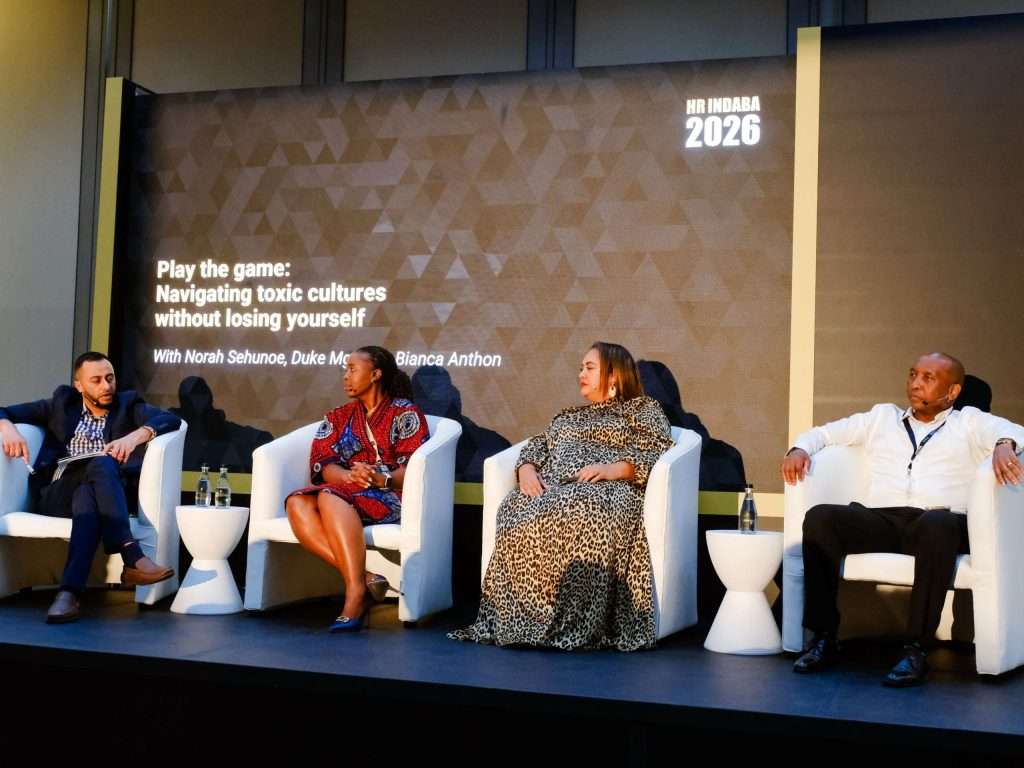
In a packed room at the 2026 HR Indaba, three top HR execs led a conversation about navigating toxic work cultures without losing yourself.
Organisational politics are inevitable, but how leaders respond to them is a choice, according to human capital executive Norah Sehunoe, who joined Duke Mgaga, CPO at the Parliament of the Republic of South Africa and Bianca Anthon, HR director at Illovo Sugar, for a panel discussion titled Play the game: Navigating toxic cultures without losing yourself at the 2026 HR Indaba.
The discussion focused on practical ways HR leaders can navigate toxic workplace cultures while remaining grounded in their values and maintaining their integrity. “Organisational politics are inevitable but I find that political behaviour is a choice and as leaders we have to choose whether we’re going to play the game,” Norah said.
She explained that organisations have both formal and informal structures of influence, which can shape workplace culture positively or negatively. In some cases, individuals who hold significant influence are also the source of toxic behaviour, she added.
“Toxic cultures thrive in silence so as HR leaders we need to develop what I call organisational intelligence. HR leaders must know their organisations wholly and hold people who perpetuate toxic behaviours accountable,” she said.
Norah urged HR executives to identify their personal values and remain anchored to them when navigating difficult organisational dynamics.
“Personally, I ask myself what I’m willing to sell my soul for. As a leader, you need to know your values and be grounded so you can navigate the toxic game without becoming toxic yourself,” she said.
Practical steps to navigate toxic workplace cultures
Duke recommended that HR leaders make understanding organisational culture a priority during their first 90 days in a new role. He advised executives to appoint a mentor who can help them understand the organisation’s culture, identify key stakeholders and determine which individuals they can align themselves with.
“There are also unwritten ground rules. They’re not in the policies or in the strategy but they influence the environment and set the tone around the business and performance,” Duke said.
He outlined four principles for HR executives seeking to navigate organisational politics without compromising their integrity.
First, leaders should establish their personal values and use them to guide their decisions. Second, they should cultivate alliances with positive influencers across the business. Third, they must recognise that transformation takes time, particularly in long-established institutions such as Parliament, and develop the resilience needed to sustain change. Finally, they must remain true to their values.
Distinguishing high-pressure environments from toxic cultures
Bianca encouraged leaders and employees to distinguish between high-pressure, high-performance environments and genuinely toxic workplace cultures. Drawing on her experience in demanding organisations, she said businesses can maintain high expectations and pursue results without compromising human dignity.
“I’ve worked in high-pressure, high-performance organisations and I’ve found that we can be tough about results, but not at the expense of human dignity. Leaders must be held accountable in terms of their behaviour and this can be done through a 360 degree feedback model that is anonymous,” she explained.
Bianca added that building a positive organisational culture starts with the executive team and its willingness to address toxic behaviour. While strong leadership does not necessarily eliminate toxic managers, she said, it can create the psychological safety employees need to identify and challenge inappropriate conduct.
To conclude the discussion, Bianca encouraged attendees to reflect on whether they still found purpose in their organisations and how that purpose could help them navigate challenging periods.
“I’m not asking you to endure toxic work cultures but to truly interrogate whether an organisation is toxic or it’s currently under strain due to economic pressures. As we’ve learned from Viktor Frankl, a person with a strong why and purpose can endure the toughest challenges,” she concluded.