

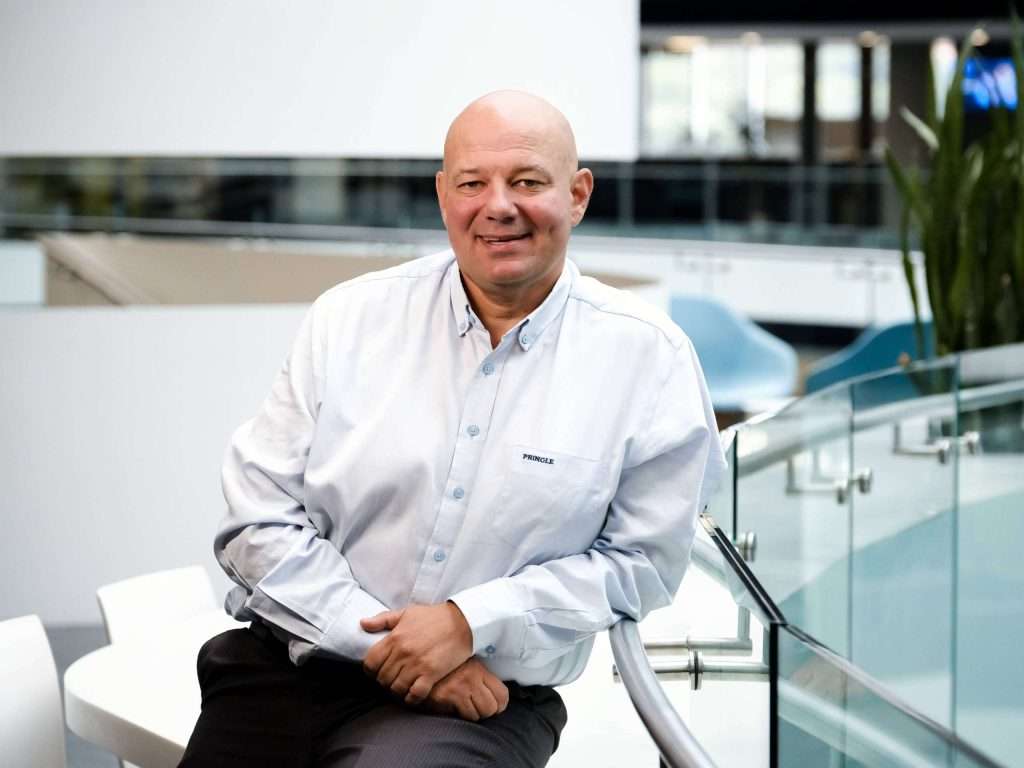
When it comes to imagining the workplace of tomorrow, Steven Teasdale doesn’t just think outside the box. He wants to rebuild the box, upgrade it and make it human-centred.
For Steven Teasdale, the walls of an organisation should respond to the people inside, shaping experiences rather than constraining them. Every process, every team interaction, every corner of the office is a chance to nurture growth, curiosity and wellbeing and his role as chief people experience officer at Discovery gives him an opportunity to do just that.
“I’m obsessed with how we create a workplace and systems that will thrive into the future, particularly for large organisations. That complexity and challenge excites me. There is nowhere else I would rather be than in organisations navigating the tensions of the human realities of today and the opportunities of tomorrow. That is what keeps me motivated. Discovery is a remarkable organisation, constantly breaking barriers, changing, adapting and doing something new. It’s a difficult value proposition to match or replicate.”
Even as a kid, he couldn’t resist the challenge of stepping into leadership. “I discovered my passion for leadership quite young. I was very keen on leading, particularly in situations where I could help others manage difficult circumstances, typically where their natural guardians were not near them, such as in boarding schools. That was probably where it all started.”
Even when numbers and spreadsheets tempted him at the time – he was convinced at one point that he would be an accountant – his curiosity about human behaviour kept nudging him towards people. He saw patterns in systems, but he also saw people behind the patterns and that became his playground.
Battling with dyslexia could have been a roadblock, but instead, it turned into a secret superpower, teaching Steven to approach challenges differently and find his own rhythm. “I had struggled with studying as a youngster but managed to find a system for understanding and absorbing information. When that system clicked, my academics took off.”
Combining creativity, innovation and change
A move to London became a laboratory for learning how to orchestrate people and systems at scale. It was a place where Steven discovered that guiding humans through change could be just as satisfying as balancing books.
“I started working for Deloitte in London and eventually moved to the consulting side. I moved from one job to the next, one client to the next, always focused on being useful and contributing wherever I could. As I built a reputation as a reliable resource to partners and senior managers, I began working on major transformations, which always included a people component. I naturally gravitated towards those projects, leading people streams, change management, design and restructuring work.”
An MBA stitched together the finance and human sides of his brain, giving him the language to speak to both numbers and people with authority. “During that time, I focused on a combination of creativity, innovation and change, all centred on people and strategic finance. I realised that to influence and work with people effectively, you have to speak their language. So for my MBA, I majored in strategic finance and human-centred approaches to change.”
In his final role in the UK before returning to South Africa, he held a senior strategy position at an actuarial and investment consultancy confronting a structurally declining revenue base following the widespread closure of defined benefit pension schemes. Rather than pursuing a conventional outside-in market response, he led a strategic reset grounded in an inside-out resource-based view of strategy, starting with a rigorous assessment of the firm’s distinctive skills and capabilities.
“It was incredibly successful,” he notes. “We developed new strategies, products and service offerings, including businesses that were ultimately spun off into partnerships. This was the early emergence of big data as a strategic asset – bringing together data analytics, actuarial modelling and relationship management in new and powerful ways.”
Family eventually drew him home, but it was mentorship and opportunity that made him stay. South Africa’s promise of growth and transformation intersected perfectly with his skills, and he jumped at the chance to shape organisations from the inside.
New lessons
“We had our first child in the UK. My wife said we needed to go home as she couldn’t see raising children in the UK. Around 2005, during the Homecoming Revolution and Africa Summits, South Africa was aiming to reverse the brain drain. I had two offers, SAB and Eskom. What convinced me to join Eskom was a mentor, the then HR director, Mpho Letlape, who showed me how my work could connect to purpose and contribute to South Africa’s growth. The job involved consolidating logistics and procurement across new build power stations, a major organisational design, development and change programme. Within about a year, I was promoted to head up organisational effectiveness for the group, marking my first executive-level role in South Africa.”
Steven was quite young at the time, but had the privilege of working alongside some older deeply experienced organisational behaviour experts, and was grateful for their guidance and teaching. Returning to South Africa after leaving soon after ’94 was a very different experience and the diversity in the workplace was incredible, he added. “Just a week after I got back, load shedding began. It gave me the opportunity to navigate complexity, manage difficult situations, work with outstanding executives, support teams and help build the organisation.”
He also held executive roles at Tiger Brands, but it was Discovery that was the canvas where all of these lessons converged. For him, it became a place where experimentation, innovation and human-centred design could run at scale.
“I came to Discovery in 2018 as the group head of organisational development and transformation and shortly after Covid, I was promoted into a much wider scope as chief experience officer for the Group. We literally created the role. It includes organisational development and effectiveness, transformation, internal communication, innovation, organisational design, wellbeing and recognition. Beyond that, it encompasses the overarching role of human experience, or people experience, within the organisation.”
Covid tested him and the organisation like never before, but he proved that purpose could be operationalised even in crisis. “We turned our organisation into a vaccination centre. We had to lead South Africa on mandatory vaccination for our workers. It was a very difficult decision with numerous challenges. The quality of execution had to be rigorous and human-conscious. It was tough but rewarding,” he elaborated.
Staying grounded
“I believed in what we were doing. I was convinced the vaccination would save lives and our number of staff deaths reduced dramatically. You feel you are saving lives. Purpose and meaning drove me every day.”
Even as he navigates such complexities, Steven has cultivated a practice that keeps him grounded. “Meditation is part of my life. It helps me focus, reflect and approach challenges with clarity. It is about finding calm and understanding in the middle of complexity,” he said.
“I work with leaders to try to help them develop presence and resilience. It is about helping them understand that even in the most chaotic environments you can find the stillness and clarity that then allows you to bring your skill to the solutions in a systemic and sustainable way. You learn to approach situations with intention rather than being swept along by the urgency of events.”
He applies the same principles to Discovery as he confirms that meditation informs his approach to leadership, strategy, and even the way people experience work.
“The ability to pause, breathe and observe those are skills that make leaders more effective. It’s not just about making better decisions; it’s about creating an environment where people feel seen, supported and are liberated to bring their best selves to work to deliver on the strategy, and more importantly the organisation’s purpose.”
“Build organisations where people and performance accelerate each other; or concede the future to those who will.”