
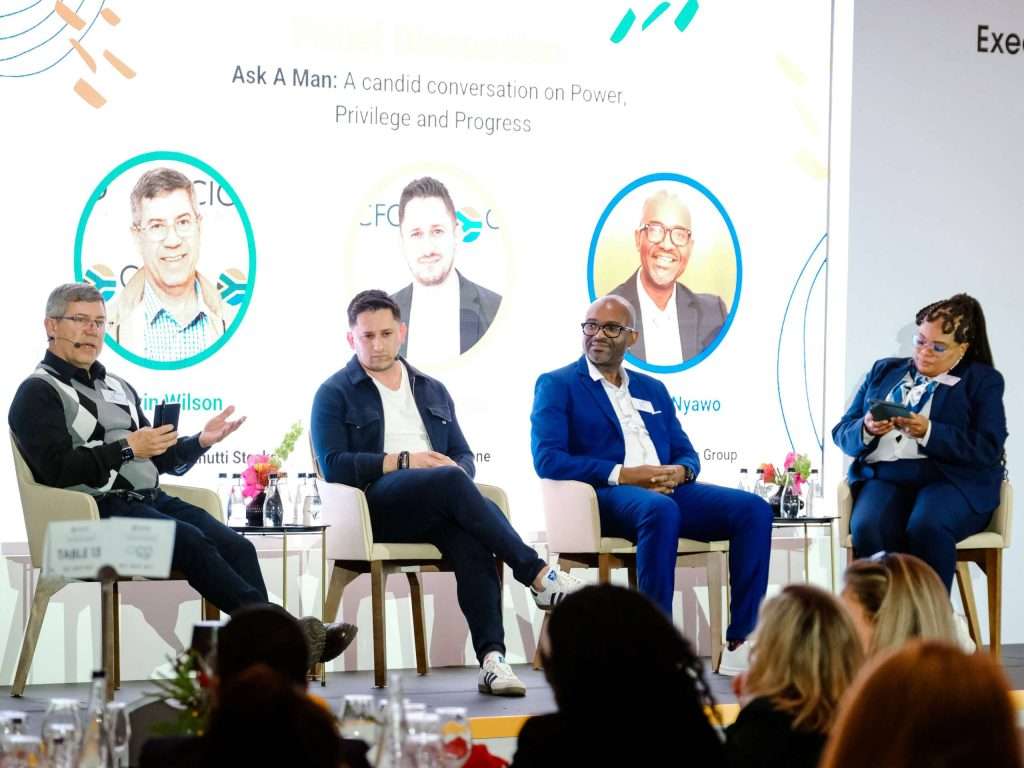
Ask A Man was back by popular demand at the 2026 ExCo Women’s Dinner, giving women the chance to put much-needed leadership conversations on the table, and once again, the men had to do the answering.
With three senior male executives from HR, IT and finance taking on the questions, Njabulo Nyawo, CPO at Momentum Group; Kevin Wilson, group GM for IT at Stefanutti Stocks; and Mikaeel Tayob, CFO at Bridgestone took the conversation beyond the usual leadership advice, and unpacked the systems around women, the expectations placed on them and the perceptions that can shape how their leadership is received.
For Njabulo Nyawo, the conversation started with the women who had shaped his own leadership story. Raised by a single mother, he reflected on how many of his most formative lessons had come from women at different stages of his life.
“I don’t think men can ever tell women how to lead. I was raised by a single mother, so a lot of my foundational leadership lessons came from her, and that is enough validation.”
“As I was reflecting and preparing for today, a powerful revelation was that a lot of my development and leadership development actually came from female leaders, from school to university and now at work. My three most recent leaders have all been female, and my current leader is actually a woman. So it’s my way of saying there’s not much we can teach women how to lead because I’ve learnt a lot of lessons from women.”
Women don’t need fixing
Njabulo therefore does not believe the challenge is a lack of leadership capability among women. The bigger issue, he believes, lies in what happens between talent and opportunity, and whether organisations are creating the conditions for women to progress.
“I don’t believe in having specific leadership development programmes for women. I think women have leadership skills and adaptive leadership talent. For me, we need to focus on understanding why we are not seeing the evolution of women leaders and what needs to change to make that possible,” he added.
“It’s probably something in how we design the policies. I think all organisations can stand up and say they have the best policies in class. We can all win best employer awards, but the reality is, why are we not seeing that evolution?”
The answer, he suggested, sits in the gap between what organisations promise on paper and what women experience throughout their careers.
“I think it’s the way we design and implement. It all starts with the way the policies are designed, for the most part, in the design of policies and governance processes, but also in how we implement them. We don’t really talk to or see the holistic person. We need to see a woman as not just an employee, but as a holistic person.”
That broader view of women’s careers also requires attention to the everyday moments in which leadership credibility is built, and Njabulo highlighted preparation and participation as two ways leaders can strengthen their impact in critical conversations.
“Preparation goes a great deal at this leadership level. If you’re preparing for crucial conversations, like decision-making meetings, the ability to demonstrate that you are quite prepared, that you’ve done your digital preparation for the agenda items that are to be discussed, I think that is very key. It does show up in how you show up in the conversations themselves,” he noted.
“The other thing is just always be prepared to contribute. It’s not good enough to be in a group discussion and just wait for your turn to speak because it’s not a domain area that has been discussed. I believe the ability to demonstrate that you are curious and willing to contribute outside just your immediate domain of expertise is another key differentiator when you’re looking at leadership.”
The pressure to be everything
He then brought the focus back to the responsibility of organisations to create pathways in which women can emerge and progress.
“If we don’t change how the environment allows women leaders to emerge, it will not take us very far. You need to change how the environment enables women to emerge into leadership. There has definitely been a lot of progress when you look at the female leaders emerging in the leadership space, proving they are capable.”
The conversation then shifted from the workplace structures surrounding women to the expectations women carry into their working lives where Mikaeel Tayob highlighted the pressure created by trying to excel simultaneously across professional and personal roles.
“Men and women have unique problems, but they’re both problems or challenges. The issue we deal with is stopping apologising for being a woman and stopping apologising for being a man. There’s an expectation and a perception that women are supposed to be the best mom, the best wife, the best girlfriend, but also the best professional. The issue here is that the same expectation is not placed on a man. Not yet, anyway.”
Mikael also challenged the idea that leadership should be measured by sacrifice and long hours.
“Some of the best women leaders that I’ve learnt from have told me it’s not about the effort over long hours; it’s about the impact and the influence. If I can echo two things that I think, again, not just women but men should be able to grow, it’s those two things: impact and clarity, and then having the amount of influence and the courage to use that influence.”
Passion is not emotion
That influence becomes particularly important in the boardroom, where the same leadership behaviour can sometimes be interpreted differently depending on who is displaying it. Kevin Wilson tackled a similar perception placed on women.
“I’ve constantly heard in boardrooms that when a woman says something with passion, they mistake that for being emotional, and that is a problem because we need passion in the world. I don’t believe that you can do anything without passion. If you’re not passionate about what you do, it’s going to end up bad,” he said.
“Bringing your passion to work is very important. I think it’s the arguments in the boardroom that are mistaken for emotional. If you bring passion to the right kind of places, regardless of who you are, that passion will drive the process. I’ve never seen any project that’s gone across the line without passion. It just doesn’t happen. And I think because women are more empathetic, they can bring more passion to the table.”