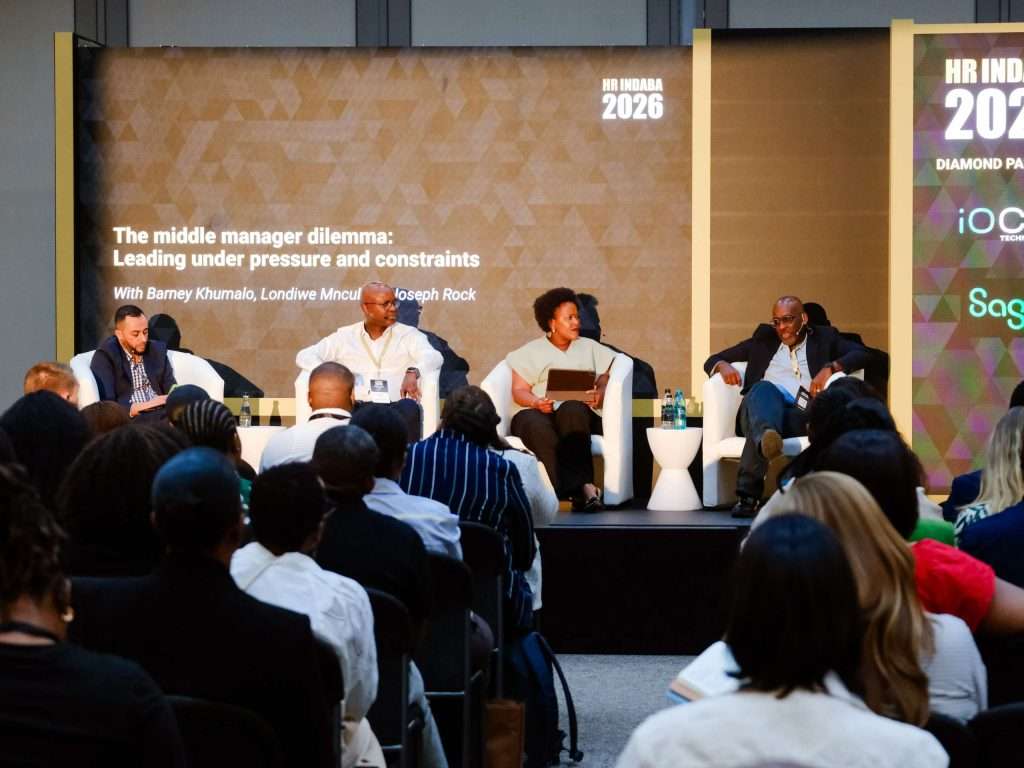
Middle managers carry significant accountability, often without the authority to match. This was a talking point at the 2026 HR Indaba.
Barney Khumalo, chief people officer at Rainbow Chicken; Joseph Rock, business and HR executive; and Londiwe Mncube, CHRO at the Competition Commission South Africa shared how organisations can equip this critical layer to lead effectively, at the 2026 HR Indaba.
Barney described middle managers as the levers for change and the executors of strategy, yet they are often overlooked.
“Senior managers set the tone for how middle managers operate. We invest in coaching and skills development, yet often overlook this middle layer. We give middle managers significant accountability without giving them enough authority. Very few middle managers progress to executive positions,” he said.
For middle managers aspiring to executive roles, Barney emphasised the importance of looking beyond day-to-day operational responsibilities and developing a broader understanding of the business.
“You need business acumen and an understanding of the broader business agenda. Don’t think narrowly. Build networks, influence others and establish connections that help you be heard and seen. Middle managers have a unique understanding of operations and should share their insights with executives. We also need to equip managers with people skills so they can motivate their teams, not just deliver on strategy.”
He added that leaders must create conditions in which team members can speak up without fear of victimisation.
Clear expectations and the right environment
Joseph urged middle managers to establish clear expectations with their senior managers from the outset. “Make your manager look good,” he said, including agreeing on responsibilities and understanding what success looks like.
He pointed to governance as a common weak spot. “We often have incompetent people in important positions who just send down accountability without empowering,” he said. He added that the framework and environment must be conducive to developing middle managers, including for the world of AI. “It must be clear who will deliver the change and transition. Middle managers must be trained and supported sufficiently on what the technology can do and how it is incorporated into the system.”
Joseph also encouraged middle managers to build relationships at the top, which can help when problems need to be reported, and to choose which battles are worth fighting. “Don’t derail the whole team because your team is scared to talk. Turn feedback into action when it’s given, as it creates a culture that encourages communication.”
Failing forward and delegating well
Londiwe challenged organisations to reconsider their reliance on the same high-performing employees whenever workloads increase.
“Middle managers must be allowed to fail forward, rather than having more work continually piled onto the most competent team members. Instead of relying on the same high performers, organisations should focus on upskilling the broader team. Delegation paralysis can alienate capable employees, so managers must be honest about how and why they are delegating responsibilities. At the same time, delegation must be supported by clear expectations and consequence management,” she said.
Her argument highlighted the need to balance accountability with opportunities for employees to learn, take on responsibility and develop their capabilities. Londiwe said effective delegation requires managers to distribute work more broadly while ensuring that employees understand what is expected of them and remain accountable for outcomes.
Protecting the team – and yourself
Londiwe highlighted the emotional demands placed on middle managers, who act as insulators protecting their teams from pressure. She argued that the role takes a toll and that managers need psychological support to prepare them to act as shock absorbers.
She also encouraged managers to be vulnerable with their teams when overwhelmed, because it allows colleagues to offer support until the manager is back on track. And in understanding how teams are really doing, she said, accurate observation can be more powerful than surveys.