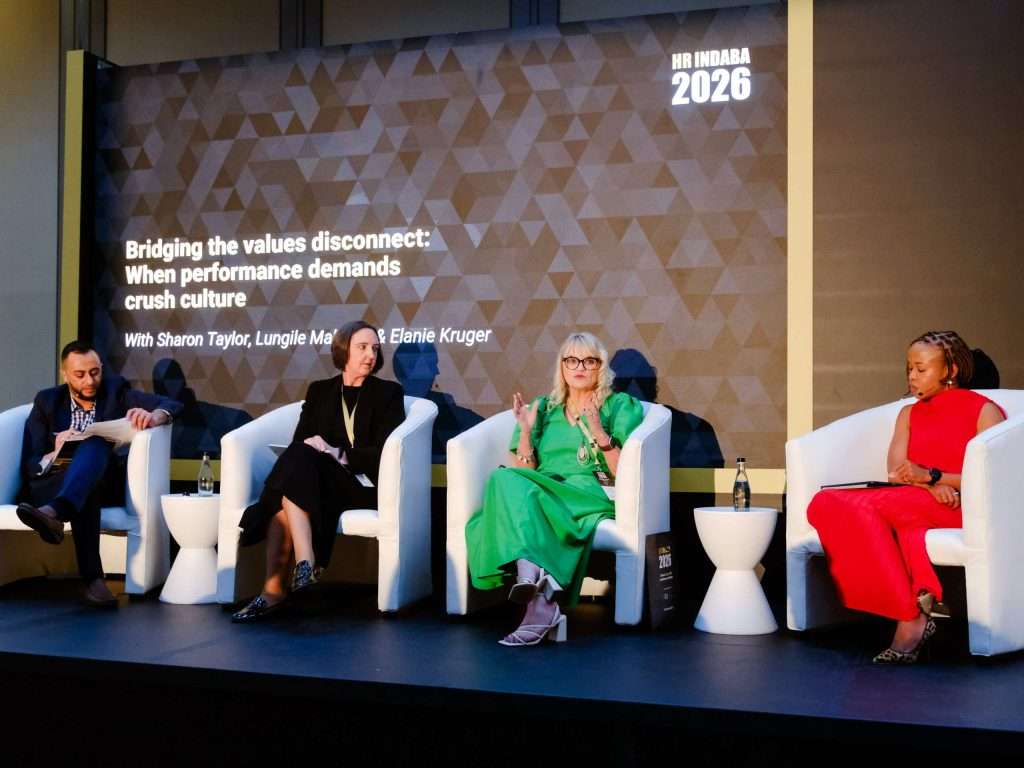
HR leaders from Standard Bank, Tsebo Holdings and Deloitte discussed the disconnect between organisational values and employees’ experiences at the 2026 HR Indaba, emphasising the need to balance business performance with workplace behaviour.
Leading HR executives Sharon Taylor, chief people and culture officer at Standard Bank, Elaine Kruger, group CHRO at Tsebo Holdings, and Lungile Mahluza, chief people and purpose officer at Deloitte, sat down to discuss the gap between company values and culture and the employee experience in a session titled Bridging the values disconnect: When performance demands crush culture.
Sharon emphasised the importance of finding a balance between financial and behavioural outcomes to bridge the disconnect between values and performance demands.
“You have to try and keep these two things in balance, and that is not easy. You have to focus on what is expected in terms of hard outcomes, as well as the softer outcomes such as the behaviour you expect from employees. The hard outcomes are easier to see and measure as those have a ton of metrics such as client outcomes, operational excellence, employee engagement, risk and conduct, operational excellence and sustainability metrics.”
Sharon says Standard Bank’s behaviours are engineered into what it takes to deliver the strategy. “We expect that all of our people will live the values of the bank. It is non-negotiable.”
Sharon says softer outcomes such as behaviour and applying Standard Bank’s values have an impact on the overall performance of employees. “No matter how well people are doing in delivering the outcomes, their performance ratings can be downgraded by an entire level if their behaviour is poor.”
“Standard Bank recently turned 164 years old; although we are doing well, we can never be too complacent. We refreshed our values for the first time in 25 years. We wanted our values to reflect the best that we are. Values have to be true to who you are as an organisation. Good values have to be excavated and not innovated. We also worked on our people pact, the value proposition for our people. We chose the word ‘pact’ to signal a two-way commitment between Standard Bank and our people.”
Identifying key disconnects
Lungile noted that performance managemnt systems reflect an organisation’s values.
“If we think of the topic, the performance pressure reveals what our culture really is. I have a theory of what I think my values are, but I do not really know for sure until those values are tested. The systems that we build teach people what our real values are. One of the key areas is often how decisions get made. Targets are set through a top-down approach.”
As leaders, we leave the people in the middle to work out the contradictions and trade-offs. Line managers must look after their teams, deliver performance at pace, and manage quality, but they were not part of setting those targets. We often devolve managing those trade-offs and contradictions to people in other parts of the organisation who may not have the influence and authority to do so,” says Lungile.
Lungile added that we must consider how disproportionately important the line manager-employee relationship is when it comes to values. “A line manager does not control absolutely everything around the employee experience; however, they are often where the rubber meets the road in terms of how people experience the values of an organisation.”
Lungile emphasised the need for leaders to build trust. “We need to learn how to build trust as leaders through consistency, helping people understand why we do the things we do.”
Upholding values
“It is very important that when we go through the process of deciding on our values, we really apply our minds to it. We ensured that we go through a process of identifying our values and making them practical. We feel very strongly about our core values, which are integrity, caring, enterprising, and diligence,” says Elaine.
Elaine added that, from a group perspective, people must understand what the non-negotiables in the business are; however, there are sub-cultures that will exist in different divisions and functions.