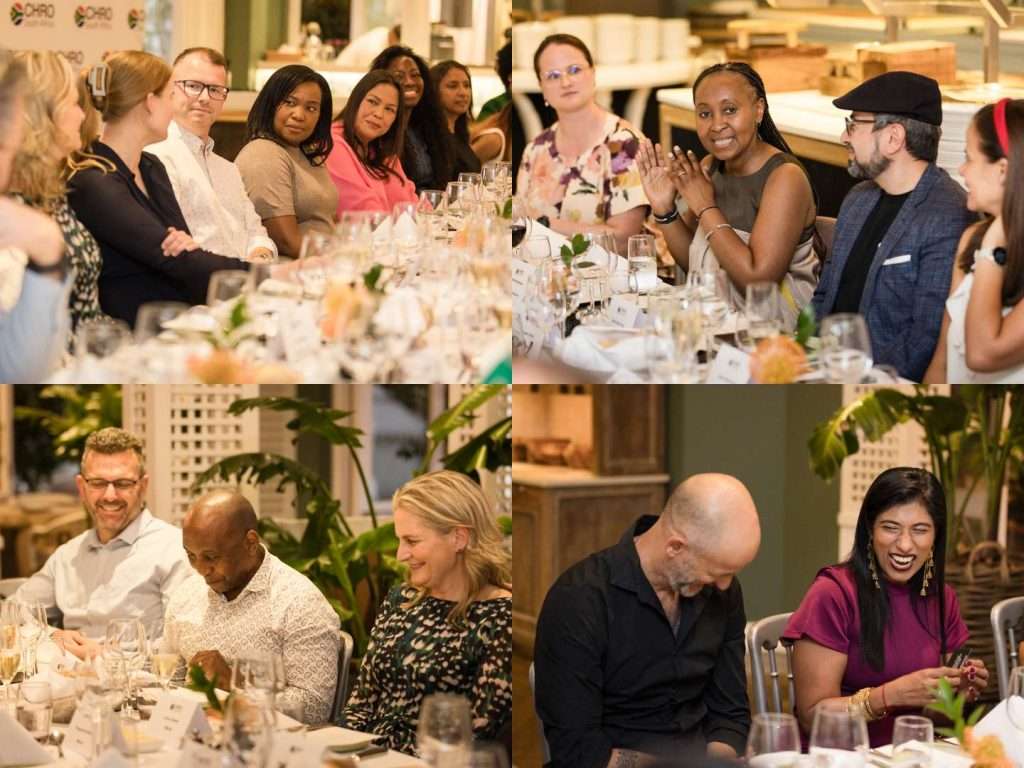
A table full of the Mother City’s top HR leaders, a beautifully laid dinner spread and plenty of stories to share made for an evening of lively conversation on 10 November at the Mount Nelson’s Oasis venue in Cape Town.
There was plenty on the menu at the CHRO dinner, and not all of it was served on a plate. Alongside the delicious food was a generous helping of candid opinions, shared experiences, laughter and lively debate as HR leaders gathered to look back on 2026 and consider the people agenda for 2027, although the conversation would soon prove too interesting to be confined to one theme.
Before the starters had made their way around the table, icebreaker cards got the evening off to a lively start. Among the questions was one asking an attendee to give their career story a book title, and their response offered a glimpse of the humour around the table.
“I would title it WTF standing for ‘Where’s the Fun?’, not what you’re thinking,” the attendee responded and joked.
She explained that the fun she had in mind was not about company parties or social events. “Fun in how employees feel when they are at work, fun in how employees feel empowered, fun in how employees take risks with no punitive repercussions, fun in exploring opportunities they never imagined.”
AI is the new office colleague
With the ice broken, the conversation soon found its own rhythm proving that getting a table full of HR leaders talking was never going to be a challenge.
An attendee working in the software industry highlighted how the rapid advancement of AI has brought particularly difficult questions about the future of the business and the people who work in it.
“It has been turbulent. It has been difficult to adjust to, and that is what keeps me up at night. We need to figure out how to change the way we work, what we sell, how we sell it and how our operations function. I'm the head of an office, which includes HR, so this raises questions about what we teach people and what we hire for. None of this is really knowable just yet,” the attendee shared.
“There is a huge amount of uncertainty in my business, but that is what we need to figure out next year. We need to get to a point where we understand what our new operating model looks like and how our operations will work. Things are not going to be the same as they were a few years ago,” the attendee added.
The uncertainty was not confined to the technology sector, as another attendee turned the discussion to the economic environment and the difficult conversations taking place around budgets, asking how many others at the table were having to make significant cuts.
When asked what kind of cuts they meant, the attendee clarified that these were not necessarily reductions in headcount, but cuts to projects, AI development and initiatives planned for the following year, including those relating to employees.
“It really is challenging, particularly in financial services. The environment we operate in, together with the impact of the Trump sagas, the wars and all those things, makes it tough. We are a large financial company operating across the continent and in other jurisdictions, and it is tough,” acknowledged the attendee.
There were nods of agreement around the table as others recognised the challenges being described. At the same time, the conversation also touched on how the growing use of AI is forcing organisations to reconsider not only how work gets done, but also which skills and roles will be needed.
Mind your AI and HR
One HR leader illustrated this through the changing responsibilities of analysts in their sector.
“AI is also replacing a lot of jobs, particularly in my sector. I can give you an example. The role of an analyst used to involve conducting research independently. They would look at all the organisations and decide which ones they wanted to pursue. Now AI does a big chunk of that work.”
“We now need different people with high levels of judgement who know how to work with these technologies. Right now, we are looking at the people who are ready for the future,” shared the attendee.
But the idea of a future-fit employee prompted another attendee to question how organisations could prepare people for a future that was constantly shifting.
There was also a reminder that the race to adopt AI needs to be balanced with caution.
“I think it is quite a bold move to replace people with AI. One of my biggest challenges is that we started the year with AI integration and AI initiatives. Halfway through the year, our approach became more cautious. We had to consider copyright, GDPR, data privacy breaches and our intellectual property. We want to make sure that we are not left behind in terms of technological advancements, but we also need to be safe in how we do so, while considering the employment environment and the high unemployment rate in which we operate,” one attendee said. "It then became a case of saying we are not going to replace people immediately, at the very least, but we are going to use AI with caution.”
“The reality is that technology is moving at such a rapid rate. If you don't adapt, you're going to be left behind,” added another HR leader.
With napkins draped around laps, recruitment offered another practical example of how technology is changing established HR processes.
“Recruitment used to involve having three or four people who would scan applications, conduct market research, speak to recruitment agencies, develop interview guides and sift through everything. But now, a lot of that is done automatically. On average, for every role we advertise, we receive 600 applications. There is no way we can manually sift through all of them, so the applications are filtered using software that checks for specific criteria and keywords,” shared one attendee.
Another attendee pointed out that, “Interestingly enough, the most recent research is looking at AI insurance because of all the errors AI can make in a hiring process.”
The comment prompted a light-hearted response from another guest: “That's your next revenue stream! Everyone, go for AI!”
Behind the laughter was a more serious question about what organisations should do with the time and capacity that technology creates.
“AI still needs to be human-led. You can plan for where you want to go, and I think that is the exciting part. You can navigate towards that vision and plan to build those capabilities, but then you have to reskill people into those roles,” stated an attendee.
The statement brought the conversation back to responsible implementation and the need to think carefully about the value created by the technology.
“The tactical question then becomes how we use AI responsibly and what we do with the time it frees up. It should be used to create value as well. I think we must be cautious, use it to our advantage, put proper guardrails around it and ensure that it remains human-led. But we must also acknowledge that it will require fewer people in certain areas,” stated another attendee.
Wellness on the menu
As the clink of knives and forks continued around the table, the conversation shifted from how technology is changing the way organisations work to how people are experiencing those changes, with rising living costs also putting employees under strain.
One attendee spoke about the growing need for flexibility and the impact of financial pressure on employee wellbeing.
“From a people and organisational perspective, the macroeconomic factors have made the need for flexibility even greater, particularly because of the cost of the petrol crisis. People have become really strained financially, and that is a real concern from a wellness perspective,” shared the attendee.
“The other thing is that we are seeing spikes in mental health issues and fatigue. Those are very real things. People cannot leave their emotions and feelings at the door. There is a bigger need for us to understand how we can maintain mental wellness in the business while also managing the flexibility and the amount of time involved. Those are all things we must figure out in terms of what is feasible to accommodate and what is not. Wellness is becoming a big topic,” added the attendee.
With the aroma of the main course filling the room, the conversation turned to what meaningful employee wellness looks like beyond wellness days and formal programmes, and the importance of making space for people to talk about what is happening in their lives.
“There is the wellness we all do, with wellness days and all of that, but there is also what is happening in people's lives, what is happening to their families and what they are living through economically. The opportunity simply to be heard is so significant,” noted one HR leader.
“I think we cannot have all the answers to these things. It cannot be a tick-box exercise. Sometimes, simply giving someone the opportunity to talk to others about what they are going through is huge,” the HR leader added. “I worry that wellness is going to be taken over by wellness organisations that promise to solve all your wellness problems, but wellness is also a conversation point. With AI, we must never forget that we need to embrace it, but we must never forget human connection,” they added.
As mouthwatering dessert was served, the conversation returned to the human side of organisational change, with one attendee reflecting on the importance of support and connection as businesses adopt new technologies and navigate uncertainty.
“As organisations grow and change, people need to be able to navigate that change. While we talk about all the fancy agentic AI and compliance, we must not forget that there is a big need for wellness and mental health support, particularly given the economic circumstances we are living through. That is one of the big components from a people perspective. People need to be heard,” stated an attendee.
Click here to see visuals from the evening and get a glimpse of the elegant setting, engaging conversations, and memorable moments from the dinner.
Those in attendance were:
Aba Ayirebi, Head of people, Stor-Age Prop REIT
Alicia Dean, Head of people, PKF Cape Town
Andrew McDonald, Head of people, Discover Africa
Andrew Millson, HR and sustainability exec, Food Lovers Market
Bridget Makhura, CPO, Clicks Groups
Dineo Sekwele, Human capital executive, Ninety One
Duke Mgaga, CPO, Parliament of the Republic of South Africa
Johan Pretorius, Head of operations, Polymorph
Kgaogelo Letsebe, Community manager, CHRO South Africa
Laura James, Director: people & organisation, Mulilo
Lesley-Ann Muller, Head of talent & people solutions: Central Office, Pepkor
Ninette Oliver, CPO, PepsiCo
Pragashnie Naidoo, Executive: people & culture, Maersk
Reabetswe Motshegare, HR director: Sub-Saharan Africa, Scatec
Sana-Ullah Bray, Group executive: human capital, Sanlam
Sandi Richardson, CPO, RCS Group
Sarah Robertson, People director, Luno
Siyasanga Tetyana, HR specialist, Atlantis
Sphumelele Khumalo, Senior writer, CHRO South Africa
Thabile Molapisane, Head: shared services, Amathuba Collective