
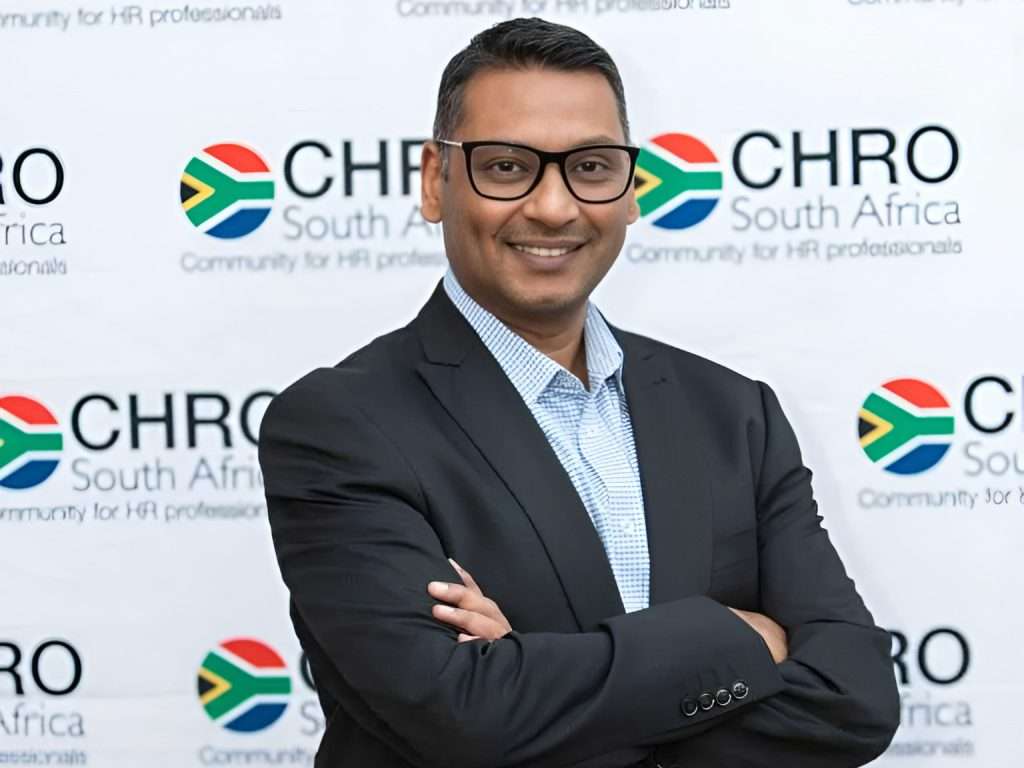
Regenesys Corporate Education CEO Nishen Munnisunker explains how the organisation is preparing leaders for a new era with AI-integrated development programmes, a dedicated school of AI, and a 2026 executive HR leadership development programme.
AI is reshaping work at a pace that no longer allows leaders or HRs to sit on the side lines. This is according to Regenesys Corporate Education CEO Nishen Munnisunker and his leadership team, as he says that the conversation has moved far beyond basic awareness. The question now is whether executives, and particularly HR executives, are prepared to lead organisations into an AI-enabled future that demands sharper judgement, stronger ethics, deeper stakeholder engagement and the ability to redesign entire organisational structures.
As Nishen explains, the shift is no longer theoretical: “Those repetitive jobs and roles are pretty much now being very quickly replaced by artificial intelligence.” Globally, he says, organisations are far ahead of South Africa. “If we look at training and development or skilling of individuals globally, they're already shifting away from awareness level training into implementation.”
This transition is particularly visible in HR where AI is already screening candidates, profiling talent, scheduling interviews, recommending development pathways, analysing performance, managing payroll and leave, and personalising learning journeys. The outcome, he says, is that “individuals in an HR function now need to start thinking and shifting their mindset around what is required in terms of skill is more the higher-order or higher-level thinking roles”.
These higher-order skills, he says include judgements ethics, stakeholder management and change in organisational design. He explains that “AI can give you a report but the judgement still lies in the hands of humans. Sometimes the system throws you data and you have to make an ethical judgement, but you need to be skilled enough to make ethical decisions. AI is not doing that. That's your role as an individual.”
Nishen believes that it is the role of HR to now shape how AI transforms organisations, their structures, and their future workforces.
This, he says, is why Regenesys is investing so heavily in leadership capability that can match the velocity of AI.
Six pillars of personal mastery
Unpacking this, he explains that Regenesys builds all learning programmes, executive and academic, on six interconnected pillars of personal mastery. These pillars ensure that executives don’t just gain technical AI knowledge but develop the human capabilities needed to lead through it. These pillars are intelligence, emotional, spiritual, financial, networking and physical quotients.
As Nishen explains, there is more to these pillars than meets the eye. The spiritual component is “not teaching people how to pray. It's really about teaching people about the purpose of self, purpose of leadership, purpose of organisation, and building resilience,” he says. “The financial pillar focuses on both business and personal literacy, helping leaders with financial literacy and acumen.”
The networking quotient centres on “the human connection, whether it's for business purposes or fun, while the physical pillar recognises that you’ve got to be physically healthy, your brain needs to have the right nourishment to shift your mind.”
Together, these pillars, he says, form a core part of Regenesys’s academic and non-academic programmes, including its new AI-integrated offerings.
Making AI learning stick
The need for these programmes is critical, he believes, as people need to not only understand but also use AI successfully intelligently and ethically. “The key demand of every client I sit with now, is to learn how to use it,” he says.
This is why Regenesys incorporates prompt engineering into its leadership curriculum – not as a standalone course, but as a practical module woven into every programme.
He says that executives learn to structure prompts by anchoring them in expected outcomes; ethical considerations; risk management and strategic intent. Just as importantly, Regenesys uses sandboxes and design labs so that executives can practise AI decision-making safely. “We’ll build a sandbox where you can go and play around with the different tools in a safe space: make a mistake, and learn from the mistake,” he says.
To ensure that learning embeds and is not forgotten, the programmes are aligned to the Kirkpatrick model (which measures the effectiveness of learning programmes across four levels: participant reaction, knowledge gained, behaviour change and organisational results achieved), measuring from Level one (immediate learning experience) to Level four (business impact). Executives are not only assessed on theory but on behavioural change and the real-world application of their new skills.
Seeing AI at work on the ground
In this case, real world means global as Regenesys also takes executives to AI and technology hubs in India, Singapore and China to “kick the tyres,” as Nishen puts it. “Had they not been on this opportunity they wouldn’t know the ‘what’ behind the artificial intelligence,” he says.
Leaders often return with new partnerships already in motion and a renewed urgency to transform their organisations. “Executives are starting to implement what they saw internationally using those systems and tools here in South Africa,” he says.
To meet the moment, Regenesys will launch several new programmes in 2026, including a new school of AI and a flagship executive HR leadership development programme.
The HR programme aims to shift HR professionals into strategic architects of the future organisation. “We are crafting the next level or the higher-order level HR executive: shaping the organisation, designing the organisation, understanding the future, reading the trends, and planning different scenarios,” he says.
He adds that this work includes understanding which roles must be introduced, redesigned, or phased out, all informed by AI-driven shifts in business strategy.
Nishen emphasises that this is the only programme in the market “that is building these HR capabilities. If you put a programme like this on your CV, your future employer is going to say 'those are the capabilities they need’.”
He says that HR leaders will learn to design roles for an AI-driven future; shape organisational strategy; analyse trends and plan scenarios; exercise high-stakes judgment; anticipate ethical implications; and manage enterprise-wide change and stakeholder dynamics.
Nishen is clear: AI may automate tasks, but it also enhances the importance and complexity of what is expected from leadership. For Nishen this is not daunting but exciting. “Our executive leadership development programmes digital component teaches leaders how to shift their organisations. It focuses on how to be a leader in a digitally transformed world or how to transform your world into a digital world.”
Regenesys ’s programmes blend theory, practice, ethics, international exposure, AI integration, and human-centred skill building. In a world where AI adoption is accelerating, HR leaders now have an unprecedented opportunity to not just to keep up, but to shape the organisations of the future.
“This is the opportunity to move ahead, to ensure that you as an individual have the right skills for the future. That’s critical.”