
The recruiter has AI. So does the candidate. One is using it to find the right person faster. The other is using it to become the right person on paper. That was the ongoing workplace tension explored at a recent Lumini webinar themed The AI Recruitment Reality.
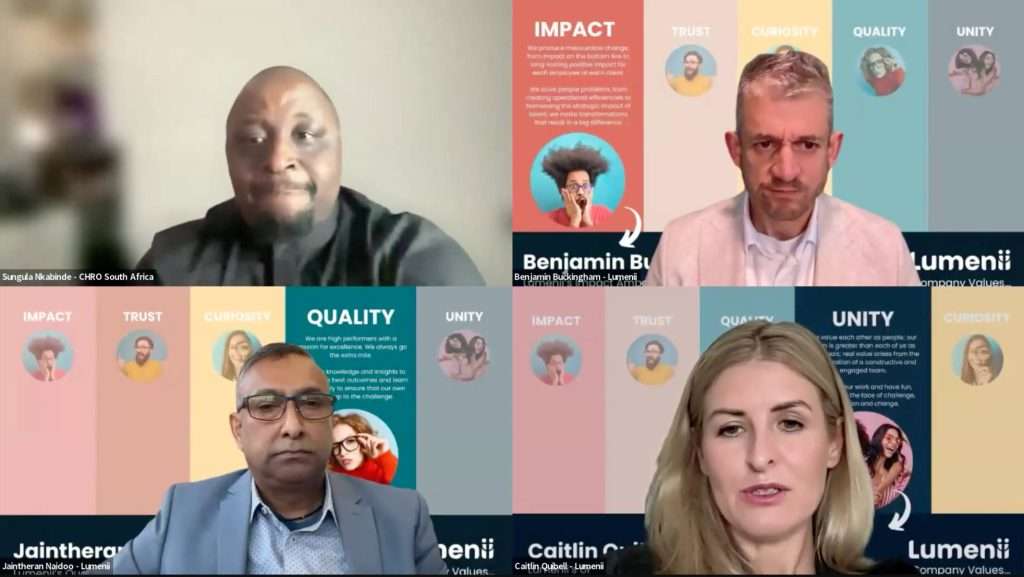
Caitlin Quibell, head of product & senior psychologist at Lumenii; Benjamin Buckingham, managing director at Lumenii; and Jaintheran Naidoo, delivery director & principal psychologist at Lumenii, unpacked what happens when both sides of the hiring table have access to the same increasingly powerful technology.
According to Caitlin Quibell, head of product & senior psychologist at Lumenii, this new reality creates a paradox that HR leaders need to confront.
“We’re seeing more and more companies start to use AI, and we’re seeing that it helps recruitment teams move more quickly. But that same tool is helping candidates get better at telling you what you want to hear. So the better AI gets for recruiters, the better it gets for candidates as well. And then the question we need to ask ourselves is if there is a risk that we’re all going to end up further from the truth and not closer to it,” she says.
The audience poll reflected just how early many organisations remain in that journey, with the majority raising concerns about losing the human touch.
The mirror effect
For Caitlin, the usefulness of AI is clear, particularly when it comes to repetitive work.
“We’re going to use the analogy of a mirror. And I’m sure we’ll all agree that AI is extremely good at reflecting back what you give it. AI is genuinely excellent when it comes to supporting humans with doing tasks at high speed and scaling repetitive tasks. It’s great with using clear, structured output in a consistent way and, realistically, not bringing in the errors that a human being may bring in if they were doing repetitive tasks all day.”
“Ultimately the biggest benefit I would say is freeing up recruiters’ time by removing some of the day-to-day administrative burden. However, AI can only see what it’s reflected in the mirror, not necessarily what’s behind it or beneath the surface of an iceberg. So an AI tool can only infer information from what it’s fed. It has no view of what’s not on the page in front of it.”
She explains how that becomes particularly significant when the information being assessed has already been polished by AI, because what arrives on the recruiter’s screen may therefore look increasingly impressive without necessarily revealing more about the person behind it.
“If you take a well-written CV, an AI-polished CV, and if you take a video interview answer where the person has used an AI tool to help shape their answer, and you look at them as inputs to your recruitment process, they’re both just a polished self-report at the end of the day.”
“Our challenge as recruiters used to be dealing with high volumes and filtering people effectively. Now our focus needs to shift away from just filtering what candidates are telling us to verifying, to looking beneath the surface.”
She notes how the need for verification becomes even more important when the technology itself is not always as predictable or transparent as its confident outputs suggest.
“AI is, by design, a non-deterministic tool. Practically, what that means is if you ask an AI model the same question twice, you can get two different answers, which is fine if you’re doing exploratory work or drafting an email, but it becomes a bigger problem when you have to stand behind a hiring decision that is made.”
“AI models are not transparent. They are opaque. What that means is you can get an answer out, but you can’t see all of the elements used in the reasoning. It’s a bit like a black box in a way. You can’t see how A plus B became C, so you get this great, confident answer. It’s very polished. It makes you feel very confident, but you can’t necessarily open it up and see how it got there.”
For HR leaders, that lack of visibility has consequences as recruitment decisions need to be explainable and defensible, particularly where bias or discrimination may be alleged.
“AI models have generally been trained more on English and just disproportionately so on US English. So there could be a risk here that it reads US-style CVs or communication as the right answer and anything else as perhaps a little bit weaker.”
Verification becomes vital
The concern Caitlin raises is not necessarily an argument against using AI, however. Rather, it is an argument for understanding what the technology can and cannot tell you.
That distinction runs through Lumenii’s approach to assessment, where AI is viewed as one source of information rather than the final arbiter.
“Our take on this is not to be anti-AI. It’s to be anti-lazy AI. We should be sure that we’re using it in a disciplined way and we’re using it in a multimethod approach.”
That multimethod approach becomes particularly important when candidates themselves are using AI to prepare.
As Jaintheran Naidoo, delivery director & principal psychologist at Lumenii, puts it, competency-based interviews can increasingly serve as a verification layer.
“We are seeing now that competency-based interviews are becoming a verification layer and process rather than just another evaluation step in our previously defined recruitment process that included various elements.”
“While it’s still really important to use multiple sources of information so that you can triangulate your decision-making and your information, I would say that the competency-based interview does become an important verification step.”
He references the STAR methodology which gives recruiters a structured way to probe beyond a polished first answer. The acronym STAR refers to situation, task, action and result.
“Typically, an individual who uses AI to prepare might get past your first STAR probe, but if you ask a second and a third one, it’s less likely that AI is going to prepare you for that second and third probe.”
“We are basically saying you need to formulate your question so that it elicits a response about a particular situation, the task the person had to perform in that situation, what they actually did and what the outcome was. These are designed to allow the person to provide evidence of performance across various competency areas.”
From there, recruiters can start testing the details, he says.
“Make the probes very specific. Ask for details such as who was involved, what the impact was, what your actual role was, who made the decision and so on. We don’t need to rely only on reflections of previous performance. We can also investigate consistency of performance, so not just asking someone to tell you about a time, but also asking how they make sure they perform consistently over time.”
“We can also ask questions not just about when things went well, but when they didn’t. Tell me about a time when it didn't go well, what you learned from that and what you put in place to make sure you perform well in future.”
He explains that the structure of the interview matters because it helps reduce the opportunity for confidence, fluency or personal bias to influence the decision.
“When you are scoring and assessing the responses, remember this is relying on a technique called behaviour observation, which, once again, is dependent on the individual’s level of skill in behaviour observation. But to make your task easier, make sure that it is as structured as possible.”
“That means having a fixed rubric, your competencies well defined, your behavioural indicators well laid out, and you need to avoid being influenced by the fluency and confidence of the individual. So if you stick to your very structured rubric, you are more likely to score the person as objectively as possible.”
Don’t automate the judgement
According to Jaintheran, the human element is therefore not simply about having a person present in the interview, but about ensuring that person is trained to make sound judgements.
“As human beings, we are prone to bias. As a behaviour observation assessor, be aware of your biases and don’t read too much into body language. We’ve been told about things like eye contact and so on, but remember that these things can be quite culturally specific, so don’t rely too much on them.”
“You, as a human being, need to make the judgement call about whether that was a genuine response or not. Ultimately, you need to own that decision and be able to verify why you made it.”
That question of who owns the decision becomes even more important as AI tools become increasingly capable of handling multiple stages of the recruitment process.
Benjamin Buckingham, managing director at Lumenii, jumped in to explain how organisations have moved from using specialised AI tools for discrete tasks towards increasingly powerful general-purpose models.
“Previously, what we were seeing was AI methodologies being applied to discrete components of the process, for example, interview analysis or video. So, it was being used at various steps. Now what we see is that frontier LLMs are becoming ever more powerful and multimodal. They can actually do everything, and they do all of these components very well.”
“However, that leads us into this trap where we feel that they can do everything all at once, and I think that’s really where the risk is.”
The alternative he explains is to retain the different layers of the recruitment process and use AI where it adds value.
“We must really avoid this risk of taking some input, throwing it into something like Claude or whichever one we’re using, and then getting an output that doesn’t have a sort of traceability about how it got there.”
“The idea is to try to extract those elements from the process that give us insight into information and then use human wisdom to interpret or discern from that information.”
The human advantage
That is also how Lumenii approaches the creation of AI-powered recruitment tools. AI can be highly effective at extracting and organising information, but that does not mean it should decide who gets hired.
“Very often, that’s used in pulling out structured information out of an unstructured CV as an example. And then also being able to verify that that’s being done correctly.”
“What we would never do is have a bot or an AI system make a decision or even make a recommendation based on information that is only surface-level. More and more, this information is actually provided by AI itself, through people polishing their CVs or their cover letters using AI.”
He explains that the role of the technology should therefore be carefully defined.
“The bots should really create efficiencies in the process. They should help us translate unstructured information into structured information, but they should really feed into a rigorous process with multiple steps.”
That does not mean candidates should be viewed with suspicion simply because they have used AI. Jaintheran argued that there is an important distinction between using AI to prepare and using it to misrepresent yourself.
“We need to be careful not to throw the baby out with the bath water. AI skills are going to be critical in the workplace or are already critical in the workplace, and Caitlin and Benjamin both mentioned that we can’t get by doing our work without using AI in some way.”
“Using AI to prepare for your interview is a little bit like getting a career coach or a mentor to help you prepare for that interview, if it’s used responsibly. I think where the line becomes blurred and there’s a transgression is when an individual uses AI to misrepresent themselves. So, instead of just preparing for an interview, understanding the organisation and doing the research, they fabricate possible answers to interview questions or to non-negotiable hard criteria in the application process. I think that’s when it becomes an issue.”
As both candidates and recruiters become more comfortable with AI, the role of the recruiter is therefore likely to change rather than disappear.
Caitlin believes AI will become necessary simply because of the scale of modern recruitment. “When we think about the landscape in two years’ time, my personal opinion is that AI will need to play a role in supporting recruiters to keep up. But, as we’ve mentioned, it needs to be in its own lane and respect the role of humans.”
And she adds that there is one thing technology cannot afford to take away: the human experience of being recruited.
“It ties back to candidate experience and an employee value proposition that you don’t want to come across as cold and impersonal. You want candidates to have a good experience. You don’t want them to be overanalysed, and you don’t want to do anything unethical or against regulations.”
Jaintheran added, “The role of the recruiter might become a lot more technical in terms of what they need to be doing, and maybe we need to then consider technical skills, investing in that over time, because that’s really going to be the main domain of recruiters.”
That leaves HR with a rather different challenge from the one AI is often presented as solving. It is not simply about finding ways to automate more recruitment, but about deciding what should be automated, what should be measured and what should always remain a human judgement.
Caitlin captured that distinction in the final message of the presentation.
“AI is about information at speed at scale. Humans are about making decisions with wisdom, but only a human can bring wisdom, judgement, context and ultimately accountability for the decision.”
In an AI-powered recruitment market, then, the competitive advantage may not belong to the organisation that automates the most, but the one that knows where automation should stop and human judgement should begin.