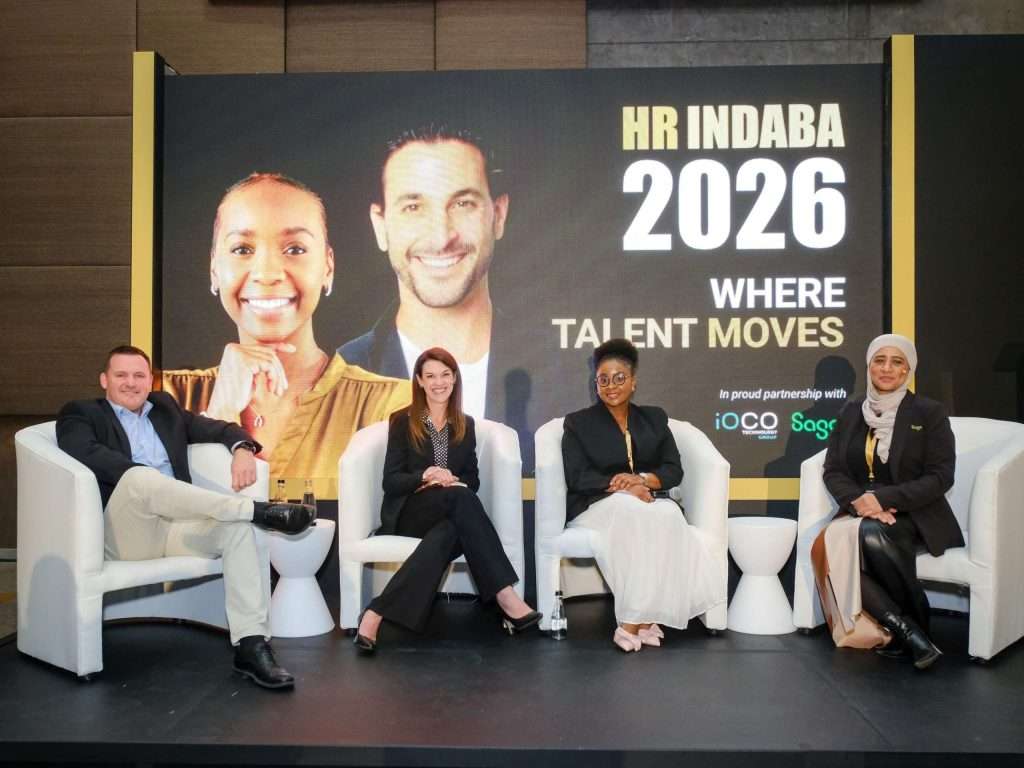
As AI changes how people work, organisations must decide how to embrace innovation without losing employee trust. Drawing insights from Sage’s latest HR and Payroll Leaders’ Report, a panel discussion at the 2026 HR Indaba explored how leaders can adopt AI responsibly, support employees through transformation, and create more connected experiences across HR and payroll.
Notwithstanding a challenging economic environment, HR and payroll leaders are overwhelmingly positive about the future, said Sakeena Adams, regional people director at Sage, citing the findings of Sage’s latest HR and Payroll Leaders Report. Sakeena was joined on the panel by Ronel Oosthuizen, digital services director at Sage, Lusanda Modise, people’s business partner at Sage, and Richard Wood, vice president for retention and renewals: AME, at Sage.
Sakeena shared findings from the global survey during a panel discussion titled People, Technology, and Trust: The Next Chapter for HR and Payroll at the 2026 HR Indaba held at the Sandton Convention Centre.
Outlining the outcome of the survey on South Africa, Sakeena said the survey found that 89 percent of respondents expected artificial intelligence to significantly change HR within five years, while 91 percent believed that HR would free up time for strategic, people-focused work. According to the survey findings, 82 percent of respondents conceded that they faced resources and capacity challenges, while 70 percent reported skills gaps that limited AI adoption.
Open communication critical when migrating to AI
Sakeena noted the importance of transparently communicating an organisation’s AI adoption roadmap with employment and creating open lines of communications where employee concerns and questions are addressed.
“One of the most important responsibilities is making sure that this transformation remains human,” Sakeena said. “That means involving employees, listening, communicating clearly and creating an environment where we can embrace change with confidence rather than fear.”
Ronel Oosthuizen, digital services director at Sage, echoed Richard’s sentiments and added that people do not generally resist the technology but fear the unknown. “They fear what will happen with the implementation of this technology in their lives, will it replace their jobs, will it substitute their skills, their experience, will they still be required and needed?”
She added that the future of HR is not just about technology but about the people. “Real transformation is only possible if people understand the purpose of change and feel supported by it,” she said.
Richard Wood, vice president for retentions and renewals at Sage, advised organisation taking the AI route to be unambiguous about the rationale behind this change. “Organisations need to be very clear about the purpose of this, who is likely going to be impacted, and what the organisations seeks to solve with the integration of AI into work processes. Once people understand where they fit in this, and that AI will not replace them but rather automate repetitive tasks and free up time to do more productive work, then they are more likely to buy into this transition,” said Richard.
Lusanda Modise, people business partner at Sage, said successful transformation is not about keeping everybody happy. It’s about ensuring that people are informed, connected, and heard, particularly when things are changing in an organisation. People need certainty and clarity about what is going on. Leaders have a responsibility to give people a certain level of comfort even when the leaders themselves don’t have all the answers,” said Lusanda.
It’s about humans after all
Ronel noted that discussions on AI focus a lot more on technology and neglect the human behavioural aspect which is key to the success or failure of new innovations. She said research has shown that between 90 to 95 percent of technology at implementation phase fail not because of the technology itself but because of human behaviour.
“In as much as we dedicate a lot of time on technology readiness, we should equally invest time on human behaviour readiness,” said Ronel.
Responding to lingering concerns about potential breaches to personal information that AI may pose, Ronel said the scourge of cyber risks necessitates organisations to adhere to stringent IT governance and protocols and conduct due diligence on the data tools they allow in their systems to insulate themselves against possible attacks and leaks.