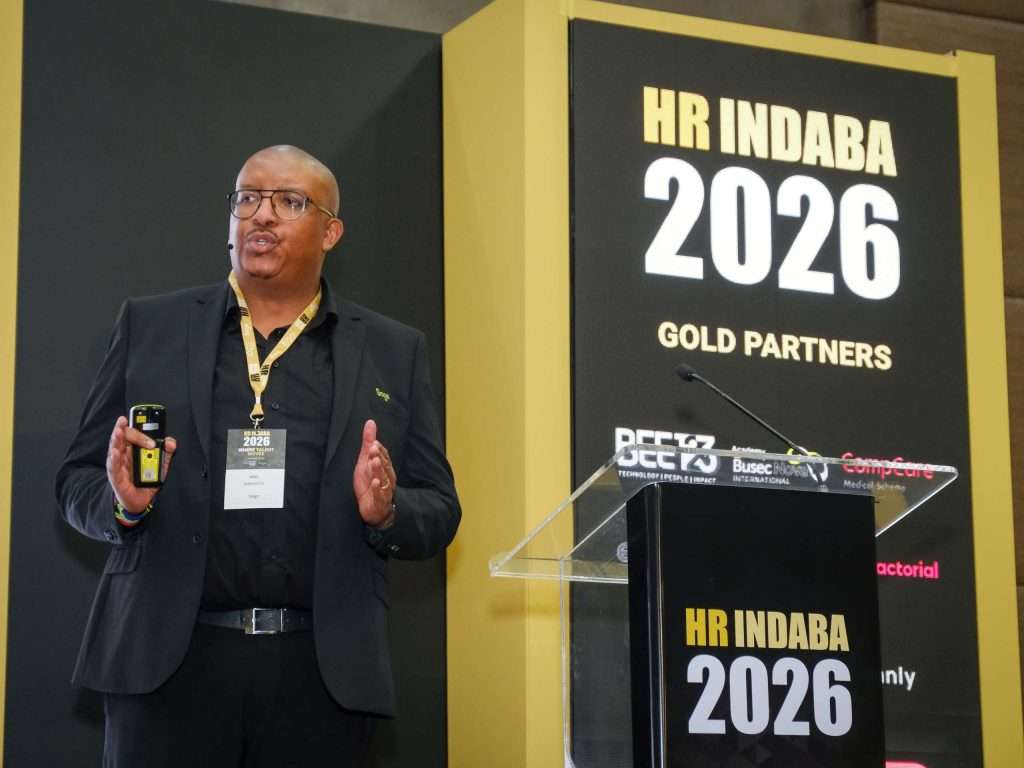
As HR leaders face growing workloads, expanding responsibilities and pressure to adopt AI, Abel Makgato, field sales manager for payroll and HR at Sage, urged organisations to prioritise trust, accuracy and simplicity when choosing technology at the 2026 HR Indaba.
Speaking during a session titled HR and payroll reimagined, Abel highlighted that the expectations placed on HR professionals have expanded, with strategic responsibilities piling on top of existing administrative demands.
“If people power a business, then HR and payroll power the people,” he said, emphasising the importance of giving HR and payroll teams reliable systems that simplify their work rather than add to its complexity
HR’s ever-growing to-do list
Yet, despite how critical these functions are, he explained how HR and payroll leaders are carrying more responsibility, pressure and expectations than ever before. To understand these challenges, he noted how Sage commissioned independent research surveying 1,800 HR and payroll leaders across the UK, Ireland and South Africa, representing businesses with between 20 and 2,500 employees.
“One of the strongest messages from the research is that the role of HR hasn’t just evolved, it’s expanded. Over 90 percent of the leaders told us that their role has changed dramatically over the last five years. Not because the admin disappeared, but because strategic responsibility arrived and stayed on top of it,” Abel said.
“HR is expected to be operationally flawless, deeply compliant, emotionally intelligent, people-centric, data-driven and strategically influential all at the same time. That’s a heavy load on its own,” he said.
Although the research found that HR and payroll leaders remain optimistic about their profession, he highlighted that many are also concerned about burnout, capacity and whether their roles will remain sustainable in the future.
“They care about the future of their profession. They believe in its impact. They genuinely want to do meaningful work. But at the same time, many told us that they feel anxious, burnt out, and not just because we’re drawing towards the end of the year. They are worried about capacity, how they will handle things if they don’t have the right systems, and they are unsure how sustainable their roles remain to be into the future,” he said.
These pressures raise an important question about the role technology should play in supporting HR. While digital systems are intended to make work easier, managing multiple platforms can create additional complexity for professionals already struggling with limited time and resources.
Abel put this to the audience directly, asking how many delegates felt overwhelmed by the number of HR and payroll systems they were expected to use, and how many felt frustrated by technology that added complexity.
One size doesn’t fit all
According to Abel, addressing this challenge means understanding what organisations actually need rather than prescribing a one-size-fits-all approach.
“We’re not here to dictate to you how things get done. My team and I work very closely in conjunction with our Sage-certified partners so our ecosystem is an indirect business model. What that entails is that we own the IP to the Sage software. It gets distributed through a software-as-a-service subscription model, and what then happens is that you’ve got our Sage-certified partners that then implement our solutions and become your first line of support,” he said.
He added that Sage also maintains its software from a legislative perspective, ensuring that its solutions can serve businesses with different operational requirements, from sole proprietors to multinational organisations operating across multiple countries and languages.
Abel said the research also highlighted the importance of understanding the different pressures facing businesses of different sizes.
“When we look specifically at South Africa, some things stand out very clearly. There is particularly a strong focus on payroll accuracy, legislative compliance, the trust element, and you’ll constantly hear me making mention of the trust element because that’s a very big element of why people choose the right systems,” he said.
“In South Africa, payroll isn’t just an operational process, and this doesn’t only just go to South Africa. It expands to the rest of Africa, the Middle East, and the rest of the world. It’s a trust function. If payroll is wrong, confidence erodes very quickly and we don’t want that to happen.”
Keeping payday on track
Abel mentioned that the confidence becomes especially important during demanding payroll periods.
“Confidence ties back, especially during tax year-end, mid-year submissions, preparations of IRPs when they want to breathe. Now, that's where Sage Payroll Advice comes in. When payroll works properly, HR gets breathing room to focus on people,” he said.
He explained that Sage Payroll Advice is designed to simplify payroll for growing businesses through a cloud-based solution that can be accessed through a web browser on different devices.
“It’s a web browser-based solution, no flows, no fuses. You can then access it from any mobile device, in essence, through your laptop, desktop, you name it.”
“It helps ensure seamless tax compliance throughout the entire year. It brings HR capabilities together with payroll under one roof, so admin doesn’t expand as the business grows. Put simply, it reduces risk, it restores confidence and it gives HR leaders time back to focus on people and not paperwork.”
Beyond the technology itself, Abel returned to the wider purpose of HR and payroll.
“When HR teams are consumed by many of the processes, payroll risk and administrative pressure, even the best intentions become hard to deliver consistently. That's why accuracy, reliability and confidence in payroll and HR systems matters so much, especially in South Africa. When that support is in place, HR doesn’t just keep the business running. It helps the business grow sustainably, confidently and with a human touch.”