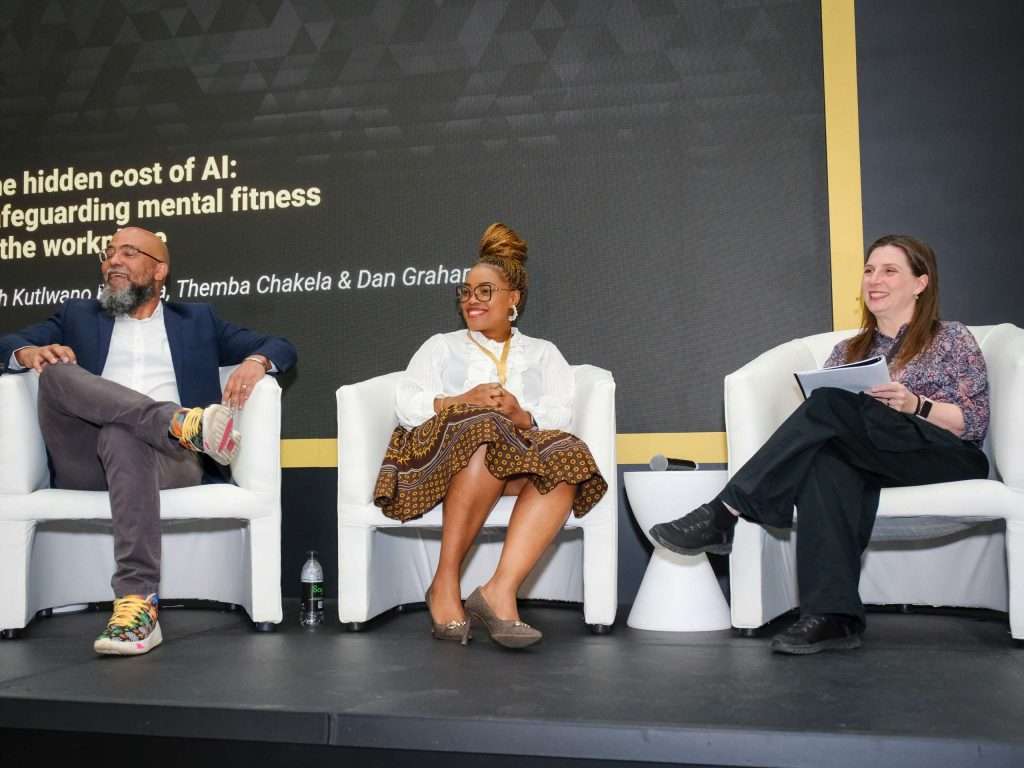
As organisations race to adopt AI, HR leaders must ensure that the pursuit of efficiency does not come at the expense of employee wellbeing, trust and workplace culture. This was explored in-depth by Kutlwano Rawana, group HR executive at the Mustek Group, and Themba Chakela, head of people, culture and change at e-Motion Consulting.
During the session titled The hidden cost of AI: Safeguarding mental fitness in the workplace at the fully packed 2026 HR Indaba, Kultwano and Themba challenged organisations to look beyond what AI can automate and consider how it changes employees’ workloads, responsibilities and experiences at work.
The discussion opened with an example of a business that had moved aggressively to embed AI across its operations in pursuit of greater efficiency. Instead of delivering only the intended benefits, the implementation contributed to pressure, anxiety, stress and talent loss, forcing the organisation to rebuild its culture and restore the human element of leadership.
More AI, more anxiety?
As Kutlwano Rawana, group HR executive at the Mustek Group put it, this illustrates a common mistake businesses make when introducing new technology. “I think the mistake or oversight that most business leaders make is assuming that if implementing AI improves quality, or even simply enables people to do more, that is automatically a good thing. When you implement AI in a business, you have to recognise that it is there for human augmentation, not necessarily for people to do more. I always say that AI is there for our people to do better, not more,” she said.
She explained that without careful implementation and support, the technology can increase pressure on employees instead of making their jobs more manageable.
“AI shouldn’t be implemented with the assumption that everyone could work like 10 people without realising that it is actually there to help one person add more value by producing higher-quality work more efficiently.”
“We need to be mindful that when we implement AI, we do so alongside enabling our environment and our people to use it efficiently. Careless implementation of AI can disrupt the business culture. You can find that employees have been given so much more work that they end up feeling stressed and anxious, and they fall apart. The culture itself then loses the human element of leadership.”
AI needs an introduction
While technology can change how work gets done, Themba Chakela, head of people, culture and change at e-Motion Consulting argued that organisations must pay equal attention to how they introduce those changes to employees. Simply placing a new tool in people’s hands without explaining its purpose or implications can create uncertainty and fear.
“If we just stick to introducing it properly, that’s where leadership comes in. I always talk about leadership being difficult, hard and well-paying, but leadership’s job is to create clarity. The kindest thing a leadership team can do is create clarity.”
He compared the process to explaining a decision to his 14-year-old child, who wants to understand both the reason behind it and how it will affect him.
“It’s a bit like raising my 14-year-old. When we introduce something new, his first question is why we’re doing it. Once I explain, he wants to know what it means for him. I have to explain that, too, before he decides whether to adopt it. It’s the same with AI.”
Themba cautioned that organisations risk contradicting their own values when they promote themselves as people-first employers but introduce technology without considering its impact on their workforce.
“You say our people are our biggest asset or that we’re a people-first company, yet you have an AI-only policy. You need to create clarity for your business around how you’re going to use this tool. AI is just the next calculator, printer or fax machine in the story of technology. It should make jobs better, strengthen teams and help achieve the strategic objectives that allow the business to continue operating into the foreseeable future. That’s what business is about.”
The hours AI shouldn’t steal
While AI can reduce the time spent on repetitive tasks, Themba questioned whether organisations have given enough thought to what happens to the hours employees gain.
He warned that efficiency gains should not automatically translate into longer workloads or more pressure to deliver additional output.
“The hours saved through AI should not simply become additional working hours but should be redirected towards more purposeful work.”
Kutlwano similarly argued that the time recovered through AI should give businesses an opportunity to reflect on performance, reassess priorities and identify areas for improvement, rather than simply increasing the volume of work expected from employees.
She reiterated that the focus should remain on improving the quality of work and enabling teams to contribute more effectively.
“As leaders, we need to fully understand what it means and how we can enable our environment through AI. I must still engage from a cultural point of view and ensure that my environment has the right wellness tools to support the transition. People shouldn’t feel that they’ve been given a tool and are now expected to do more, without any leadership guidance or support,” added Kutlwano.