
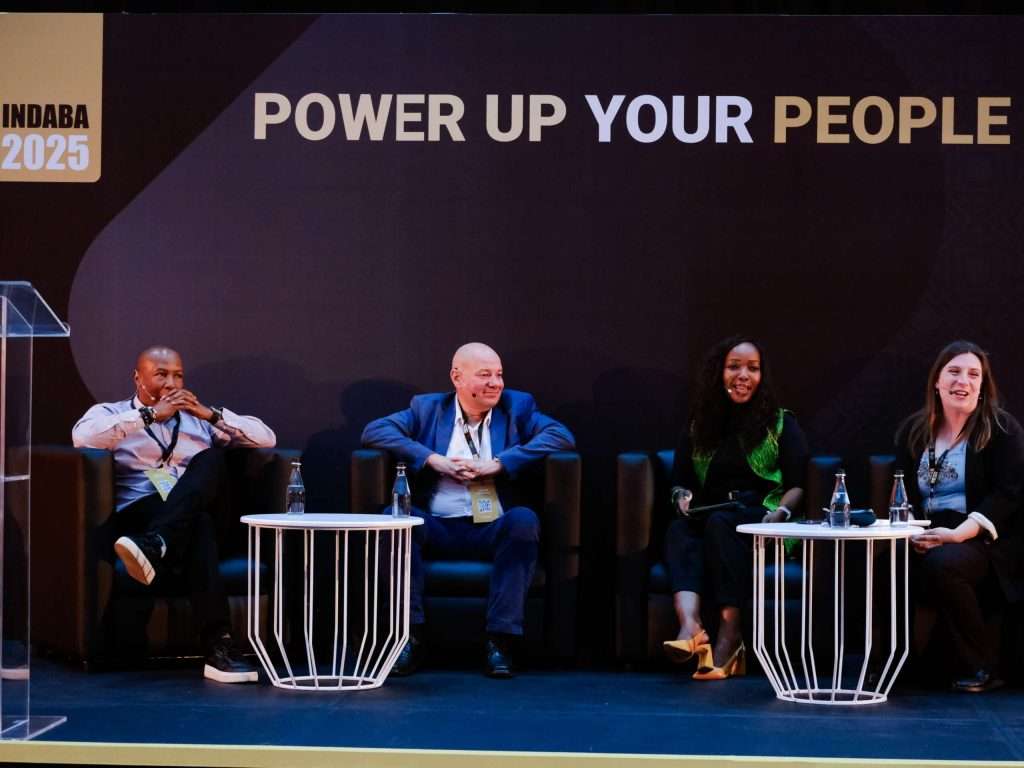
HR leaders shared what they must do now in preparation for the next decade at the 2025 HR Indaba, as the world of work is transforming fast – and artificial intelligence, automation and shifting employee expectations are redefining what it means to work, lead and belong.
During the 2025 HR Indaba masterclass titled Preparing for the Workplace of 2030, Nomaswazi Ngwane, OM Bank’s chief people experience officer, Steve Teasdale, Discovery Limited’s chief people experience officer, and Tswelo Kodisang FirstRand Limited’s group chief people officer shared what HR leaders must do now in preparation for the decade ahead.
They all advised the audience to stay curious, embrace discomfort and lead ethically, and be adaptable.
For Nomaswazi, the biggest threat to HR professionals is complacency, she said for HR a shift means rethinking career architecture, job evaluation, performance measurement, talent management and even career pathways.
Adapting processes to support flexible, portfolio-driven work is critical. She said there’s a shift in how work is structured, moving away from traditional, linear career paths towards more portfolio-based work.
“Many of us have spent years on rigid career tracks, with our ‘school cards’ full of roles and titles but at the end of the year, it often doesn’t translate into meaningful experiences,” she added.
“What we’re observing now is a world where work is defined less by a single job or career path and more by the experiences we want to have. Imagine a day where you could work for multiple companies or projects, all in one day. That scenario is starting to emerge, even internally within organisations.”
Nomaswazi noted that the future of work will likely be more project- and portfolio-based, rather than role-based.
“Take OM Bank as an example, a new bank that allows employees to engage in a variety of projects. You might start as a strategy expert but then take on different pieces of work across the business,” she said. “While we’re beginning to integrate this thinking into traditional structures like IGPs, it’s clear this approach is gaining momentum and will likely define work in the coming years.”
Unsettling comfort to lead ethically
Tswelo highlighted that the biggest disruptions are not only technological but moral and cultural.
"AI forces us to face questions of fairness, bias and accountability. Curious leaders are best positioned to address risks early and act responsibly."
He said at FirstRand, HR is implementing control structures that bring together data analysis and human judgement to ensure fairness in machine decision-making.
Tswelo underscored curiosity as learning technology as well as questioning every day whether innovations serve people, not just performance.
He also added that by 2030, HR will no longer simply run people processes, it will build robust, high-performing systems. The workplace will not be defined by tech, but by how individuals develop, learn and lead with integrity.
“I’d like to dispel the notion of jobs being at risk, because it’s fearmongering. If one looks at the evolution of life, there have always been jobs that were created and others that became obsolete. It’s simply the natural evolution of life and living,” Tswelo noted.
“Secondly, I don’t necessarily see AI taking whole jobs away. I actually see it as people needing to develop fluency in artificial intelligence and digital platforms. This will increase their capacity to do more and to do things differently, rather than assuming the machine takes over and people simply disappear.”
Reskilling before roles become obsolete
Steve echoed this mindset, declaring that reskilling is no longer an option, it’s survival. “We can’t wait for jobs to become outdated to act. Learning has to be ongoing."
Steve emphasised that inside Discovery, employees are encouraged to acquire new skills on a daily basis through digital tools, internal academies and worker-to-worker learning clusters.
He said this mindset drives performance and builds retention, he also urged HR leaders to embrace discomfort as a form of growth.
"People stay where they can develop. The more space we give to learning, the more robust our organisations become,” Steve argued. “If you’re too comfortable, you’re not evolving. The best HR leaders constantly challenge their own thinking.”
HR leaders who embody curiosity, continuous learning, ethics-driven vision, and human-centric design will build workplaces that thrive with AI, automation, and transformation.