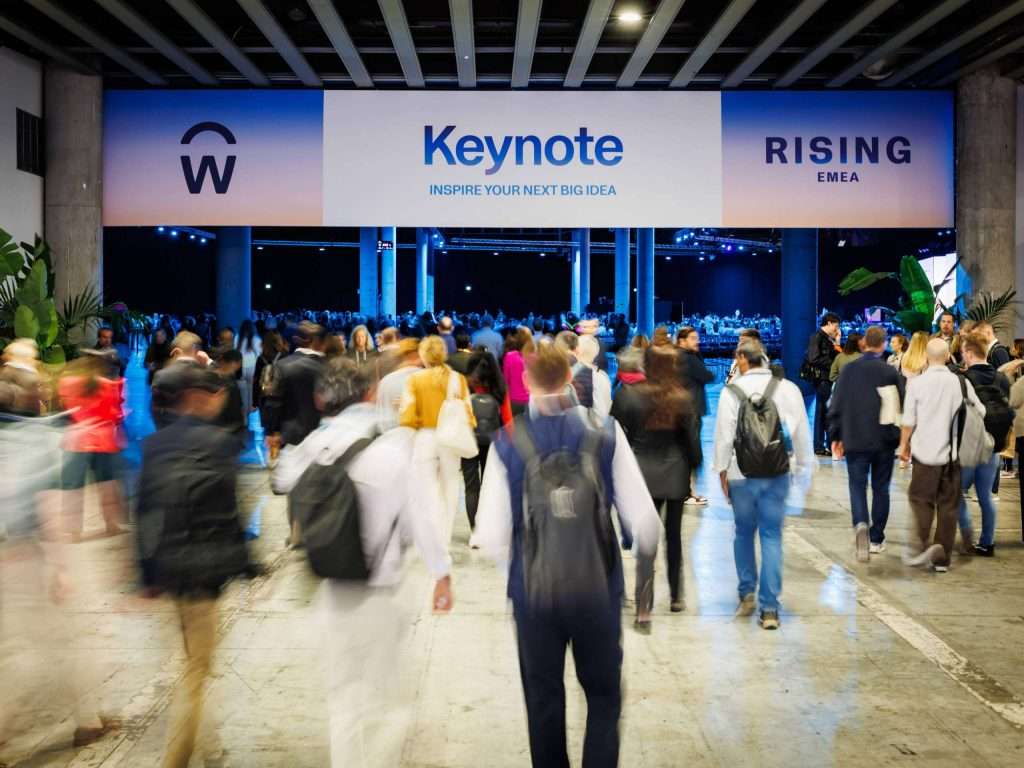
AI may be the talk of the town across industries, but Workday Rising EMEA set out to show what it looks like in practice and how it can make a tangible difference in the workplace across HR, finance, and IT, to create a new Workday indeed.
Held in Barcelona, the event’s opening keynote brought that vision to life with the unveiling of nine innovations demonstrating how AI can change and improve the way HR, finance and IT get things done, from finding new ways to match people with opportunities to taking the legwork out of everyday tasks and making business decisions with greater speed and confidence.
Angelique de Vries-Schipperijn, president of EMEA at Workday, opened by introducing the theme of the event and the importance of preparing employees for the changes ahead.
“At the centre of this week is one key theme, a new Workday. It’s about making AI innovation real and simplifying how work gets done. We know employees recognise the need to develop AI skills to succeed, but fewer believe their employers are helping them build those skills. I think that’s the opportunity we have this week to focus on developing those skills, helping people grow and turning that opportunity into reality,” said Angelique.
The intelligence to stay ahead
For Workday CEO and co-founder Aneel Bhusri, the opportunity is part of a much bigger technological shift. Reflecting on the company's 20-year journey, he spoke about the principles that have guided its growth and its ambition to lead through successive generations of technology.
“When we started the company, we spoke a lot about what makes a great company. It’s a company built around culture. It’s focused on its customers. You build great products and innovate. Most importantly, great companies stand the test of time. They lead not in just one technology, but across multiple generations of technology,” he said.
“I think of Workday as a pioneer in the cloud. We started out in the cloud and led our spaces in HR, finance and IT. Now we have the opportunity to do the same thing in AI and make the transition from being a provider and leader in the cloud to doing the same in AI. AI is probably the most important technology of our lifetimes. It will certainly be one of the most important, and it’s a massive opportunity for all of us in this room, including Workday,” he added.
However, he noted that innovation alone is not enough, and believes that trust remains essential to whether organisations can use AI effectively. “AI that isn't trustworthy isn't useful,” said Aneel.
The conversation on how AI can make a practical difference for employees and organisations came through in a demonstration by Alet Blanken, vice-president of AI engineering at Workday.
She showed how Work Intelligence could help workforce planning leaders understand the work happening across their organisations, identify where automation could add value and prepare employees for changing roles.
“For workforce planning leaders, knowing the right next step is often difficult. Today, it means late nights poring over spreadsheets or even bringing in a very expensive consulting firm. But none of these approaches tells you where automation can really make a difference," she said.
A little AI goes a long way
She demonstrated how the tool breaks work down into the tasks people perform, allowing leaders to categorise them as automatable, augmentable or human-led. “This gives them a clearer view of which roles could change first and where teams could reclaim time. This used to take months, even years. Now it takes seconds,” Alet said.
Using the example of a security engineer, she demonstrated how Work Intelligence could identify possible career paths for employees based on the skills they already have.
“When roles change, you’ll ready. You’ll know where your people can move, how closely their skills match and how to set them up for success,” she said.
Alet explained how the tool also helps leaders assess the financial value of automation by comparing the cost of automating tasks with the cost of completing them manually, and can estimate the hours freed up and how quickly employees could get up to speed in new roles.
“It's no longer just headcount planning. This is work planning,” she said.
From planning how work gets done to making everyday employee experiences easier, Joel Hellermark, chief AI officer at Workday, demonstrated how an AI agentic experience and operating system called Sana Concierge is being integrated into the platform.
He demonstrated his own onboarding experience, showing how the system had prepared for his arrival before his first day.
“With Sana now at the heart of Workday, my onboarding has literally built itself before day one. It has already scheduled all the right training sessions for me. Sana has also scheduled meetings with my colleagues, the people I'll be working most closely with, as well as all my direct reports. It's also granted me access to all the systems I need to do my job," shared Joel.
Joel credited how quickly the technology worked, remarking, “This feels quite magical.”
He further explained that traditional onboarding often involves multiple tasks across different systems, with requests turned into tickets that employees then have to wait for someone to resolve.
Sana Concierge changes that process by understanding an employee's request, applying company policy and coordinating across systems, bringing in a person only when necessary.
Getting HR and finance to add up
He demonstrated this by requesting access to Claude. Rather than simply raising a ticket, Sana handled the request and made access available with a single click.
The demonstration also showed how the same intelligence could support decisions across HR and finance.
Yasmeen Ahmad, senior vice-president and general manager of Data Cloud at Workday, demonstrated how Decision Intelligence brings workforce and financial information together to help leaders understand the impact of their plans on business performance.
“As we switch over to the CFO world, it's the same decision intelligence, using the same data across HR and finance,” stated Yasmeen.
Yasmeen used a scenario in which HR had identified employees with the skills to fill certain roles internally. The question was whether those internal moves could help the business move faster and increase its revenue potential.
“Finance alone cannot answer this question because the inputs aren't limited to cost data. We need HR’s insight into our actual people and their skills, as well as demand data from Salesforce. Decision Intelligence brings all of this together, factoring in time-to-start, ramp-up time by role and retention, to give us an answer," she noted.
The demonstration drew on skills and career interests from HCM, employee feedback from Peakon, actual costs from Financial Management and demand data from Salesforce.
She explained that bringing these sources together would usually take six weeks, five spreadsheets and an analyst manually connecting the information. This time, it took one question.
The system then presented a proposed plan for approval, including 42 hires, nine internal moves and an increased revenue target. Once confirmed, the plan was written back into the system, with the approval trail visible.
“We didn’t just understand the data. We analysed it, made a decision and wrote that decision back to the system of record, with every security protocol and approval workflow intact. One record, one decision, a country fully funded. That’s HR and finance finally in sync.”
The broader thinking behind this approach was outlined by Gerrit Kazmaier, president of product and technology at Workday. He said organisations needed to consider how their entire business could grow, rather than focusing only on individual growth.
“When a company is scaling quickly, there are a few things we need to figure out. HR needs to know whether the business has the people and skills to support that growth. Finance needs to know whether the plan is affordable, and where and how potential trade-offs can be made,” he said.
“This capability gives HR, finance and even IT teams one place to work through complex decisions, examine workforce and financial data independently or together, and use AI to support their analysis,” Gerrit said.
He believes the real opportunity lies in how organisations apply AI, rather than how much of it they use. As he put it, “Real AI transformation is about driving real growth, faster, better, more, and new. The winners are going to be the ones who apply it the best.”