
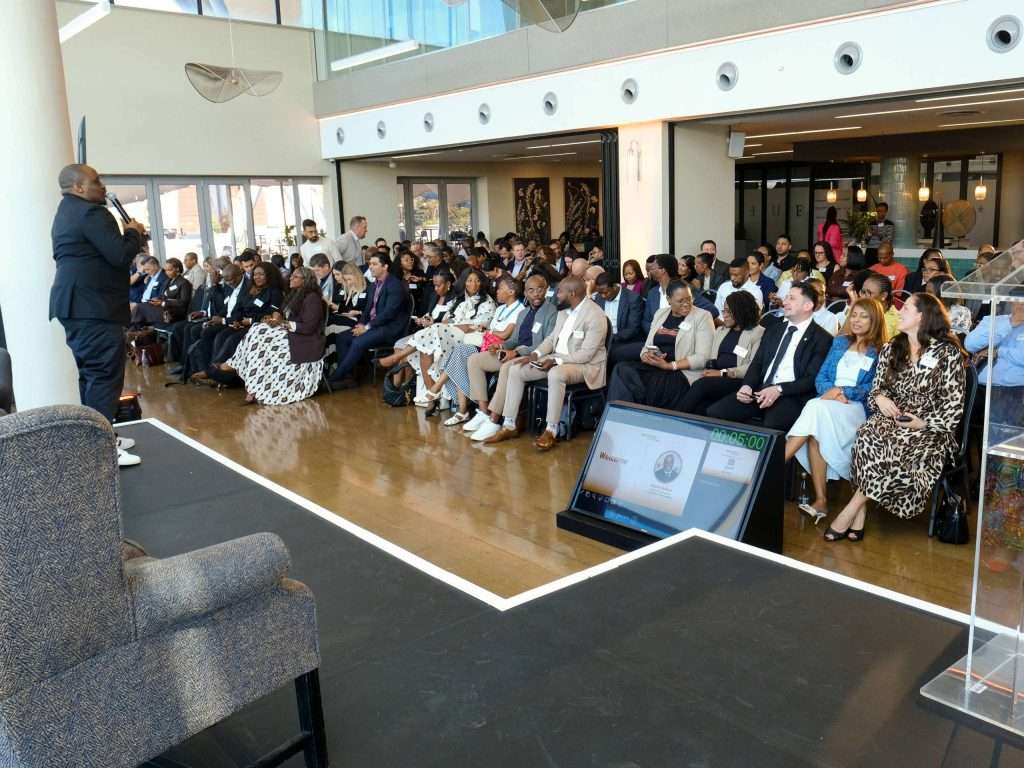
The 2026 Executive Day did not waste time getting executives comfortable. On 3 September, CHROs, CFOs and CIOs were thrown straight into conversations with people they may never otherwise have met, networking in true Executive Community style before diving into the bigger questions shaping leadership, technology and the future of work.
The speed networking session gave executives a chance to swap experiences, compare challenges and, perhaps most importantly, speak candidly with people outside their usual circles.
It was a fitting start to a day that would repeatedly challenge executives to step outside their usual thinking.
The AI reality check
That was brought sharply into focus during the event’s first panel, Bubbling Blindspots: What’s missing from the conversation on AI adoption?, where Thabile Makgala, executive vice president of people, SHE, risk & corporate affairs at Sasol, and Ravi Bhat, AI officer at Microsoft, unpacked the gaps between adopting AI and actually adapting the way organisations work.
“I think one of the things we are not getting right with AI and we will still get there, is that we are treating it as a technology programme instead of recognising it as a fundamental organisational model. We are so consumed with deploying the tool rather than thinking about how we are redesigning the way we work and whether we are actually redesigning the way we work,” said Thabile.
“When you think about AI, it has less to do with the technology and is actually more about the behaviour, leadership and culture of an organisation. If you look at all the revolutions that have happened, they have been successful because we have not only adopted the technology, but fundamentally adapted the way we work. I think the organisations that will win and succeed are the ones that not only adopt AI, but adapt to it and redefine their policies and ways of working,” Thabile added.
That conversation moved naturally into the CEO's office for a panel discussion where Paul Norman, group CHRO at MTN, and Celiwe Ross, group chief human capital and corporate affairs officer at Old Mutual, put the CEO-CHRO relationship under the executive microscope, unpacking the green and red flags.
“I believe CHROs matter much more overall. Ours is the only job that performance-manages both sides. I don't think any other role in business does that. We have to motivate them for increased labour, their performance and their feedback, while also holding them accountable,” stated Celiwe during the session.
C-suite chemistry
Meanwhile, Paul highlighted one of the clearest green flags of a CEO. “The green flag would be the CEO who walks in and can admit that they don’t have all the answers, that there are things that they can work through together, but also one where the intelligence of the organisation, of the Exco, is actually lifted,” he said.
Following a morning of thought-provoking panel discussions, executives then broke away into smaller groups for the deep dive conversations on unlocking integrated intelligence, where the big leadership questions of the day were brought into much more intimate conversations.
In one room, Vinolia Singh, people and culture director at Coca-Cola Beverages, joined Dr Denisha Jairam-Owthar, group CIO at the Council for Medical Schemes, and Rebecca Pole, VP for finance at NTT Data, unpacked the purpose and pertinence of board servitude.
During the session, Vinolia shared, “What is very critical is that culture is a big thing, and purpose is a big thing. When you’re looking at executive teams, these are also critical when you’re looking for board members. They need to come with the purpose of serving the organisation’s purpose and culture. A lot of the friction starts there, where you don’t have a culture fit with board members.”
In another breakaway room exploring change fatigue and moving fast without breaking trust, Steven Teasdale, chief people experience officer at Discovery, Norbit Williams, general manager: group IT at Eskom, and El Kope, CFO at Cell C, examined what happens when organisations move faster than their people can sustainably absorb.
“The biggest mistake we make with middle managers is taking incredibly effective operational people and assuming they can manage. We don't change their role enough, and two things happen: we lose some of the best operational people, and we de-energise their teams because they become victims of management incompetence,” stated Steven during the session.
Another breakaway asked executives to examine what happens when expectations are unclear. Titled The friction audit: Tackling tension with tact and intention, the session brought together Inette Swart, VP of people at AB InBev, Phila Ndarana, CTO at Auditor-General of South Africa, and Pulana Ngwasheng, CIO at Zeda.
“If I reflect back on all the years of leading different teams, small teams and dynamic teams, it always comes down to intentionality. If you’re intentional about showing what your vision and purpose are, and that is communicated across the organisation, it also becomes clearer. You cannot expect people to deliver if they do not know what is expected of them,” shared Inette.
Under the surface
In another breakaway, Nolo Thobejane, chief people, culture and purpose at YUM Africa, Lauren Odell, CFO at Eqstra, and Dr Stanley Mpofu, CIO at the University of the Witwatersrand, challenged leaders to examine the gap between what organisations say they want and what their systems actually encourage.
“I tweaked in the middle and looked at what we’re doing from my organisation’s point of view and what we want to achieve. We know that the environment is constantly changing, that there is uncertainty and ambiguity, and we want leaders who can handle that, build trust and get people to follow them. But then we still operate or develop people as if they can only operate in the environment that we know now.”
After the intensity of the breakaway conversations, executives got the chance to tackle one of the day's biggest topics in a decidedly less conventional way. Bullshxt Bingo: Separating AI myths and hype from its real impact on the future of work, led by Bronwyn Williams, futurist, economist and business trends analyst, and Sharon Pearce, Business transformation specialist & disruptor, turned AI scepticism, predictions and hype into an interactive session of bingo.
The lighter format did not make the subject any less serious. If anything, it reinforced that executives need to become better at distinguishing genuine transformation from noise.
The first 150 attendees to arrive also received signed copies of Survive the AI Apocalypse by Bronwyn and Sharon, giving them something tangible to take away from the conversation.
But after a day dominated by insightful insights, the final session titled Human too: Leading while navigating personal challenges, featuring Jacques Rikhotso, CEO at Bridgestone, and Jonathan Muthige, CEO for growth markets at Alexander Forbes, closed the day with a reminder that behind every executive title is a human being, navigating their own challenges while carrying the responsibility of leading others.
Click here to see visuals from the day and get a glimpse of the elegant setting, engaging conversations, and memorable moments.
The day was made possible by Principal Partners, Cassava Technologies, Entelect, iOCO, MakwaIT, Old Mutual South Africa Corporate, Regenesys Corporate Education, and Executive Partners, BDO South Africa, Discovery Limited, Deel Local Payroll, powered by PaySpace, HCLTech, Hyland, ITR Technology, Jem, Kaspersky, LRMG, Marsh, Ninety One, STANLIB Asset Management, Wits Plus and Workday.