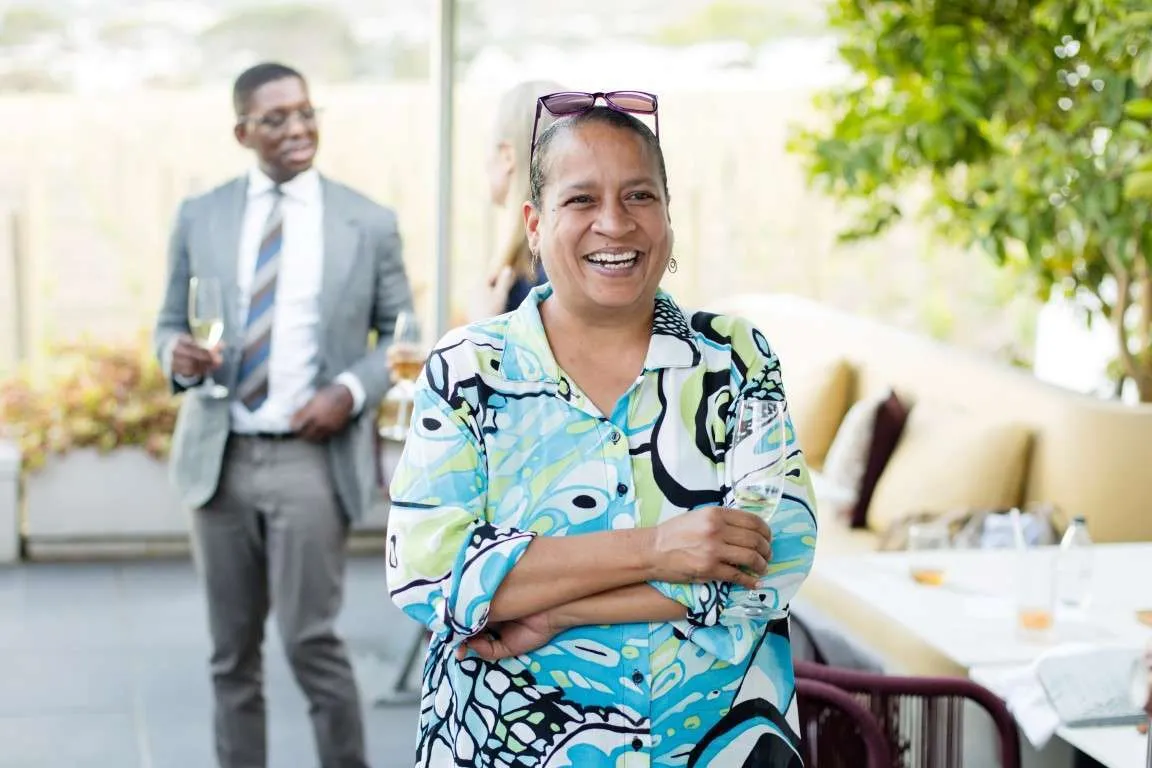
Khabonina Ramoupi, group chief people officer at AECI, is shaking up the culture at the company and managing change in a business that has been around for 100 years.
“We are one AECI because AECI is an amalgamation of companies. We are one now, let’s forget where we came from – and I think that’s why the focus for our strategy is on our culture,” says Khabonina Ramoupi, group chief people officer at AECI on changing the company’s way of doing things, at a company that has been around for a century.
“It’s a culture that has been there for quite a long time, so it’s embedded,” adds Khabonina, who has more than 30 years of experience in the HR industry, 15 of which were at executive level. Many people, she adds, have been at the company for more than 10 years, while some have been in the trenches for 40 years.
The culture work has been given a two-year time frame, “because you want to take people with you. And you would be taking steps forward and steps back,” she says. The changes will be cascading ones, starting at the top with a new exco. And as a new exco, she adds: “We need to understand each other’s rhythm, create our own rhythm as that new team.”
Her approach is one of collaboration and inclusion. “There is a lot of co-creation. HR people, for example, were given a blue sky scenario, and that process made people feel involved. From a change management point of view, it’s part of getting people to buy in. This is their strategy, this is what they want.”
Creating the next 100 years
AECI previously worked with a decentralised operating model. “Now we are centralising in a bid to chase our global ambition, which is to be number three in the world.” The board will certainly have a say in which direction the company will head on a global scale, but the challenge lies in getting everyone on board. “You then need to explain to people, what does this centralisation mean to me every day, to my autonomy?”
She believes that if people sit back and simply go with the process, they will understand their organisation better. “I believe our people have the solutions: where we are stuck is doing things as they always have been done,” she explains.
The story AECI is trying to deliver is: “If we don’t change, then we die. And now is the chance for us to create the next 100 years,” she says. “Isn’t that a nice legacy, to say I was part of it, I crafted, I co-created where this company’s going?”
Khabonina , who has a BA, a postgraduate qualification in industrial relations and various leadership development programmes under her belt, cut her teeth at Ster-Kinekor as a training officer many moons ago. But her first real foray into HR was at Coopers & Lybrandt as an HR officer, and later at KPMG as a consultant, as well as Omnia and more.
A brief stint in the public sector proved to be a steep learning curve, dealing with multiple stakeholders and building relationships with unions.
“I’m that loyal dedicated citizen, and I thought at a certain age I must go and serve. For me working for the public sector is serving – that is when Transnet happened.” She stayed at Transnet for two years.
She credits a willingness to learn and a can-do attitude as instrumental in her journey. “I was a go-getter; if I hear something, I’ll go get a book, I will read that book, and I will do it. I would seek out people who know and want to be close to them.”
All about teamwork
She warns against stagnating. “It is a willingness to learn,” she says. “If there are new things happening out there, you must co-create, you must work with the young ones who are coming in and looking at things differently. That generation is looking at the why. Why are you doing this? You can learn from that, and they can learn from us. We can hold each other’s hands and still move into the future.”
She is also a firm believer in reflection. “Every day is a new day, is a new me. What have I learnt? Can you imagine if days were the same? It’s boredom, right there.”
One of the other challenges she faces while change-managing the culture at AECI is the older generation of employees who feel undervalued and left out in the cold.
“There are some people who like and cherish showing their expertise, and you can see the older generation feeling they have been forgotten about. When you acknowledge them, then they come out of their shells.” She urges using the institutional knowledge that exists, and sharing it with those who do not, but she also notes that while institutional knowledge is important, one does not want people to take 10 years to learn it.
She reiterates the importance of teamwork. “If you want to go somewhere alone, it’s not nice – there’s no weakness, there’s no one who is egging you on, so alone is never always the best, it is not as fulfilling. We are social beings: God made us to be social beings. Teamwork is the work right now. We are better together, and we have seen that, because with the strategy that we’ve got you can’t do it as individual beings.
“Be that NASA janitor: yes, I am sweeping the floor, but if I don’t, it becomes dirty, and people get sick. We landed that thing on the moon, but I was part of it, I was there. It’s that effect that you want – obviously you will not win them all, but you start with your 20 percent and you will get there slowly but surely.”
When not at the office, Khabonina is a mom of four boys, two in varsity, one in matric, and one in grade 10. Watching their transformation into men has been another rewarding journey for her. A devout Christian, she loves gyming and walking. “Those are the times I can think,” she says. Reading is another passion – and playing board games with the family. And by all accounts, these can get quite heated.
She also credits her parents with giving her the tools to fly. “I had a can-do attitude early. I would never say no. I always say my attitude is my altitude – it informs how high I can go. And I am here because of that.”
As for her future ambitions, she has this to say: “I want to put people on boards, I want to work at the UN, I want to touch more people. So boards, UN, here I come.”