
At last week’s Humane Capital Summit, CHROs had the chance to brainstorm solutions for recurring challenges faced in their different industries.
By Kgaogelo Letsebe
Managing high-performers who burn out, retaining critical skills and talent, being agile amidst the economic crisis and cultivating a positive culture and environment: these are some of the top issues that leading HR professionals are battling to deal with.
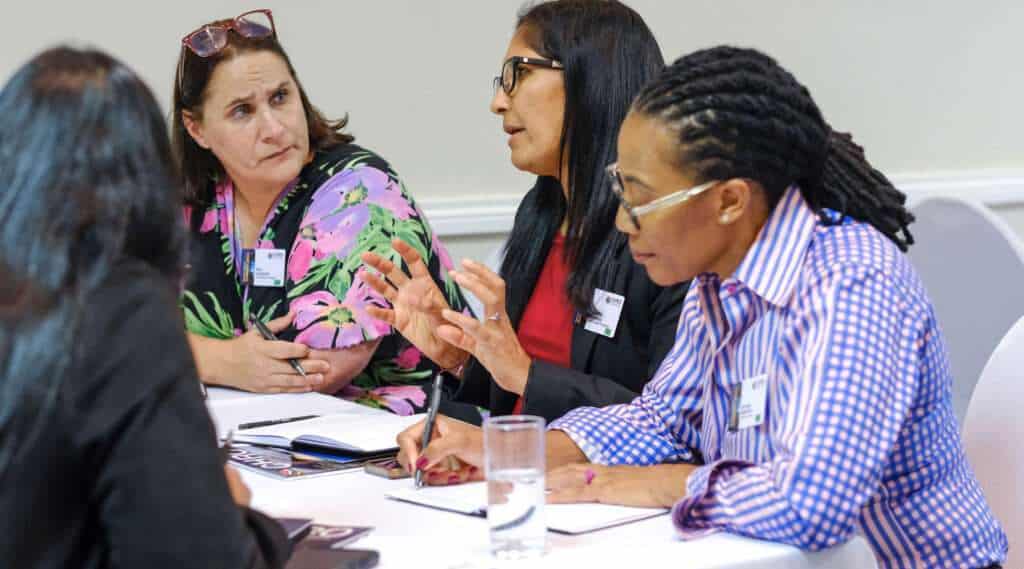
This was revealed during the CHRO South Africa Humane Capital Summit, which took place on 23 February in Johannesburg, when top HR professionals took part in boardroom brainstorm sessions where they were faced with coming up with practical solutions for some of the human capital challenges they face on a daily basis.
When asked how they dealt with managers who are prejudiced against people in their team because they are different to them, Great Well founding CEO Tantaswa Fubu suggested that perhaps leaders have to learn to lead with compassion.
“Leading with compassion, loving the people that you are working with. If you treat your people compassionately, you also change the culture of the organisation and leadership fundamentally to being a compassionate culture,” she said.
“There are benefits to compassionate leadership. Firstly, when people are well and happier in the environment, absenteeism decreases, productivity is higher and of course, more money is made – bottom line issues," she added.
Blue Sky CPO Themba Chakela said over and above compassion, leaders who stray off the organisational value and culture path need to be held accountable and led back to it, “We need to not tolerate the behaviours that are counter-cultural and counter-’people’ You need to quickly and visibly call out lapses and meaningfully address them.”
Data-driven solutions
Chief people officer at Adcorp Group Vinolia Singh said, “Leadership accountability is key. With great accountability comes responsibility. As senior management, they are responsible for efficiency in the company. So we report on a frequent basis on key HR metrics. Data usually shows the consequences of our decisions and actions as leaders in an organisation.”
Brigitte Padayachee, human resources director at Oneplan Insurance, noted that honesty and transparency is a viable solution. “We can no longer be the rescuers and must have the courage to sit down with an executive and highlight that at some point he or she will become irrelevant in the organisation and that is a reality. Roles are always transforming and so should the person responsible for that role.”
Retaining critical skills and talent was highlighted as a key challenge for attendees, with many agreeing that better-structured exit interviews were needed.
Themba gave an example of how to deal with what he termed the churn-challenge.
“There is a trust deficit when it comes to employee exit interviews across the board. Early on in our business, we were missing a key data point by not having structured exit conversations. Before structuring the conversation we first identified someone who the entire company trusts to conduct the interviews,” he said.
“The impact of having a safe, structured and open conversation resulted in people being more relaxed, trusting and honest. This directly led to better data quality and actionable intelligence. Furthermore, we encourage managers to give consistent and documented feedback on the check-ins they have with their teams. These are intentionally framed in the positive and double up as ‘stay’ conversations,” he added.
This, according to Themba, enabled the company to gather data on employee engagement and experience allowing them to proactively circumvent potential resignations.
Curbing burnout
Employee burnout, particularly from high-performers, was another challenge that was discussed.
Felicity Ramiah, HR manager at Rand Refinery Limited, explained that the difficulty was translating the importance of employee wellness to senior management.
Felicity said she struggled to unpack that wellness is not just the physical vitality checklist such as blood pressure, weight, height and BMI. Now, more than ever, it includes mental and emotional wellness.
“In our instance, the board has a different view from the discussions of what employee wellness is. The programme is handled by the safety, health, environment and quality department (SHEQ) and it is not necessarily geared towards solving psychosocial wellness. I’m of the view that vitality checks and mental wellness is integrated,” she said.
A group solution, in this case, was that the data collected via the SHEQ programme could be used to influence decisions regarding psychosocial wellness.
“It is not either/or but instead it can be both. If you have blood pressure data from a specific department that shows that these guys are well-stressed – that’s true data that can be used to understand the actionable intelligence. Targeted-based data intervention will be more viable,” Themba added.