
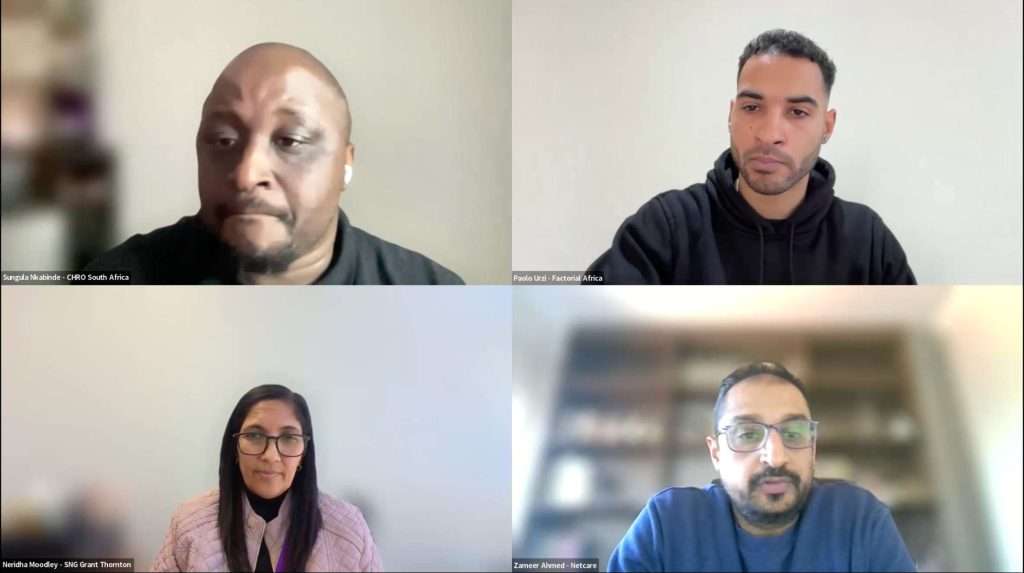
A recent webinar, hosted in partnership with Factorial, brought together Neridha Moodley, people and culture lead at SNG Grant Thornton; Zameer Ahmed, head of HR digital transformation at Netcare; and Paolo Urzi, partnership development manager at Factorial, to unpack what responsible AI adoption looks like in practice, and how HR leaders can harness technology without losing sight of the people at the heart of the function.
As AI moves deeper into recruitment, employee wellness, payroll, performance and everyday HR administration, the conversation is shifting from whether organisations should adopt it to how they can do so without sacrificing human judgement, trust and the employee experience.
According to Neridha Moodley, people and culture lead at SNG Grant Thornton, the starting point for digital transformation was not the technology itself, but identifying where it could make the greatest difference across the employee lifecycle.
“What we did as a starting point was we looked at our entire value chain for human resources and we identified areas where we could easily automate and areas that would be value adding points for the organisation,” she said.
One of the first areas identified was payroll and leave. The organisation had been dealing with a manual process and found an opportunity to introduce a system that could allow employees to manage leave through WhatsApp.
“This was really phenomenal for the organisation because it took away the manual processing of leave forms from the HR team, including having employees come in to sit with us, apply for leave and go through the entire process with them.”
“It freed up a lot of time for my team by reducing the manual processes around self-service, leave applications and related tasks. We also saw a significant improvement in employees’ experience of the system. They were very happy to engage with the chatbot and, in fact, were quite excited about it. Rather than having to wait a few days for someone to process and approve their leave, the approval could happen instantaneously through the chatbot.”
Bots with benefits
The organisation then applied a similar lens to employee wellness, where Neridha found that the existing employee assistance programme was failing to generate meaningful engagement.
“Again, the provider we had in place wasn’t quite meeting our needs. My staff were telling me that they were never available and didn’t respond timeously. They also didn’t feel comfortable engaging with them because they felt that the provider was reporting everything back to us.”
“And so there was a whole stigma created around it. It just so happened that I attended a function where an organisation called October Health was presenting, and I became very interested in the product because it is essentially powered by chatbots.”
She said the platform is built around different AI-powered functions, including a chatbot designed to provide daily support and another focused on diet and exercise.
“October Health took our policies and fed them into the system, and these chatbots are then there to assist my employees from a holistic perspective. You’ve got a chatbot called Luna, who helps as a daily companion, so to speak. If you’re dealing with an issue or concern and need some advice, you can go onto October Health and chat with Luna. Luna gives you advice, offers meaningful solutions and helps talk you through the situation you’re facing.”
“There’s also a dietician called Ivy. Ivy helps you with your exercise goals and provides recipes if you want them. There’s a great butter chicken recipe on Ivy, just by the way. But it also helps you work towards your exercise goals. Then there’s a coaching function within it. Coaching isn’t just from a work perspective, but also from a personal perspective, and it covers various aspects such as conflict resolution.”
The response from employees surprised Neridha, particularly because the platform had been introduced in an area where organisations often worry that technology could feel impersonal.
“With my previous EAP provider, what I was seeing was about four interactions per quarter from my people, if I was lucky. What I’m seeing now is an 88 percent uptake in terms of registering on the platform. There have been 2,633 interactions just in this last quarter, so that’s a significant number. What we can also tell is that between 57 percent and 60 percent of our employees are actually undertaking those interactions with the chatbots.”
“What it’s done for the organisation is remove the stigma. There was a huge stigma around mental health and supporting or confiding in the EAP service provider around mental health issues. People are even scared to have those conversations with managers because the thought is always that their information is going to be taken and put into the next round of career assessments, and then they’re going to be held back. Now there’s no such stigma, and I see that there are a lot of interactions from a mental health and wellness perspective.”
AI, but make it human
Rather than eliminating the human element, Neridha said the technology had also created opportunities for the organisation to identify where human intervention was still needed.
“I do get feedback based on what we’ve seen coming through from the interactions. There may be some work that needs to be done around the resilience of individuals, and perhaps we can help with a forum session around this.”
“October Health isn’t just promoting chatbots. There are also live forum sessions that happen every hour, on the hour. There you have qualified psychometrists engaging with people and providing valuable insights as well.”
That balance between automation and human involvement was central to Zameer Ahmed, head of HR digital transformation at Netcare’s perspective on digital transformation. He argued that the starting point for any HR technology project should be the organisation’s strategy, rather than the technology itself.
“I think the easy answer to that is to start by saying what digital transformation and AI are not, and what they should not be. The reality is that, especially as HR teams and organisations, we fall into the trap of thinking AI or digitisation equals headcount reduction. As soon as we start having that conversation or framing it in that way with our board members and business leaders, we automatically frame it incorrectly.”
“The reality is that it’s all about aligning with the strategy of your organisation. If I take my organisation as an example, patient care is the core element of our strategy, and as an HR team, how do we enable that? The best way to do that is through the employee experience. Everything that we do from an HR perspective is geared towards improving our employee experience. As we all know from research, improving your employee experience leads to better retention and happier employees, for lack of a better word, and ultimately that should translate into a better patient experience.”
Zameer explained how the language used around AI can determine whether HR is positioned as a strategic function or simply another cost centre.
“We’ve moved away from the framing that, by introducing AI or transformation from a digital perspective, we’re going to reduce costs. HR, in my opinion, should move away from that framing. As soon as you start having that conversation, your relationship with the business becomes one of cost rather than value. HR is about value, and that is the reality and the changing conversation that we need to start having. What we should be saying is that we’re not automating to remove people. We’re automating to free people up for people.”
“Effectively, what that means is you’re taking your manager, even taking your HR team, and saying that by implementing these AI solutions or going on this transformation journey, we’re going to free our HR team, for example, from spending two weeks managing leave queries to having that whole process automated.”
“In those two weeks where they were spending time resolving leave queries, our team can now engage better with our data points and start talking about wellness issues that they’re picking up. They can identify that an employee is frequently sick or look at what the underlying issue might be. I think we need to anchor our digital transformation perspective in value creation from an HR perspective, not cost reduction.”
Measure what matters
That does not mean organisations should ignore cost as Zameer noted that HR leaders still need to demonstrate that investments are producing results, but the metrics need to connect directly to the original business case.
“What I’ve found, and I’ve had a few digital transformation experiences, is that we put a lot of good work into our business case and sell to the board why it’s so important to transform HR, but the lagging indicators are not inclusive of those business cases. Then, once we implement it, they want to see the hard numbers, but those hard numbers are actually going to be something that we need to achieve over a period of time.”
“I think for me, there are metrics that are available. There are your engagement survey results, your statistics around labour turnover and your statistics around people being hired and leaving us and how soon they’re doing that. We can leverage and package those as part of the solution, but they can’t be disconnected from what we go to the board with. That disconnection is what I find brings us into difficult conversations with the business.”
He said the metrics selected should ultimately reflect what the organisation is trying to achieve, rather than simply measuring what is easiest to count.
“I’ll give you a simple example. I used to work in retail at one point in time, and one of the KPI metrics that they had in a site was looking at the number of new accounts that the site opened up. Obviously, when you open up a new account, people are going to buy more on credit and therefore increase the revenue. But at the end of the year, when they did a performance review for that site, everyone in the store did fantastically well, but the reality is the store didn’t make revenue because the wrong metric was actually being measured in terms of what they were trying to achieve."
“Being able to understand what you want to get and what the output is, and then finding the right metric to enable that, is what’s going to help us close this out. I think we do have a lot of KPIs available to us, but we need to package it up front and get the business buy-in from the beginning.”
The conversation inevitably turned to the impact of AI on jobs, particularly as organisations globally continue to announce restructuring and workforce reductions alongside their investment in artificial intelligence.
Neridha said the answer for HR should not be to treat automation as a direct route to reducing headcount, but to consider how the capacity created can be redeployed.
“I think it would be very short-sighted of us to say that because of the introduction of AI, people are going to be losing their jobs. I’m not of that view at all. What I believe is that we need to reskill our people. We need to retrain them. There are things that AI cannot do.”
“AI can take your data, analyse your data and give you outcomes, but what it can’t do is make decisions for you. That’s where the human element comes in.”
Reskill, don’t replace
She said this approach had informed how her own team had been redeployed as automation reduced some of the operational workload.
“From our perspective, what we’ve done is, in the areas where we’ve been able to reduce the operational concerns and introduce efficiencies, I’ve retrained my people. I’ve made sure that I’ve retrained them so that they are now having more focused discussions and business partnering with the leaders in the organisation around what their actual needs are. We can talk about their needs and the data that’s coming out of the various systems.”
“My CFO always asks me that question that I’m putting systems into place, how many people am I going to be letting go of. My answer is always consistent. I’m not letting go of my people because my people need to help the organisation navigate through the system, first of all, and secondly, use the data coming out of that system more effectively to help the organisation make strategic decisions.”
“For me, putting ourselves in a situation where we’re letting people go because we’ve introduced AI is extremely short-sighted. There’s a good opportunity for us to invest in coaching skills. There’s a good opportunity to invest in leadership development skills and train my people and culture team to support those initiatives instead of having them focus on the manual tasks at hand.”
For Zameer, however, the shift will still require HR professionals to acknowledge that their roles will change.
“I think we need to be honest with ourselves that with the implementation of AI and transformation and transforming HR, jobs are not going to look the same, but it doesn’t mean they have to be replaced.”
“It’s a fine line between creating that safety or psychological safety with your staff and employees and saying that we are looking at leveraging AI, this is the capacity and how we’re going to use it, but in order to do that, we need to enable you.”
At Netcare, this includes putting governance around AI adoption before focusing on how employees will use the technology.
“At Netcare, we have an AI governance committee. Any AI solution that you bring into the organisation needs to pass certain criteria before it’s actually implemented. Through that, the upskilling is coming because, as an organisation, once we understand what AI we’re leveraging, we’re then able to put together our development programmes around upskilling and training our employees.”
He said organisations also need to build a basic level of AI literacy before expecting employees to master more advanced tools.
“You can talk about so many different elements of AI that people can just get lost in. I think there’s a literacy element that we need to focus on as a starting point, but thereafter, as we bring these programmes into the organisation, the change management that we bring around that needs to really focus on showing employees how we’re empowering and enabling them through potentially a colleague of the future.”
“We need to start seeing AI more as a colleague or partner, and that’s hard because we see it as a threat.”
Zameer said that change had to begin with leadership before it could filter through the wider organisation.
“The first thing for me is that there needs to be leadership buy-in. If there’s no buy-in from the top, then you’re wasting your time implementing something because a service line leader or a leader in the organisation will never promote something that they don’t buy into.”
“So the first step is to make sure that you’re including your leaders in this decision-making process. The second part is also making sure that your people feel included. What’s necessary, and what we identified upfront, is a proper change management programme that includes those aspects of inclusivity across the organisation. Simply implementing something and telling your people afterwards that you’ve implemented this and they should go and use it now, they’re not going to do that."
“We had to go through a whole series of creating the hype around the systems that we were putting into place. We had to make sure people understood the system, could see the value of the system for themselves and understood the benefits that the system could have in terms of their own careers, their health and wellbeing.”
Leading the AI team
The conversation then moved from the organisational philosophy of AI to the technology itself, with Paolo Urzi, partnership development manager at Factorial outlining how Factorial is positioning automation as a way to bring different HR functions together while keeping decision-making with people.
“The platform enables better business decisions, and that’s the main focus. The people in the company need to make the decisions, and they need the insights to make those decisions. Those insights come from all sorts of areas within HR, including recruitment, policies and employee engagement. All of these elements are brought together in one system instead of being managed across separate systems scattered throughout the organisation.”
“It also streamlines the basics, such as shift management, scheduling, document management and e-signatures. All of this is managed in one place, with information organised into dedicated employee folders. The system is also highly customisable, allowing you to choose the features you want to use and maximise. It requires minimal effort, with a range of automations and workflows designed to streamline the day-to-day tasks you need to manage.”
The platform's AI capabilities take that automation further, with Factorial's AI agent, One, designed to assist HR teams across different stages of the employee lifecycle. A demonstration during the webinar showed the agent handling a series of administrative tasks while the HR professional focused on a conversation with an employee.
Paolo explained that the distinction between completing tasks and supporting the person responsible for them is important.
“Factorial One handles everything from automations to talent-related tasks, including screening, calling and matching the best candidates during recruitment. It can also assist with performance reviews, allocating data and a range of other HR processes.”
The impressive scope of the demonstration also raised one of the webinar's first difficult questions: what happens when AI is responsible for filtering candidates and applicants know how the technology works?
“Of course, that happens a lot,” Paolo confirmed. “You can see a job board, use AI to identify the specific skills required for the role, and then create your CV around those requirements to try to get past the AI screening.”
“With Factorial, even though there is AI screening, the manager still has to approve candidates and move them through the different stages if they choose to. Ideally, if you want complete control, AI should help you fast-track the process, but ultimately, the manager or another person should be making the final decision. Factorial also has permissions and workflows that can be configured and automated. AI can help at the first stage, for example, but before a candidate progresses to an interview, the manager can review them. The AI can then schedule the interview. There are different workflows you can put in place to maximise how the process works.”
That human checkpoint becomes important where recruitment decisions need to be explained or reviewed later. The platform, Paolo said, maintains a record of activity throughout the recruitment process.
“There’s an audit trail throughout the whole process. Whatever comments are made, or if a candidate is rejected, for example, all of this is saved within Factorial. At the end of the month, if the recruitment manager wants to review an audit log of the different recruitment processes, they can do so. Everything is kept in Factorial.”
“Even in the recruitment phase, you can set surveys that candidates have to complete, with certain disqualifying criteria built into the process. For example, if they don’t have a driver’s licence or aren’t legally permitted to work in the country, they can be automatically screened out. They still remain in your pipeline, but they don’t progress to the different stages.”
The future is a team effort
Paolo said the platform also maintains a record of activity throughout the recruitment process.
“There’s an audit trail throughout the whole process. Whatever comments are made, or if a candidate is rejected, for example, all of this is saved within Factorial. At the end of the month, if the recruitment manager wants to review an audit log of the different recruitment processes, they can do so. Everything is kept in Factorial.”
He also addressed whether the technology could verify qualifications, distinguishing between identifying discrepancies and conducting formal verification.
“It will screen, and it won’t per se verify, but if there is a discrepancy, let’s say, in the CV or in the candidate specifically, it will flag it and tell you that there is a problem with the CV or there’s a problem with this candidate. Maybe something doesn’t match on LinkedIn that matches on the CV, because it screens the different platforms that this person is going to be on.”
“It makes sure that the candidate is telling the truth and does have relations to all their different socials, let’s just say, on the recruitment side. It doesn’t do police clearances yet, but it will in the future.”
The wider value of automation for him is ultimately measured by what HR professionals are able to do with the time and information it creates.
“The main focus here is that, as One is taking over all the admin or all the tasks that she needs to do, she’s actually focusing on what actually matters, right? Having a one-to-one with the employee within the company, checking their performance reviews and ultimately actually promoting that person because they are hitting all targets and KPIs.”
The same principle applies to the wider HR lifecycle, he said, with automation allowing teams to spend less time processing tasks and more time working with their people.
“The people in the company need to make the decisions, and you need the insights in order to make those decisions.”
For an HR function still relying heavily on spreadsheets and manual processes, Paolo said the transition does not have to happen all at once.
“I think it is prevalent here in Africa as well from the companies that I’ve spoken to. Maybe they have one or two systems in place but not a full scope of HR. So maybe time and attendance is done automatically but document management and recruitment are done very manually.”
“When I speak to people about this, I tend to focus on what they would do with the time saved through these processes. I want to understand what they would focus on and which people they would prioritise.”
He noted that the challenge for HR, then, is not to resist the technology or surrender to it, but to determine where it can create capacity, where human judgement must remain firmly in control, and how organisations can prepare their people for a workplace where both will increasingly work side by side.
As Zameer put it: “The future leaders are going to lead people and AI agents.”