
The speakers revealed how HR professionals can use employee experience to overcome staff fatigue
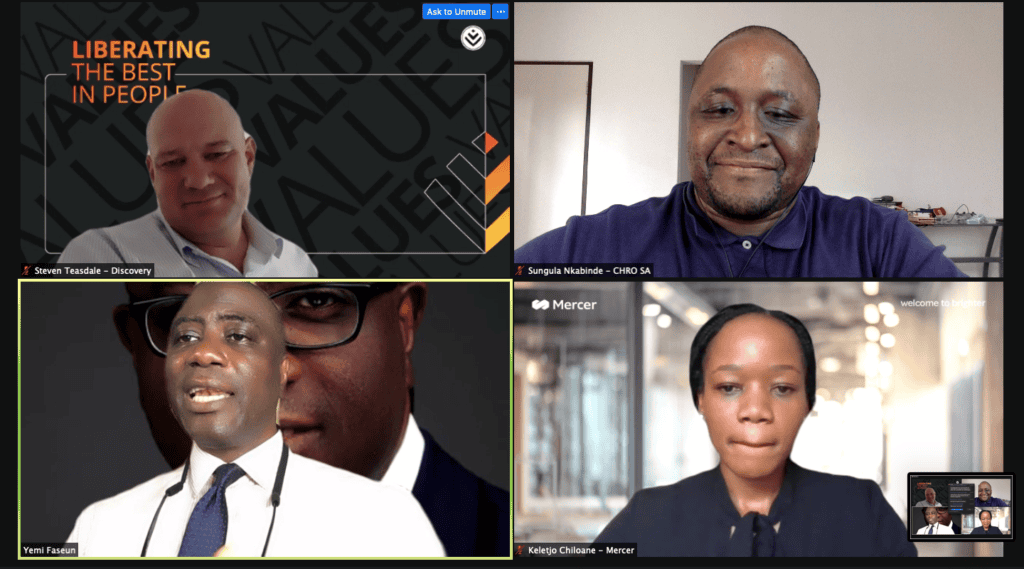
HR professionals had the unique opportunity to interact with three pioneering leaders on developing an employee experience strategy that goes beyond employee engagement. This is particularly relevant at a time when burnout, fatigue and overall malaise is taking its toll on the workforce.
This was made possible through a webinar hosted by CHRO SA in partnership with Mercer, ‘How to re-energise your workforce’.
Keletjo Chiloane, senior associate at Mercer, set the scene by outlining some of the key findings of the company’s annual Global Talent Trend report, zoning in on the South African research in particular.
“There has never been a time like the present for leaders to show empathy and figure out how to deal with exhausted employees. The report highlights the need to balance economics with empathy. Leaders need to find a way to do what is right for tomorrow, while enhancing the employee experience for today,” she said.
Research conducted pre-pandemic had already highlighted key approaches companies were looking at adopting in a downturn. These included better leveraging staffing levels (50 percent); increasing strategic partnerships (40 percent), reducing headcount (34 percent) and divesting from underperforming businesses (30 percent).
“The biggest issue HR foresees in 2021 is employee fatigue,” she highlighted.
Competitive advantage
Reskilling and upskilling were particularly prevalent focus areas for companies in Asia, while North America stood out for its focus on diversity, inclusion and equity. The highest focus among HR leaders in South Africa was on reinventing sustainably and understanding how to position the organisation for the future.
“People are the last competitive advantage and employee experience drives competitive advantage. Executives believe that HR needs to rethink the paradigm around employee experience. Data can be used to inform organisational strategies, with the research showing that 85 percent of companies are using AI to plan. Employee engagement alone is no longer sufficient and not predictive enough,” Keletjo said.
The employee experience, she added, is centred around three things, namely,
expectations and engagement within an employee lifecycle, an environment that supports employee experiences, and events that shape an employee’s journey.
It is within this context that she outlined the four tenets of a great employee experience strategy, being:
• Staying connected: Developing persona groupings and touchpoints, which should include listening;
• Designing for health and wellbeing: To holistically address mental and emotional wellbeing through benefits, manager training and early intervention;
• Co-creating new experiences: Through design thinking and interactive processes, that allow for continuous listening and feedback platforms; and
• Focusing on targeted interactions: Ensuring efficiencies in dealing with the organisation and its processes, including aspects like remote health care or telemedicine, onboarding online tools and colleague recognition tools, among others.
“These tenets create a strategy to energise the employee experience. The whole person agenda, of understanding people and their realities, is leading to a rethink of the HR model moving to reinventing value, flexibility and sustainability. Another accelerated trend is the redesigning experiences to have a more lasting impact in a digital-first or blended work environments,” she pointed out.
Shared responsibility
Yemi Faseun, HR thought-leader from Lagos, Nigeria, added that organisations need to pivot to a design thinking approach and take a deep dive into what employees really want.
“Before 2020, we had mouthed the notion that employees are the biggest assets. Last year, we realised that the workforce is the centre of all processes, tech, ideas and innovation. Now that we have learnt a bit more on how to survive and thrive alongside the virus, we need to do more for employees to remain energised in this new environment,” he said.
According to Yemi, employee experience is not the sole responsibility of HR but rather a shared responsibility, with HR designing the process and line managers take direct responsibility.
“We’ve entered into a phase of multi-generations in the workforce, leadership cannot afford to not recognise how diverse and inclusive the workforce is. This affects how we attract talent and performance manage. The workforce is gradually becoming a one-employee workforce, so the way I relate to Steven must be the way Steven wants to be related with,” he explained.
Yemi sees the re-energised employee experience starting with employees, designing the process with employees, followed by monitoring and measuring progress – and creating a feedback loop by checking in with employees.
“Gone is the era where the policies and practices of people management starts with HR and leadership and ends with employees. The paradigm has changed to starting with employees and getting their buy-in at the onset,” he added.
Deliberate experiences
Steven Teasdale, global HR executive at Discovery, noted that there were many components that has led to the company achieving employee engagement scores that have outperformed the global benchmark.
“It is not accidental; leaders have been deliberate about creating experiences. The company's purpose has come alive and become visceral. There was also a national movement around getting behind a collective cause. Employee experience is not something new, and we [HR] have pushed to match our customer-facing colleagues and there is a lot we learn from them. We have developed personas and created experiences for them,” he explained.
Steven did, however, highlight a challenge that requires more attention.
“With massive engagement and being purpose-driven, it is hard for people to switch off. They are not being driven with a whip to deliver and are driving it themselves and this is potentially dangerous from a health perspective. Employees are grieving on a mass scale and South Africa struggles more than most countries with the stigma around mental health,” he said.
The audience came away from the webinar with greater insight into the challenges faced on a global scale, but also with very specific insights for HR in South Africa, as we all face up to the reality of a changed world, and workspace.