
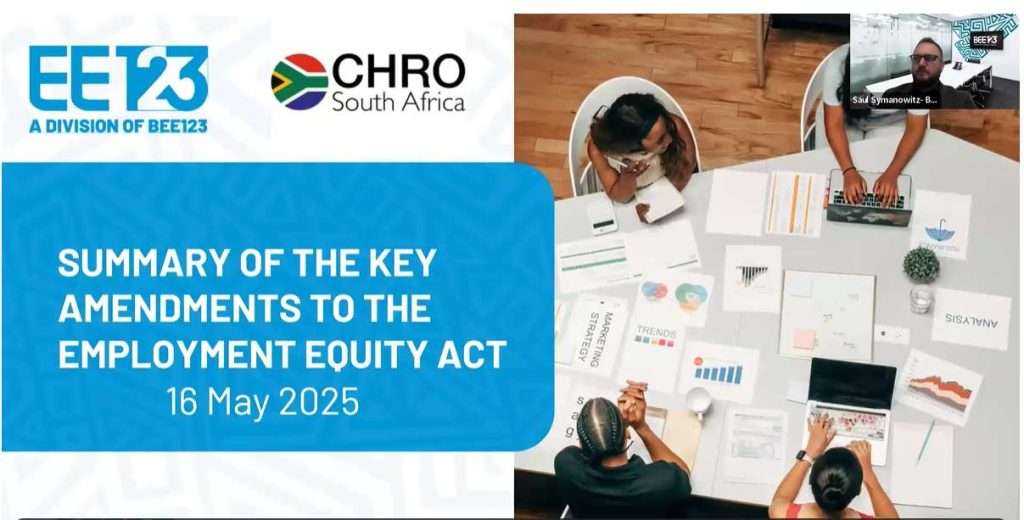
A recent CHRO South Africa webinar led by Saul Symanowitz, BEE123’s director for strategic innovation, offered a breakdown of what HR leaders need to know and do before the next reporting window in line with the amended Employment Equity Act.
Saul reminded attendees that the Employment Equity Act has been in place for 27 years, yet the pace of transformation has been slow. “If you look at research from 2001 to 2023, take top management for example, African representation only rose from 6 percent to 17 percent. That’s effectively half a percentage point per year. Given that African people make up 80 percent of the population, we’ve clearly not seen the traction the Act intended.”
“As of January 2025, the Employment Equity Amendment Act has been signed and promulgated. And as of April 2025, the final regulations and sectoral targets have been published. So all of the pieces to the puzzle are now in place, and there is nothing additional holding us back in terms of putting our plans together and implementing.”
He stresses that the new reporting window remains unchanged from 1 September 2025 to 15 January 2026, so submissions must now reflect the amended legislation. “All your previous plans are scrapped. No matter where you were in the process, everyone has to enter into a brand-new plan based on the amendments. We really need to start applying our minds to the amendments, putting in place our new plans and getting our targets set.”
New benchmark
“What has changed is the industry turnover threshold. In the past, if you had fewer than 50 employees but your turnover exceeded the sectoral threshold, you still had to comply. That’s fallen away.”
This shift significantly reduces the number of employers required to comply, from 29,269 to 15,687. “That means 13,582 businesses no longer need to comply. I don’t think this is a bad thing. For small businesses, achieving sub-targets across all designated groups is very difficult. This relieves an administrative and functional burden.”
Despite this, the number of employees still covered under the Act remains high. “It was at 7.7 million; it’s now about 7.35 million. So only about 340,000 employees have fallen off. The majority of South African employees still fall within its ambit and protection.”
Previously, businesses had discretion to set their own targets. There was flexibility. With the Amendment Act, that has now fallen away entirely.
“As of 2030, the ministerial targets defined in the regulations and sector-specific will determine what your workforce needs to look like. There are 18 sectoral targets in total, and businesses must reach these by 2030. That is the new benchmark. So how you are going to go from point A, which is your current snapshot, to point B, which is your 2030 targets as defined by the minister, that roadmap will be set by businesses themselves.”
“A major shift has also occurred in how designated groups are represented in the targets. Previously, targets were broken down into specific subcategories: African male, African female, coloured male, and so on. Now, they’ve been aggregated into broader group figures, meaning companies must internally calculate how to fairly allocate representation using Employment Active Population (EAP) data.”
Another development is the introduction of justifiable deviation grounds that companies may use to explain why they failed to meet targets.
“These are insufficient recruitment opportunities, insufficient promotion opportunities, insufficient target individuals from designated groups with relevant qualification skills and experience, a CCMA award or court order, transfer of business, mergers and acquisitions and impact on business economic circumstances.”
“They are not going to take it at face value that that's a valid reason. You will have to substantiate it with a file of evidence, and they are going to interrogate whether your reason is indeed valid.”
At the heart of compliance is the new Certificate of Employment Equity Compliance, a critical requirement with tangible consequences.
“There are four criteria for this to be issued. All four of which need to be in place. Your numerical targets need to have been met, or if you fail to meet the numerical targets, you’ve provided your reasonable justifiable grounds. You’ve submitted your EEA2 forms, there has been no finding by the CCMA court within the previous 12 months of unfair discrimination and no award by the CCMA for failing to pay minimum wage.”
According to Saul, failing to obtain this certificate has serious business implications. “Firstly, public sector exclusion. So, you will not be able to do any business with the public sector if you do not have this certificate of compliance.”
While not yet legislated, private sector pressure is expected to follow. “Amongst private sector organisations, especially amongst the larger ones, they will almost certainly make this a requirement of their procurement. You have to have a BEE certificate, you have to have a tax clearance certificate, and you will need that employment equity certificate of compliance.”
BEE123’s digital compliance solution
Giving an overview of the company, Saul explains that BEE123, is a level one black-owned and black women-owned business with over 80 staff members, and has built a robust digital compliance solution serving more than 500 clients and 5,000 users across industries.
“We facilitate compliance for legislation that has transformation outcomes and objectives, specifically triple B-BBEE. We do that through software, really powerful products. We load your data, know where you are, plan gaps, dashboards, analytics, automation, and reporting.”
“Equally, if required, we’ve got a team of expert consultants and then a scorecard solution where we can help you implement projects, programmes and initiatives for skills, ESD, SED and the like.”
While there are a number of different compliance areas in South Africa that have similar objectives, the underlying data required for reporting is exactly the same.
“We’ve created a singular platform where the relevant data would feed into the appropriate module. It’s a cloud-based product, housed, and transmitted in a secure environment, fully POPIA compliant as well.”
One of the key advantages of using EE123 is its automation and intuitive dashboards. “You can be more proactive throughout the year, especially important in the context of a five-year plan where people come and go. So all the data remains in place as it’s the company’s system and data.”
In terms of implementation, it provides full software training, technical support, and access to a digital academy. “The onboarding process begins with uploading basic HR data via CSV files so the data is going to reside in your payroll and HR system, but it's the stock standard data you’re going to find.”
“Not only will someone who’s not authorised to see a salary never see the salary figure itself, but they will also never see any calculation that uses a salary within.”
But the system doesn’t stop there. Saul explains that it also calculates what’s required to meet sectoral targets. “Our system does that automatically, and it will calculate your percentage requirement for African male middle managers by the end of 2030. So what our system will do here is reverse-engineer that percentage into the headcount number for your particular business.”
“We know that the sectoral targets are very stretched. We know we don’t have the skills base to achieve them, and certainly five years is probably not enough time to build that skills base. And we know that our economy is not growing sufficiently to achieve it.”
However, with EE123, BEE123 aims to make that challenge easier by empowering organisations to stay compliant, proactive and data-driven in their employment equity journey.