
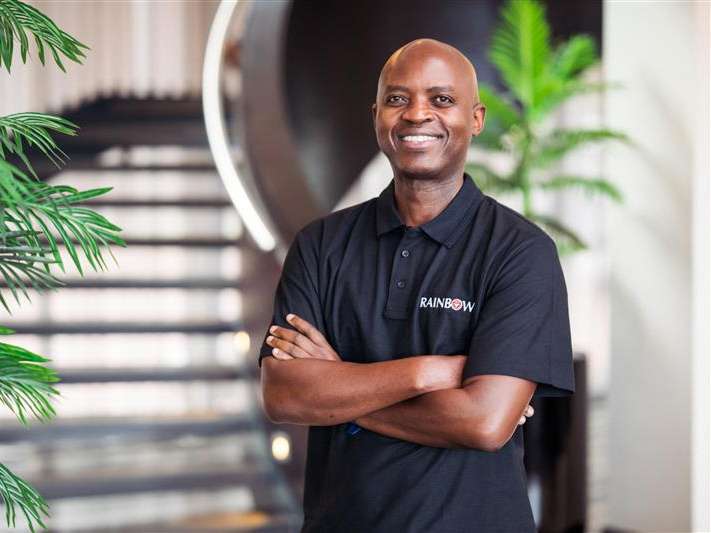
At the core of Rainbow Chicken’s transformation over the past four years lies a people-centred strategy, which has been key in effecting a strategic turnaround. In his 30 years in HR, this has been the most exciting and challenging transformation project chief people officer Barney Khumalo has ever worked on.
Barney believes his humble beginnings have been key to the professional journey that has positioned him to lead one of South Africa’s premier poultry companies through a period of substantial transformation.
“People think I went to some fancy school, but no, I went to a township school. I’m a township boy, born and bred in Umlazi township in southern Durban,” he elaborates.
Rainbow Chicken, established in 1960, is South Africa’s oldest integrated poultry producer. According to Barney, the company has demonstrated substantial scale and a rich history within the industry. It operates an integrated farm to fork model and maintains approximately 30 million chickens on the ground nationwide at any given time. It supplies leading quick service restaurants such as KFC, Nando’s, Chicken Licken and Hungry Lion, in addition to serving the retail, wholesale and hospitality sectors.
“Over the years, Rainbow faced various internal and external market challenges. In 2021, we restructured our operating model, moving towards a decentralised yet integrated regional framework. This approach enhanced accountability, agility and management focus. The company made a number of bold and decisive actions, including prioritising operational excellence,” he adds.
“One of the key focus areas at the beginning of our turnaround phase was the appointment of a relatively younger leadership team, 70 percent of them were promotions made up of high-potential executives eager to succeed, sharing the same purpose and vision. We applied the same at lower levels, picked the right people and teams, supported them with the right training and capabilities.”
With over 9,000 employees, 140 farms, three processing plants, and a further-processing plant, Rainbow Chicken operates a national footprint. But behind this scale lies a story of how Barney and the leadership team faced a major challenge of having to turn around a business that had struggled for over a decade.
Strategic steps
“Although Rainbow had been around for a long time, it had lost its soul. I joined in 2014, when it was a division within the RCL Foods Group structure. I’m proud of the work we did at RCL Foods building an integrated food business of scale, including the sugar and groceries businesses. Unfortunately, it just never worked for Rainbow as a poultry business. In 2021, shareholders took a strategic step to separate Rainbow from RCL Foods.”
In July 2024, Rainbow unbundled from RCL Foods.
“That was the best decision ever,” he explains. “We simplified the business. We fixed leadership. And most importantly, we created a culture where people feel part of something. We gave them a reason to believe again. We did it with leadership on the ground, good HR, processes, employee engagement and we rallied employees around a simple message: #WeAreRainbow.”
Barney added that the company has come a long way from the days when they were unprofitable. “In FY2025, we made history by delivering Ebitda of more than a billion rand, for the first time in our history. Though we focused hard on our agri KPIs and efficiency on the farms, the biggest shift was on culture – the way we do things in our business and the humble belief that we are just chicken people doing chicken things.”
Barney believes if you want to build a great business, start with leadership. “One thing I have learnt over the years in HR is that leadership and culture are one of the most powerful levers that an organisation can pull. Every level of leadership matters. A middle manager who models respect, accountability and empowerment influences far more employees directly than a CEO ever could.”
Since listing on the JSE in July 2024, Rainbow has operated fully independently. “We’re accountable and building a business that will last beyond our generation. We’ve made significant changes to our short-term and long-term incentives to drive value creation. We are making big commitments to transformation and skills development, and also making major strides in employment equity and B-BBEE empowerment.”
Remaining authentic
Leaving RCL Foods and starting over with a business many thought was no longer a major player in the poultry industry was a challenge he said he was ready for. “We believed if we changed the breed, focused on agri KPIs, empowered the right people, we could turn it around.” And they have.
Trust also came from strong long-term relationships with social partners in the trade unions. “At the beginning of the turn-around phase, we made a commitment to our unions of preserving jobs and creating employment opportunities. As part of that commitment, we brought back the second shift at our Hammersdale facility and reemployed a number of employees who were retrenched in 2017 during difficult times.”
Technology has also been an important factor. “While most of our employees do not work at desks, approximately 70 percent possess smartphones, which enabled us to develop an internal communication application named Scoop. Through this platform, we deliver essential information, training materials, payslips, announcements and safety notifications directly to our workforce.”
With experience in HR dating back to 1995, Barney joined Unilever's management trainee programme following the completion of his BA and honours at the University of KwaZulu-Natal. He moved to SAB after five years, where he encountered an HR environment characterised by more advanced frameworks. He was subsequently headhunted by Cell C but left after six months. This was followed by stints at De Beers, Virgin Mobile and later Nampak, where he served as HR director for Nampak Bevcan for seven years.
Barney acknowledges the significant impact that HR has had on his professional development. “Over 30 years in HR, I have grown, developed greater maturity and wisdom, and improved professionally and personally. My approach remains straightforward: I strive to remain authentic and true to myself, without attempting to imitate others. I have simply been myself,” he added.
For him, the journey encompasses individuals, organisational culture and enduring legacy. “The opportunity to establish a business, foster a positive culture and support a team, is when I am most effective. These are the core principles of HR.”
As operations at Rainbow Chicken have stabilised, he is beginning to regain a sense of balance outside the workplace. He values time spent with family and recently relocated back to Johannesburg to be in closer proximity to the senior team at the Centurion head office.
He emphasises that maintaining connections is of utmost importance. “I am a highly social individual who values opportunities to engage with others and re-establish relationships with former colleagues. In this industry, professional networks are essential for continued success.”