
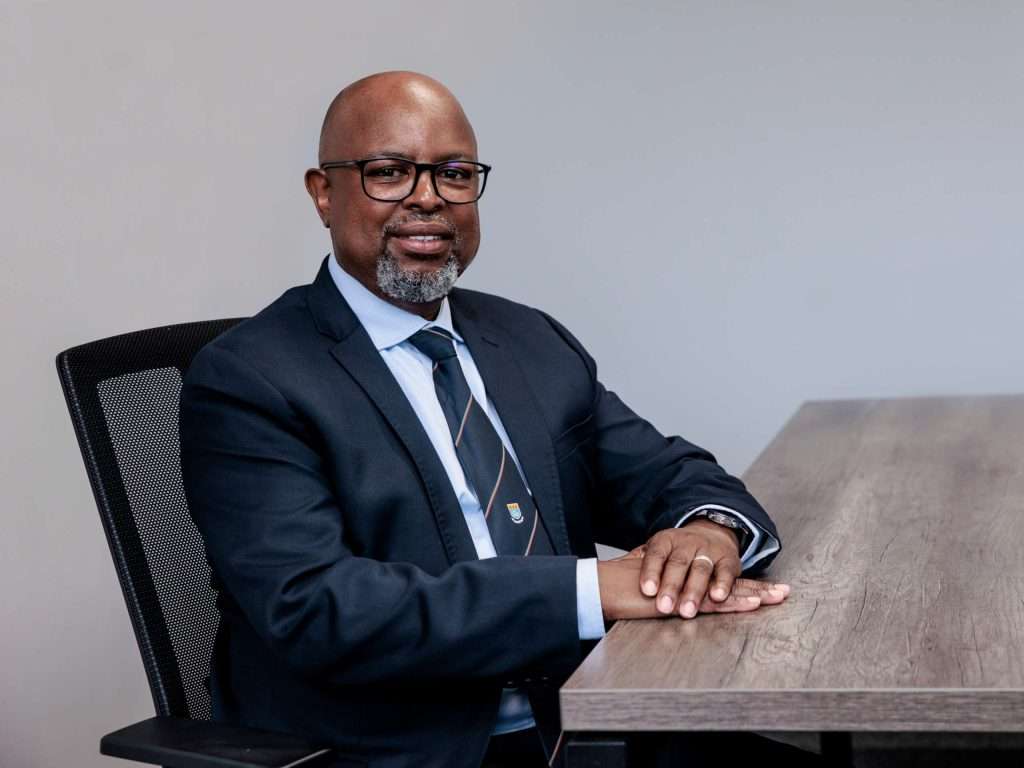
There is always a box of tissues on Meko Magida's desk, and he says it is not there by accident.
As executive HR director at the University of the Western Cape (UWC), Meko Magida believes the tissue box is a signal to everyone who walks through his door that his office is a space where they are allowed to be human.
“My office is about people. There are a lot of wellness programmes that we are driving, dispute resolution, salaries, negotiating with employees, training and developing them and also retaining them and providing them with systems and looking after them even beyond their work, like retirement benefits.”
This sense of caring started in a small town in the Eastern Cape, in a home shaped by generosity. “My mother passed away when I was three years old, and I was raised by my grandmother. She instilled values of caring for others, sharing what little we had. During supper at home, I would invite my neighbours to come and eat with us. My grandmother would ask what they were going to eat because they had no food. She would then remind me that even with the little we had, it was still possible to share with others.”
“I was also involved in the struggle for liberation, not for personal gain, but because we needed dignity, fairness and equality in society. That has guided me in law, in HR and in life. I was not involved because I wanted to get something out of it, but because I cared for other people. I felt that we need dignity, social justice, fairness, and equality in our society. So those are the things that drove me and also why I decided to study law. My specialisation has always been constitutional, administrative and labour law.”
Returning to where it all began
In many ways, Meko believes HR became a natural extension of those same principles. He shares how his career has been a full circle journey back to the university where he first studied law.
“I studied law at UWC. I’m an attorney by profession. When I finished law, I did my articles and got into practice quickly. I went to work for government in the department of labour. My heart was always on issues of social justice. The firm I did my articles at was a human rights practice, specialising in labour law and defending trade laws, representing those unfairly treated. I moved from there and became the director for equal opportunities in the department of labour."
The same way he studied, and now back at the same university confirms that developing internal talent is central to UWC’s people strategy.
“We believe in growing our own timber. Making sure that if there are any opportunities internally, the first people who get the preference are our own employees. It's also a way of retaining them and demonstrating our caring attitude, that as an employer, you always have to look after your own, otherwise someone else will take care of them.”
“Our education has also in the past been skewed and biased towards women, but we’re changing that trajectory now and making sure that women are getting more opportunities, particularly for development, learning, and also to be promoted and appointed in senior positions.”
However, like many universities, attracting and retaining skilled professionals remains a constant challenge.
“As a university, particularly situated in the Western Cape, it is always challenging to attract talent. We have to compete with other universities. We put programmes in place to ensure our value proposition, through reward and recognition and our benefits system, is attractive and meets the needs of our employees. It is also about creating the right environment.”
Smart systems, smarter HR
Listening to employees, he adds, is an important part of shaping that environment. “We recently completed what we call a culture and values survey. We conduct this survey every five years. The input from the survey feeds into plans such as the employment equity plan, which is part of our five-year planning cycle. The survey helps us identify barriers, understand the environment and engage with the climate. It also informs the institutional operating plan, the overarching five-year plan of the university, ensuring that all issues raised in the survey are incorporated.”
The data gathered flows into Project Kaizen, the human capital management system introduced three years ago to automate and centralise people information across the institution. “We need to be able to pay people the right salary at the right time and ensure that the data that we have is updated, accurate and reliable. People should be able to get that information at the press of a button – who is employed, who is retiring, overtime, leave applications online. We are automating everything so that the system helps us.”
“It also gives us an indication of the budget that we have and whether we have the right people in the right positions and jobs, whether we have vacancies so that those positions can be filled instead of having to appoint contract employees and focus on retention. For example, in a faculty of science, it shows whether we have the right number of scientists at the right levels, including lecturers, senior lecturers, associate professors, professors, and senior professors.”
The work of HR, he adds, ultimately stretches across the entire employee journey.
“So generally, we cover the A to Z of HR, starting with recruitment and induction orientation programmes. We had a big orientation programme where we showcase all our services and programmes at the university. We also need to maintain them through our value proposition, the salaries we pay and the benefits we provide.”
According to him, learning and development form a particularly strong part of that offering, which he describes as one of the biggest projects at UWC. “If you are at a university, it would be unusual not to be studying. One of the ways the institution encourages this is through tuition benefits for staff and their families.”
“We also have a rebate for that, both for our own employees if they want to obtain their degree. They can study for free. If they get married and their spouse also wants to study here, they can study for free as well. We offer those kinds of benefits.”
Rather than reducing the work of HR to policy or administration, Meko describes it as a process that unfolds slowly through engagement, negotiation and leadership from all sides with trade unions.
“Experienced colleagues help guide these conversations, and we always try to make sense of whatever we are offering. We know it is not something that can be resolved all at once. It takes time, convincing, and presenting our views and an offer that we believe is reasonable, affordable for the university, and meets the needs of employees.”
According to him, these discussions require patience and leadership, especially as pressures are often shaped by the broader economic context. “Of course, it is a difficult one. The price of petrol and diesel increased recently, so we can expect that to be raised. Employees will ask if it is reasonable to settle for such a low salary agreement when prices are rising. These are the kinds of challenges we face.”
Beyond negotiations, Meko says a significant part of his current focus is on longer-term institutional projects aimed at strengthening people development at the university. “One of these projects is the integrated talent management framework, which was launched two years ago. We are now rolling it out and focusing on key areas of development.”
“We also have a PDS,” he explains. “UWC does not have a traditional performance management system. Instead, we have a Performance Development System, which is focused on development rather than management. The emphasis is not on punitive measures or incentives but on giving people the opportunity to learn, grow, and become the best they can be. Employees need to trust someone who cares about them and shares their values.”
Investing in the next generation
And for young talent, UWC has a structural advantage that Meko leans into fully through the Presidential Youth Employment Stimulus programme.
“We are at an advantage because talent is right in front of us. You do not have to go searching for it. I hold sessions where I invite leading corporate leaders, including CEOs from major companies, and organise webinars and events so graduates can interact with future employers. These employers can explain what to expect, how to prepare for the future of work, and what an interview will really be like.”
"AI is another big opportunity I see for higher education. We need to find ways to take advantage of artificial intelligence to make life easier through the programs we implement, by using automation and ensuring that our programmes are customised to be more user friendly.”
Beyond technology, he identifies another opportunity that belongs uniquely to higher education.
"When developing a policy, you have access to the intellectual capacity around you. These individuals conduct extensive research and produce theses for their own degrees. The key is how to use that knowledge to shape the future of society, staying at the cutting edge through innovation, research, and creative work. We must contribute through policy development, guidelines and advisory roles.”