
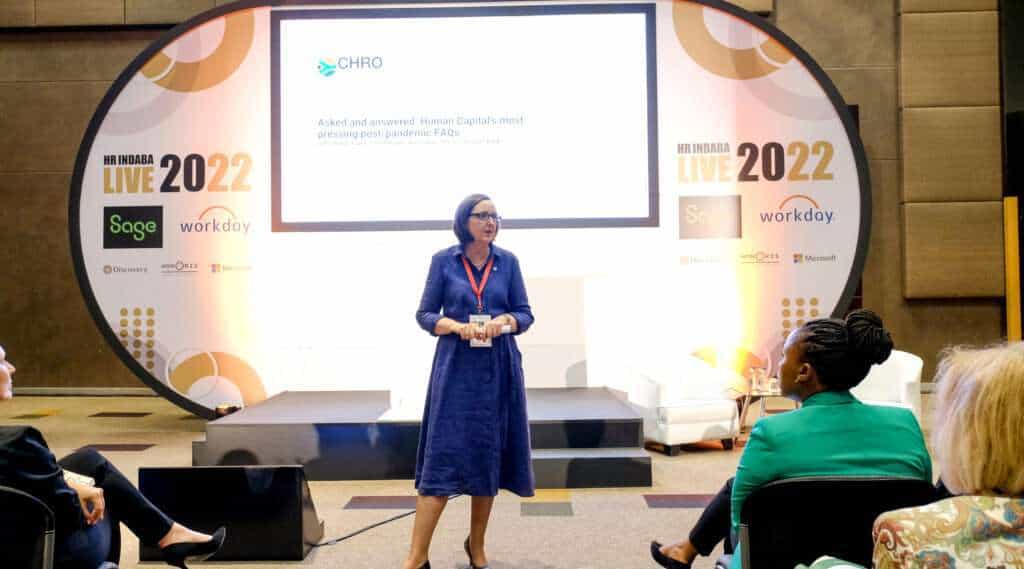
Sharon Taylor shared how Standard Bank approached uncertainty during the pandemic.
The full impact of COVID-19 on business is still being assessed and analysed and like many organisations across the globe, Standard Bank had to adapt quickly to ‘business unusual’ and then to post-Covid-19 life.
“During COVID we had no references for what was being faced. We had so many challenges arising on a day-to-day basis as businesses and especially as HR professionals,” said Sharon Taylor, chief people and culture officer at Standard Bank, at the HR Indaba.
Sharon said that the challenge now is for businesses not to revert back to life before Covid-19. “There are tools and ways of working that worked so well during the pandemic that are adding value to our day-to-day lives that we need to continue with,” she said.
She also advised businesses to resist going the ‘Elon Musk’ route and making returning back to the office mandatory five days a week. “One of the most divisive issues that I had to deal with was the issue of vaccination and how to approach it,” she said. “I learnt from that situation that we can no longer mandate things as a business; that doesn’t fly. Change management and communication are very important. You need to keep your ear to the ground,” she said.
Post-pandemic, HR now has to contend with trends like work-from-home flexibility, mental health, the ‘great resignation’ and ‘quiet quitting’. “What we noticed is that people who joined the organisation during Covid-19, left within the first year because they had no feel for our company culture since everything was remote. We had a look at why people were leaving, and we found that it was because they missed interaction.”
Sharon said the bank resisted a knee-jerk reaction to bring everybody back to the office on a full-time basis. Instead, they focused on a flexible, hybrid model that allows some employees to work in the office eight days a month. “The hybrid working model is successful because the flexibility has allowed productivity to soar. We are learning as we go, having a split workforce – some in the office full-time and others part-time is challenging but we believe that we have put together a framework for staff and leaders to do what works for their business unit and environment.”
Sharon believes that the eight days a month works well because it encourages ‘purposeful engagement’ instead of ‘presenteeism’, which is when employees are in the office just to show their faces. But like all new ways of working, the hybrid work model has its challenges, namely loadshedding and connectivity.
While for some organisations, Standard Bank’s actions might be seen as going too far, Sharon said she believes that despite the economic challenges, many people’s mindsets and attitudes towards work have changed and business has to meet people where they are. “Retention is an individualised challenge,” she noted. “There is no perfect workforce: everyone is at different stages of their lives. For many people, flexibility is important.”