


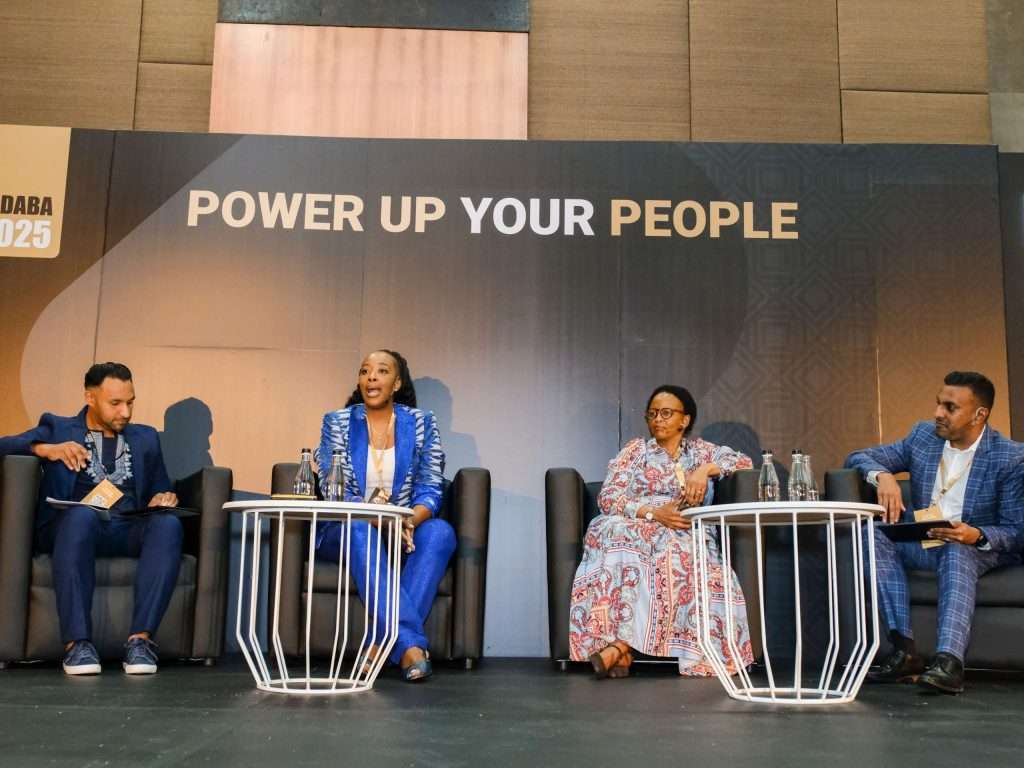
At the 2025 HR Indaba, industry leaders Charlotte Mokoena, Lindiwe Miyambu, and Kyle Chetty unpacked how organisations can break down barriers and build collaborative cultures that drive performance and impact.
The Sandton Convention Centre buzzed with energy as it housed over 3,000 attendees at the 2025 HR Indaba. In a panel discussion titled Breaking down walls to build collaborative cultures, former vice president for HR and corporate affairs at Sasol, Charlotte Mokoena; chief people and marketing officer of Afrocentric Inc., Lindiwe Miyambu; and CHRO of Planet42, Kyle Chetty, explored the importance of building and maintaining healthy culture in an organisation.
Charlotte explained that the focus on people, leadership and culture is important for an organisation to grow. She added that leaders need to be consistent with maintaining these three pillars.
“If you’re working on leadership and learning through people and culture, then you are going to be missing one element of the access of performance and impact. If you’re working on culture and it is not about the people and it is not led by leaders, then you’re not going to get the access to the impact that you require. So you need to focus on leadership and on the people and on culture to move the dial on any business issue,” she said.
Lindiwe explained that after her experience in the public sector with AGSA, the one thing she noticed that limited culture was hierarchy in the organisation. She added that in the public sector, the cultures are typically very hierarchical, to the extent that people are called by their titles instead of their names.
“For many corporations, hierarchy becomes one of the biggest barriers. And my finding in the public sector, so we talk about transformation being slow, is that sometimes we don’t realise that it is the hierarchy that actually makes things not change quickly enough. Because what hierarchy does is it says you have a voice, your title gives you a voice and you don’t have a voice,” she said.
According to Kyle, when it comes to developing positive culture in an organisation, it starts with the intention behind the change. And for him and his team, after intention, it all boils down to behaviour and these are behaviours that he wants to see in the organisation.
“But it's also about having those courageous conversations of calling some of these behaviours and saying, this is not how we behave in this organisation. This is not how we demonstrate the culture that we want to see. And going through the scale-up that we have, we want to grow as a business,” he said.














