
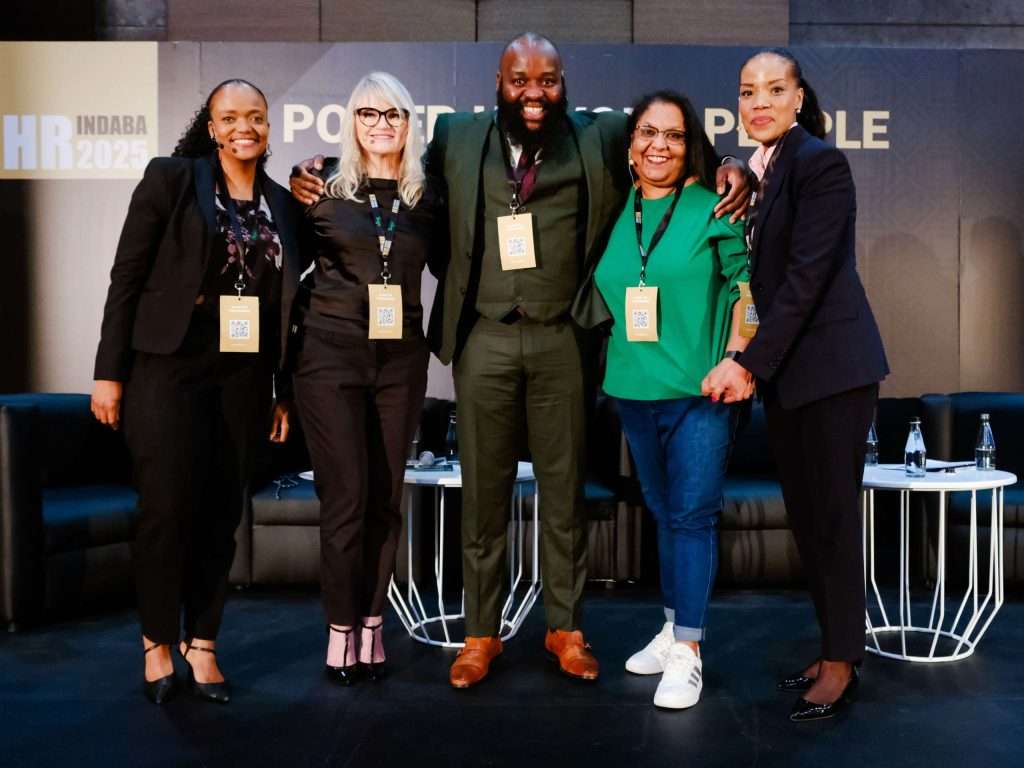
Top HR execs shared their insights on effectively collecting and managing data to enable data-driven HR at the 2025 HR Indaba.
During a session titled Mitigating the unintended consequences of data-driven HR Elaine Kruger, group CHRO of Tsebo Solutions Group, emphasised that data must have a decision-making purpose.
“Tsebo Solutions Group is a company of more than 25,000 employees across 25 countries. We manage large datasets from both our employees and customers, but before we collect or analyse this data, we need to ask ourselves why we need it and what decision it will help us make,” Elaine said. She highlighted that data should simplify decisions rather than overwhelm leaders.
Fellow speakers Palesa Matoli, executive head of human capital and transformation at Bidvest Bank, Malisha Awunor, founder of Ikigai People and Themba Nkuna, managing director of InsydOut, echoed similar sentiments.
Palesa shared her experience of navigating data-driven HR. “When I joined Bidvest Bank, we were right at the beginning of the data journey and I discovered the importance of data literacy in constructively using data. HR practitioners must walk at the pace of business and ensure that people understand the value of data and how to use it,” she said.
Palesa stressed the importance of education, change management and storytelling with data to help employees connect data to real decisions.
Intention determines impact
Malisha highlighted that the greatest risk lies not in the data itself but in the intention behind its use. “In HR, we always present data from the past and there isn’t much we can do with it in the present. We can use data to either empower or punish. For example, productivity tracking tools can either enable support or create fear. The goal is to use predictive insights that can serve as early warnings of burnout or turnover to foster wellbeing and engagement, not surveillance,” she said.
Themba brought an entrepreneurial and analytical lens to the discussion, warning that data without structure or quality leads to misleading outcomes. “We have to understand that AI runs on data. It’s not another human from another planet. The quality of our data determines how far AI can go, and this is why there are so many concerns around using AI for candidate selection. There are biases that eliminate qualified candidates and lead to teams that lack diversity. It’s essential for HR professionals to go back to their data and ensure it’s the right quality,” he said.
Malisha and Themba agreed that ethics and data quality are closely linked. “Policies alone don’t ensure ethics but intention and behaviour do. If you use the data for anything other than what you said you’re going to use it for, that’s unethical. Ethical data use should build trust, not control,” Malisha added.
The human side of data
On building a data culture, Palesa described practical steps to shift mindsets within organisations. “We need to educate our employees on what a data-driven mindset is, and we do this by hosting monthly lunch and learns. We embed data competence in behavioural competencies and recruitment criteria, and most importantly, we allow people to try, fail and learn. That is key to building confidence in using data tools,” she explained.
Malisha shared a South African case study on an AI-driven compliance tool for employment equity reporting. The tool automates reporting, identifies demographic gaps and links recruitment pipelines to equity targets. “This allows HR teams to focus on cultural and systemic change rather than administrative spreadsheets,” she said.
The conversation concluded with a reminder that data must coexist with humanity. “Sometimes people are hired for attitude, mindset and potential, not what the data says. Data should inform, not dictate, decisions,” Themba concluded.