
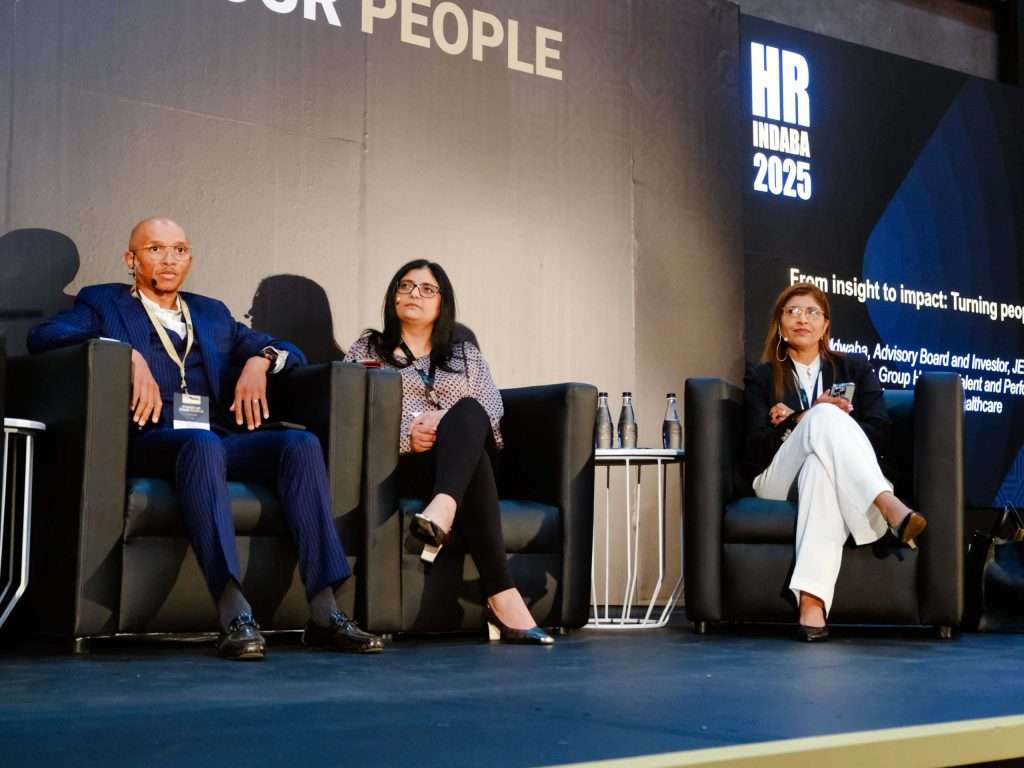
Zuko Mdwaba, JEM HR advisory board and investor; Selo Govender, Discovery executive head: talent, learning and leadership development; and Avanthi Parboosing, chief people officer, Life Healthcare; highlight the role of data analytics in helping companies make better decisions around employee wellness during a frank 2025 HR Indaba 2025 panel discussion.
Titled From insight to impact: Turning people analytics into action, the discussion offered a grounded view of how data can support stronger outcomes and position HR as a true partner in driving organisational performance.
According to the panellists, HR has more access to data than ever before. But, as they echoed, the real value lies in knowing what to do with it.
The talk further offered insights on how companies could reduce employee attrition and identify leadership potential early, while looking at how CHROs used predictive analytics and real-time insights to make better hiring, retention and performance decisions amid refining their talent strategies.
Zuko said data-driven decision-making has become non-negotiable across the HR value chain. “It’s literally what fuels everything that we do from a technology point of view,” he added. “Companies that are not at the point of using predictive analytics are going to be left behind.”
Selo urged companies to become more practical in how they conveyed strategies to employees. She said Discovery used data models, among others, to predict flight risks or employee attrition. “Discovery is intentional about the use of data and insights. From a people perspective, the attraction, development and retention of talent is top of mind for corporates globally,” she said.
Using predictive data
Avanthi, in sharing her critical insights, acknowledged that all the HR professionals attending the session were geared to have a frank discussion about the benefits of having healthy people coming to work. “Only one in five people will confide in their bosses about what is truly happening to them,” she highlighted.
“We need to understand how our employees are feeling daily. People still don’t want to talk about mental health because it is treated as a stigma,” she said.
Avanthi emphasised the importance of using predictive data and said HR practitioners must move away from the traditional thinking of what wellness means. She underscored this point by zooming in on the impact on the psychological wellbeing of nurses of the introduction of the two-pot retirement system, implemented on 1 September 2024.
“Our data has shown that people not understanding their financial wellbeing or wellness go into an acute state of anxiety,” she said. “During the two-pot system, our nurses experienced high levels of anxiety and we saw a peak in our attrition levels. What we think causes anxiety is not always true.”
Selo added that Discovery, in its drive to maximise the benefits of predictive data, looked at exit and experience data. “We overlayed recruitment data on top of the experience and attrition data, and put in place retention strategies such as a masterclass for our employees. Since then, our attrition is down to 12 per cent,” she said.
Provide authentic experiences
“We used the algorithms to help the company become more predictive, looking at who was at risk of leaving the company. There’s a feeling among employees of a lack of psychological safety so they can share authentically the emotions they’re feeling. Leaders, therefore, have a role to play so people can provide authentic experiences. Algorithms are put into place to proactively predict patterns in behaviour. At the end of the day, there’s a human being at the end of everything. We put the human in HR,” she said.
Avanthi added: “We’ve got to react to the data. We try to predict what’s happening with our people and try to react quickly. We want to ensure people are happy. We’re always on the ball in terms of watching our nurse attrition rates and nurse moods in terms of what’s bothering them. Companies need to move away from their traditional thinking of what is bothering their employees. The world is moving on, and what bothered the world six months ago is not bothering us now.”
Zuko concluded by saying companies have a responsibility to act when looking at all these metrics, and encouraged industry “to overcome the fear of data”.
“Performance and compensation are indicators of who could potentially be a flight risk. It is important to have quality data, which companies globally are doing quite well,” he said. “People tend to carry the experience of how they’ve been doing it. Cultivate a data-driven culture in companies. Purpose and profit can co-exist.”