
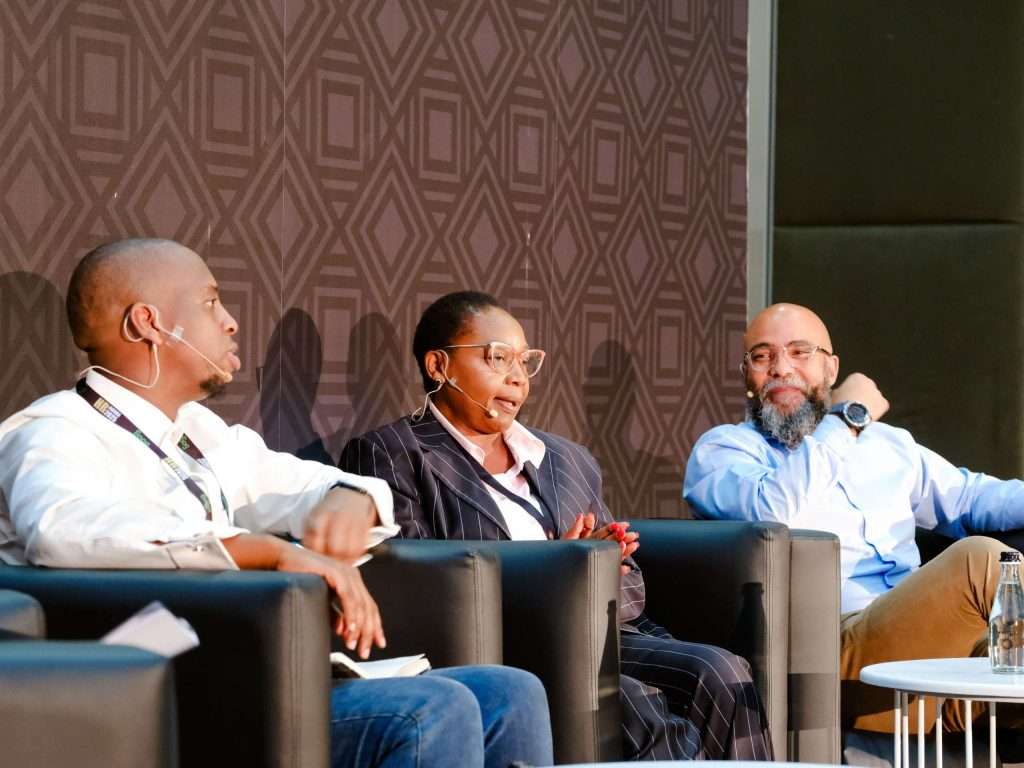
Executive confidence was at the heart of a frank discussion about leadership at the 2025 HR Indaba by a trio of visionary leaders, each with a unique story of personal mastery and self-assurance.
Touted as the masterclass of breaking the mould, KFC Africa chief people and transformation officer, Nolo Thobejane, e-Motion Consulting head of people and culture, Themba Chakela, and The Coca-Cola Company people and culture director, Mure Wesigye, put the spark in a discussion titled The superpower of executive confidence at the 2025 HR Indaba.
The session explored how executive confidence was not merely a personal trait, but a key driver of strong leadership.
It put the spotlight on the central belief that self-assurance at senior levels supported better decisions for businesses and shaped their response to pressure, while steadying teams through uncertainty.
In a powerful analysis of her experience in senior leadership, Nolo gave an energised HR audience a lesson on her tried and tested executive approach.
These qualities, she said, enabled her to be anchored throughout various difficult situations.
“I call it the triangle of trust – and it encompasses confidence, empathy and logic. It is something I hold close to my heart,” said Nolo.
“Executive confidence, in my journey, has been something I wanted to understand for a long time. For me, it means being grounded in the belief that you can lead even through the toughest circumstances. What I love about what I’ve discovered and am still discovering is that executive confidence is quiet; it is not loud,” she explained.
“It is the steadiness that allows people to know that they can trust you to lead them. It isn’t that you know everything. Instead, I’ve learnt that people don’t follow titles. They trust who they can follow.”
To develop her executive confidence, Nolo said she needed to understand who she was, in addition to the innate qualities she possessed, including her blindspot. “Once I did, then I knew I could lead other people. In my journey, I’ve learnt what makes me own the room and to be confident in the discussions I have.”
Themba, unpacking leadership, said it brought several different ideas to mind. “It can be assumed that you’re technically sound, you’re capable and competent – all of those KPI items,” he said.
Themba also outlined the ‘three Cs’, starting with curiosity. “It’s probably the one thing that the world works to diminish from the time you arrive. Throughout your young life, you’re trimmed and pruned. ‘Don’t do that! Listen here!’ In terms of confidence, how can you become confident about something you don’t understand? That’s where curiosity comes in.
He then moved on to comfort. “For those of you who’ve been on a bike, there’s nothing comfortable about the process,” he said, highlighting his recent preparations for the 947 Ride Joburg cycle race. “It is difficult to grow if you’re constantly in your area of comfort. You only get better by getting out of your comfort zone. There’s nothing nice about doing so. With leadership, you have to do a lot of things that are uncomfortable until they become comfortable,” he added.
“So, ultimately, for me, curiosity, comfort, or the lack thereof and confidence are big leadership things.”
Mure discussed self-recognition as being key in executive confidence as HR practitioners often had conceptions and misconceptions around what executive confidence means.
He defined authentic leadership, while giving birth to imposter syndrome.
“There’s a feeling that when you’re in an executive role, you walk into a room and there’s gravitas. I think there is something to that, but I don’t think that’s all there is to it. Being in a leadership role means that you’re being trusted to solve the biggest problems, to work through complexities and the most ambiguous situations,” he said.
He debunked the well-established myths.
“Sometimes people perceive that our experience being in senior roles is so different – that we’re super confident, don’t have doubts, don’t have insecurities, and we know exactly what we’re doing. So, I’m here to officially dispel the views and tell you that it isn’t true.”
He concluded by encouraging HR practitioners to have firm business fluency to understand the business they are a part of.