
The CHRO Community Conversations returned on 23 September after a short hiatus, coming back with a powerful call to rethink the relationship between people and technology in the modern workplace.
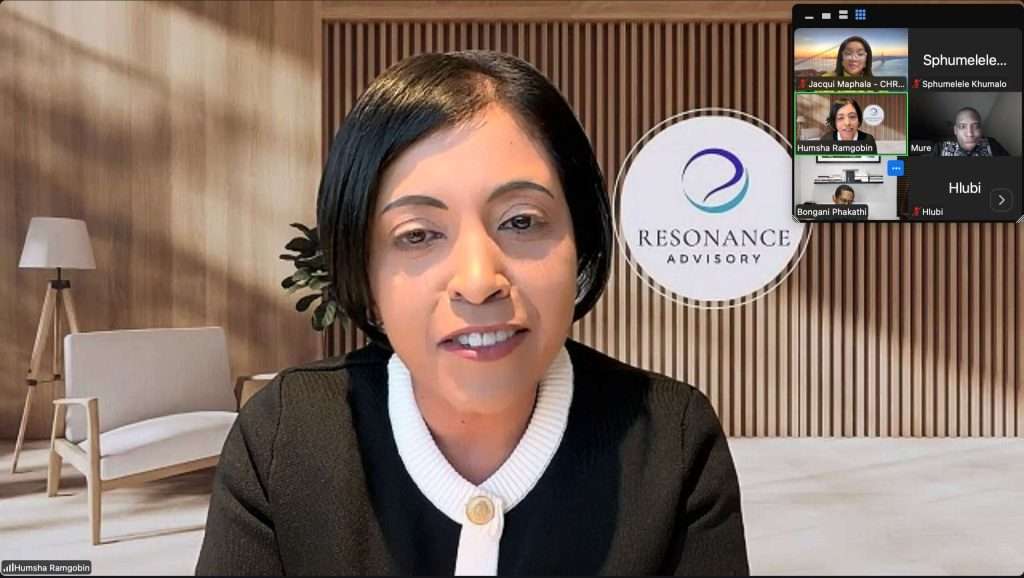
Guiding the conversation was Humsha Ramgobin, a transformation strategist and founder of Resonance Advisory, diving straight into the heart of what it means to lead, engage and transform in an AI-driven world.
She quickly set the tone by highlighting the ongoing challenge of employee engagement.
“No matter how many billions we put into employee engagement in the workplace, we continually seem to measure at a very low percentage of employees engaged at work. We’re losing trillions annually in disengagement,” she said.
From here, Humsha shifted to AI’s dual nature, as both a disruptor and enabler, which was central to her explanation. “AI is driving fear and a higher level of disengagement because of potential job displacement. According to the World Economic Forum, 44 percent of skills will be disrupted. Although 170 million new jobs will be created, 92 million will go away, and we will also disrupt and outdate 39 percent of current skills. At the same time, 60 percent of organisations have no clear plan on AI or strategy around delivering it in the workplace.”
She explained that this anxiety is most evident in the generational make up of today’s workforce. “Baby boomers are leaving the workforce, Gen Xs are moving into senior leadership and the majority of the workforce will be millennials and Gen Z. It is quite disconcerting to see the high level of fear around AI in this space – the fear of job displacement, the fear that AI will eliminate jobs, that skills may not be utilised in the future and that new skills will need to be learnt. This deepens the level of low trust in the organisation and disengagement.”
Yet, despite these challenges, she urged HR leaders not to fall into fatalism. “If you thoughtfully integrate AI into your business, you can actually boost productivity by 2.3 times. It can strengthen the human connection rather than undermine it,” she said.
Shifting the paradigm
Humsha also critiqued traditional change management approaches. “Some organisations come into workplaces putting great frameworks in place around change interventions, but those typical change methodologies have led to 65 percent failure rates. Centralised top-down approaches have never actually worked, yet we continue to use them. AI is turning that on its head, shifting our paradigm for how we should be doing things differently.”
She illustrated the risks with a fintech case study, showing the consequences of ignoring co-creation. “A certain organisation brought in a consulting company to replace 300 customer service agents and create a $40 million saving by using AI. They used the traditional top-down approach with town halls and communications. But generative AI is reactive – it handles standard issues well, but it couldn’t deal with complex problem-solving or the human touch needed for customer interactions. The entire change programme failed and they had to quietly rehire human agents. This is why most companies are failing with AI programmes. Co-creation with employees is the key.”
This prompted Themba Nkuna, founder and MD of InsydOUT, to open the floor with the first question directed at Humsha, noting her point about 60 percent of organisations lacking a clear plan and seeking clarity on whether this figure referred to global statistics or was specific to Africa.
“It’s global,” Humsha clarified. “Around 47 percent of companies in South Africa are starting to work with AI and develop solutions, but adoption is slower here. Some capability is emerging in shared services and customer support areas, but not as aggressively as in the US or Europe.”
Bongani Phakathi, founder & director of JBP Advisory stepped in to provide further regional framing. “While the US and China often lead, there are pockets of excellence globally, including in South Africa,” he said. “Infrastructure like bandwidth and data costs can affect implementation speed, but it doesn’t reflect the ability or talent in the country,” Bongani continued.
AI evolving by the minute
He also mentioned that the HR community still needs to fully embrace the technology – its capabilities and how it truly works, beyond the headlines or trends seen on news and TikTok. Even in corporate boardrooms, where leaders are typically of different generations, grasping the full potential of AI is crucial, not just in startups but also in established companies that are not traditionally high-tech.
Themba followed up with another question about the pace of AI evolution, questioning whether organisations are playing catch-up and whether what is taught today could already be outdated by next week.
In response, Humsha explained that AI is evolving by the minute, noting that organisations are still catching up with generative AI while already having to explore the implications of artificial general intelligence.
“There are breakthroughs, like researchers at Princeton creating advanced AI doctor systems and at Johns Hopkins developing brain-cell Petri dishes. We won’t fully catch up, but the idea is to find solutions in our teams today, co-create, iterate and adapt,” she added.
Adding another layer to the conversation, Mure Wesigye, people & culture director at Coca-Cola Africa, brought in his reflections, providing insight into both human behavior and the nuances of AI adoption.
“I've seen in some scenarios a hesitation to embrace AI. It’s interesting that there are different schools of thought around whether it’s because of fear of making oneself redundant by engaging with it, or other factors.”
An inflection point capability
“Another thing I’ve also observed is an appetite to ensure that people don’t dumb down their capabilities. For example, the skill of business writing reflects thinking. As we grow in our careers, how we communicate through what we write evolves with the development of our strategic thinking. What you see is people trying to create the discipline of doing the work themselves as a base and then using AI as an elevator and enhancer.”
He also addressed the broader misconceptions around AI, urging HR practitioners to recognise its full scope and potential.
“Oftentimes we narrow AI to ChatGPT or Co-Pilot, but AI in totality goes beyond this. It is starting to demonstrate its growing ability to act as an agent with its own valuation and capacity, and this whilst it’s still in its relative infancy. I think it’s important to keep that broad understanding of what it fully is in mind. It is more and more clear that it is an inflection point capability.”
While Mure highlighted the human perspective and the nuanced ways employees engage with AI, Humsha built on this by noting how leadership and HR can translate these insights into effective organisational strategy.
“Many executives focus only on productivity, cost-effectiveness and headcount reduction when implementing AI. That’s not the whole gain. Layering AI without considering how integrated our workflow processes are is where leaders go wrong. The opportunity is to use AI as a growth engine, integrated with workflows, enabling employees and creating value. Pilots help us learn, iterate and scale effectively. Early adopters, particularly millennials, can help champion AI adoption.”
She furthermore shared practical lessons from her own experience at Mediclinic. “I was fortunate to lead the rollout of SAP SuccessFactors, integrating employee central and payroll across three divisions. Co-creating with employees ensured adoption and allowed us to build centralised data for predictive analytics. Leaders could make real-time, data-driven decisions. HR can influence business strategy by leveraging technology in this way.”
Themba thereafter raised one final leadership challenge, noting that the average CHRO may not have the skills to run digital transformation projects and suggesting that CHRO and CTO roles could potentially merge, to which Humsha responded with a vision for collective growth.
“Experience matters,” said Humsha. “Not all CHROs have exposure to these spaces, which is why we’re creating a CHRO mentorship platform. Experienced CHROs can mentor less experienced ones, guiding them through AI adoption, shifting mindsets and building leadership capability. We also aim to influence university curricula and government policy, so HR leaders are better prepared.”
She closed with a reminder that transformation is measurable, but only if we measure what truly matters.
“Sentiment analysis and pulse surveys are critical. Measuring impact beyond training completion and looking at whether AI adoption creates new pathways, enables leaders and drives business outcomes. It’s about people, culture, trust and co-creation. That’s how AI becomes an enabler rather than just a disruptor.”