
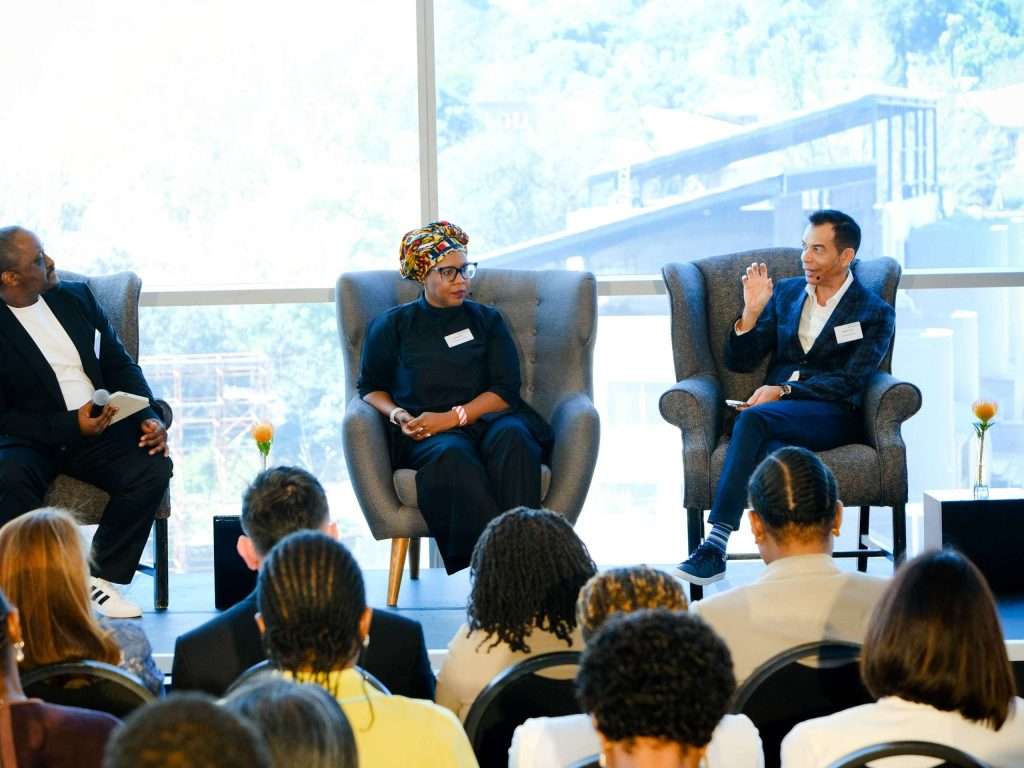
During an attention-grabbing panel discussion at the 2026 Executive Day, Paul Norman, group CHRO at MTN, and Celiwe Ross, group chief human capital and corporate affairs officer at Old Mutual, put the CEO role under the executive microscope, unpacking the green flags, red flags and everything in between that can make or break the C-suite dynamic.
The session brought a close-up view of the CEO relationship to a room filled with CHROs, CIOs and CFOs. The conversation explored the green flags, red flags and grey areas of CEO leadership.
Celiwe Ross, group chief human capital and corporate affairs officer at Old Mutual, started the conversation with four areas she believes are central to effective CEO leadership.
“When I talk about CEOs and CEO roles, I look at them through four lenses: purpose, strategy, culture and leadership. I think purpose matters individually and organisationally. It answers the question of why. I think the best CEOs balance that with great commercial outcomes.”
“They very much understand customers and customer outcomes, and the commercial outcomes that they bring. And then, largely, for those of us in financial services anyway, they deliver those customer outcomes to people,” she said.
For her, that balance between the commercial and the human would become a recurring thread in her view of effective leadership.
“They’re also custodians of strategy. They have to mobilise the organisation, but they also have to create the conditions under which people can perform, which takes you to culture.
“And I think, more than anything, they have to hold leaders accountable. They have to create clarity. They have to provide candour and push, but oftentimes, they bring the weather,” she added.
The CHRO in the middle
Celiwe noted that this makes the CHRO role particularly significant, given its proximity to both leadership and performance.
“I believe CHROs matter much more overall. Ours is the only job that performance-manages both sides. I don't think any other role in business does that. We have to motivate them for increased labour, their performance and their feedback, while also holding them accountable.”
“So I do think great CHROs recognise the value of the C-suite and how it enables them to raise their collective intelligence. You don't want to focus on profit ahead of culture or focus on strategy without thinking about how you're managing a complex set of stakeholders, whether they're in your organisation or not. This ability to toggle between different types of relationships and elevate the conversation around Exco is important,” she said.
That collective intelligence only goes so far if there is no one creating the space and direction for it to thrive. According to Celiwe, that is where the CEO comes in.
“CEOs have to be galvanisers. They have to actually create energy in the room, create clarity of direction and clarity of focus, and clear the way, and question what’s next. I think oftentimes, from a red-flag perspective, if you're not courageous, not willing to make the difficult calls, if it's difficult to clear the way for the organisation and difficult to create focus, everything becomes important and therefore nothing becomes important.”
“So the ability to clear chaos and give direction forward, I think, is a very big leadership attribute. Galvanising is one thing, but they also have a big role in inspiring, motivating and creating the conditions under which the organisation performs. That takes a lot of their energy as well.”
Green flags start here
Paul Norman, group CHRO at MTN, offered another way to spot the difference between leadership that builds an organisation and leadership that inadvertently diminishes it. According to him, you can learn a lot about a CEO by looking at the people around them.
“For me, a clear sign of a dark cloud around a CEO is one who believes they have all the answers. One of the fundamental things I look at and observe, and which is a real test of what is to come, is what happens when a CEO steps into a room and the level of intelligence in the Exco. That, for me, says a lot.”
“I think an emerging role that the CEO has to play in this context is to create an environment that thrives and grows an adaptable organisation, and to grow an adaptable organisation, you have to build trust. And for that to happen, you basically have to build the organisation up. So the emerging role that I think they increasingly play is to harness, create and orchestrate an environment where the organisation can orient itself,” he said.
He noted that a CEO may have the final say, but that does not mean every decision has to originate with them. Paul’s green flag, therefore, is a CEO comfortable enough to create room for others.
“The green flag would be the CEO who walks in and can admit that they don’t have all the answers, that there are things that they can work through together, but also one where the intelligence of the organisation, of the Exco, is actually lifted,” he added.