
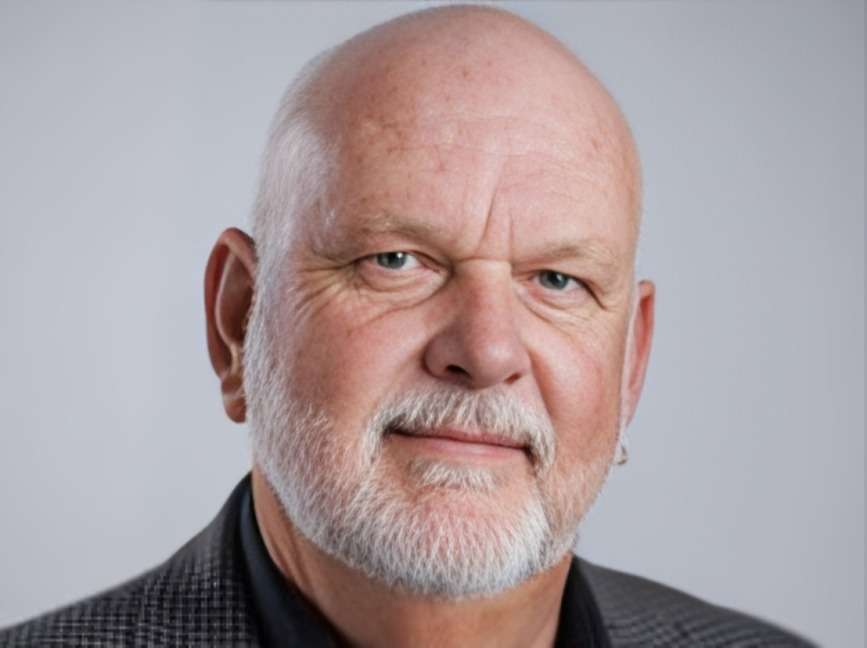
With a career spanning several industries and countries, Raubex’s group HR head, Trevor Dale, approaches the discipline with pragmatism and a deep commitment to employee wellbeing and organisational efficiency.
Trevor Dale’s journey into human resources is anything but conventional, as he was introduced to the industry after working on a mine, after completing his military service.
“In the olden days, after completion of high school, one had to complete compulsory military service. After finishing my high school in Florida on the West Rand, I completed my military service as an air space controller in the Air Force,” he recalls.
“After completing my military service, I started working on a mine with a view to securing a bursary. A friend of mine worked in HR, and that got me interested in the field. Despite being a bit of an introvert, I found the HR field intriguing with its many facets. After working underground for about six months, I was awarded a bursary and started studying towards my HR qualification,” he says.
Trevor set out charting his path in the HR field across various industries, including mining, retail, medical and construction.
“During my career in the mining industry, I started off in general HR. I was then promoted and transferred to Witbank, where I worked in OD and training, and later as senior IR officer. I was also given an opportunity to work as an expatriate in Ghana as HR manager, as I was the youngest HR manager in the JCI group at the time.”
He recalls his time in Ghana as challenging but also fulfilling. However, as fate would have it, the stint only lasted for three years, as the company he was working for collapsed, leading to mass retrenchments. But his journey with the West African country did not end there.
“Following the retrenchments I worked in a consulting role and took up the in-sourced position as HR executive in Cashbuild. It was during this time that a medical doctor who I had met in Ghana offered me a general manager position in his healthcare company in Ghana. So I returned there and managed the operations of a mine hospital and five clinics. For five years I effectively moved out of my HR field. That, together with my mining HR experience, gave me the entrepreneurial HR skills I have today.”
Back to his roots
In 2009, Trevor moved back to South Africa and took up the challenge to head the people agenda at Raubex.
“No challenge was too big, and although I wasn’t familiar with the construction industry, I knew I had a good grounding in different specialties in HR to make the role in Raubex a success. I had to relocate to Bloemfontein from Johannesburg and have grown with the group over the last 13 years,” he adds.
“Raubex is a great group to work for. Despite its size, we are not faced with the challenges that some heavy corporates experience. It’s not uncommon for employees to feel free to communicate across seniority levels.”
Under his leadership, the HR department has grown from a small team to a robust unit of professionals specialising in various HR functions. “When I started it was basically me and one other HR manager doing everything in a group employing over 8,000 employees.We now have a strong team of professionals in general HR, employee relations, training, talent management, recruitment, payroll and wellness,” Trevor noted.
One of Trevor’s passions in HR is remuneration practices, followed closely by compliance and implementing new initiatives. “I do enjoy the interaction at the bargaining council as well, and serving on task teams to fight corruption and extortion in our industry. My least favourite would be training. Fortunately I have a very competent team led by our group talent manager that executes that function very well,” he adds with a chuckle.
He also takes pride in driving the implementation of a standardised payroll system across the group, streamlining policies and procedures, and introducing wellness initiatives. “Driving the implementation of a standardised payroll system in the group and doing away with the different systems of some of the 22 entities used in the group is no easy feat. I also headed the introduction of wellness initiatives and providing psychosocial support to employees.
Another highlight was overseeing the HSE function and being instrumental in appointing a dedicated group HSE manager with HSE managers to manage the function efficiently,” he says.
However, the path has not been without its challenges. Making HR relevant and demonstrating its value has been a persistent obstacle. “It is not easy for people to see the value of what we as HR do. It took a while, and we have more work to do, but I am supported fully by our COO, which makes it easier. The other challenge is balancing the legislative requirements with reality. We are in an industry where engineering skills are not necessarily supported by our education system.”
Industry focus and talent
Last year Raubex celebrated 50 years in existence and Trevor believes this is an absolute testimony to the resilience of the group. “Raubex has always had a culture of inclusivity and a ‘family’ approach; employees become part of the family. With the growth over the 50 years, we have various micro-cultures in the respective subsidiaries, and we need to harness this as a strength, building on employees becoming long-term employees that want to stay with Raubex and share the successes.”
He adds that the golden jubilee will also aid with cementing the retention strategies.
“This will be done through easily accessible online learning, restructuring of remuneration structures to attract and retain talent, as well as new and improved internal communication in the group along with wellness programmes. We also plan to push more towards engaging employees actively so as to build the success of the group.”
Trevor is also not oblivious to the changing landscape of HR and is keenly aware of the current issues facing the industry. “In our industry, dealing with community unrest and business mafia interference, it affects our employees, and some have resigned because it becomes untenable to face it daily. We need to find new ways to deal with it and ways to support and secure the safety of our employees,” he explains.
“The other critical problem is retaining talent in a group. We have great people, but all too often some of them get lured away by our competitors or due to emigration opportunities.”
He acknowledges that there is a glimmer of hope, as he sees Africa as a future talent pool and underscores the importance of investing in talent development and skill-building programmes. “We have bursary programmes in place to attract young talent. We have also, as part of our HR strategy, rejuvenated our talent management programme and introduced modern ways of skills development and recruitment through the offerings of LinkedIn.’
With the rise of AI and automation, reskilling and upskilling employees is a priority. “[We do this] mainly through LinkedIn Learning, but we also have a full-time IT trainer in the HR department who provides training in the group,” Trevor elaborated.
Leveraging data analytics and AI tools is also on the agenda to optimise recruitment processes, improve employee performance and forecast future workforce needs. To address the skills gap and attract younger generations, Raubex is working on remuneration strategies that are flexible and appealing to younger employees. “The traditional remuneration build-up does not suit the younger generation.”
For young people aspiring to a career in HR, Trevor’s advice is straightforward: “Study, be prepared to start at the bottom, and eagerly get involved in building your career. Sometimes we don’t like certain tasks, but it must be seen holistically as part of the service one offers in this profession and a way to gain experience.”
Empowerment and trust
Trevor’s passion for his work is evident in his daily approach. “I really enjoy my work; my boss is a great person that lets me get on with it, and my team of professionals just make it easier and pleasant to work with,” he says. His leadership style is characterised by empowerment and trust, rather than micromanagement.
In his downtime, he enjoys walks in nature and is a trained venomous snake handler, occasionally catching and releasing snakes. “I’m a nature person, and enjoy walks in nature. We love animals: both my wife and I are trained venomous snake handlers and occasionally catch and release snakes, often at my office.”
“I also enjoy watching a good action series or movie and of course watching Formula 1, MotoGP, rugby and cricket – even better, when we attend a live event.”
Always living by the mantra “How can I help?” Trevor hopes to be remembered for making a positive difference in the lives of people he has worked with.