
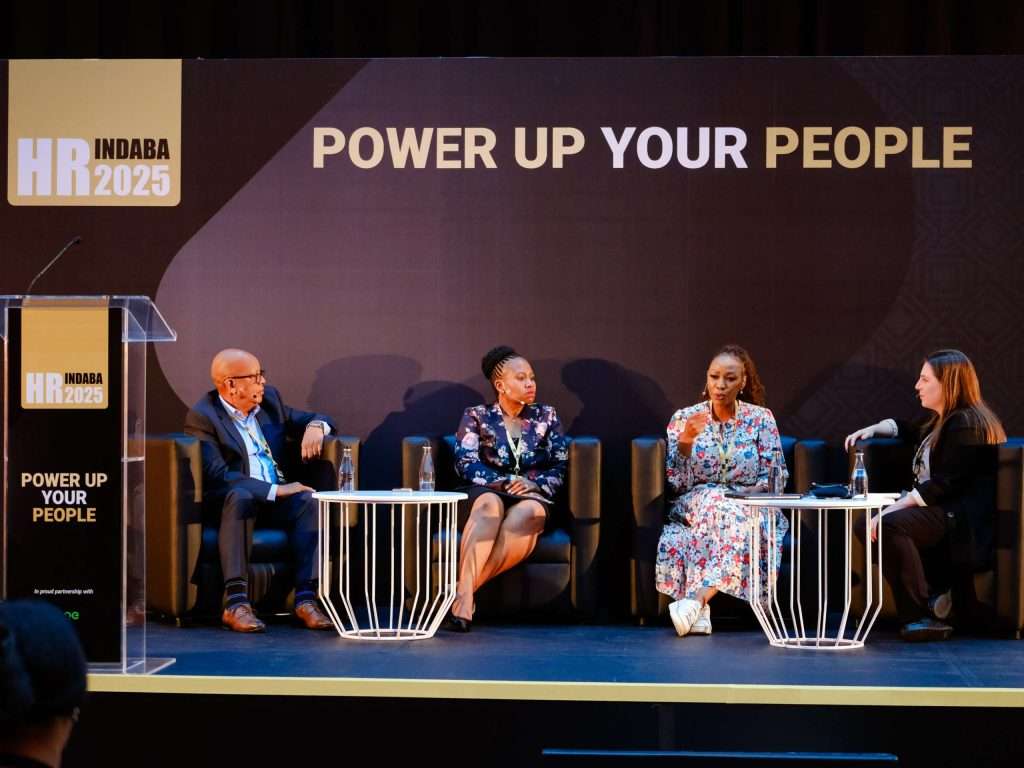
During a panel discussion at Africa’s biggest HR conference and expo, S’ne Magagula, CPO of Tiger Brands; KG Bako, managing executive: talent management & transitions at Absa Group; and Juba Mashaba, CPO at Cell C, spoke about how profit may keep the doors open, but highlighted purpose as what keeps people and organisations moving forward.
During the session titled Where purpose mees profit: What makes your organisation different? S’ne Magagula, CPO at Tiger Brands, reminded attendees at the 2025 HR Indaba that even in something as practical as food production, purpose is the ultimate differentiator.
“In my view, we nourish and nurture more lives every day. That’s our purpose and it is woven into everything we do, every product we manufacture, every brand we build and put into the market. Our people are deeply connected to the purpose of the organisation and they believe they are contributing to delivering that purpose. It’s also woven into our strategy, which drives everything we do as an organisation and everything we deliver to our consumers.”
She continued, drawing on a famous HR principle to underline how this plays out internally at Tiger Brands.
“Richard Branson said take care of your people and they’ll take care of your customers, and we truly believe in that. Every individual knows how their job links to the purpose of the organisation, how what they deliver makes a difference not only within the organisation or to our bottom line, but to the consumer out there,” she said.
“In our engagement survey, we asked whether people understand how their role links to the company’s purpose and strategy. That is our highest-rated question, because people genuinely feel they are contributing not only to their team, but also to the broader organisation and to our bigger purpose of nourishing and nurturing more lives every day.”
Shared goals
And when it comes to innovation, S’ne noted that purpose is also used as the guiding star, ensuring that cross-functional teams understand how their work contributes to a shared goal.
The conversation then shifted to KG Bako, managing executive: talent management & transitions at Absa Group, who highlighted how purpose scales beyond the organisation into society.
“We operate in system markets across the continent and it is important that when we think about our purpose, it speaks to the things that need to happen in those markets.”
She explained that financial inclusion forms the heart of Absa’s purpose, but that inclusion requires more than transactional interactions.
“Our focus is empowering Africa’s tomorrow together, one story at a time. The ‘together’ part was very intentional because we recognise that many societal challenges cannot be solved in isolation. They require collective effort, real partnerships and identifying opportunities where we can work together to address societal issues,” she added.
“That is one of the core elements we are driving as part of our purpose. We realised that we needed to look at the entire stakeholder value chain, starting with our people. They play a crucial role in ensuring that when we execute on our strategy and purpose, it is felt across the whole value chain.”
More than a transaction
This human-centric philosophy, she said, is what ensures that every interaction carries meaning. “When our employees show up, whether at a branch with a retail customer or as an investment banker meeting a corporate client, we want our customers to feel understood. That’s why we focus on making every interaction more than a transaction.”
Finally, Juba Mashaba, CPO at Cell C, concluded the discussion by explaining how purpose is most critical to unite an organisation when the path forward seems uncertain.
“Purpose is important when a company is thriving or struggling, but I believe purpose is even more important when a company is struggling, because in those moments you need clear direction to bring the whole organisation together and remind everyone what we are here for,” he said.
“As part of our turnaround, we created a compelling purpose that speaks both to us and to our stakeholders. We now have a clear purpose statement, but we also know that on its own, a purpose statement is not enough. It needs to be underpinned by values – values that guide our people’s behaviour and communicate to customers what they can expect from us.”