
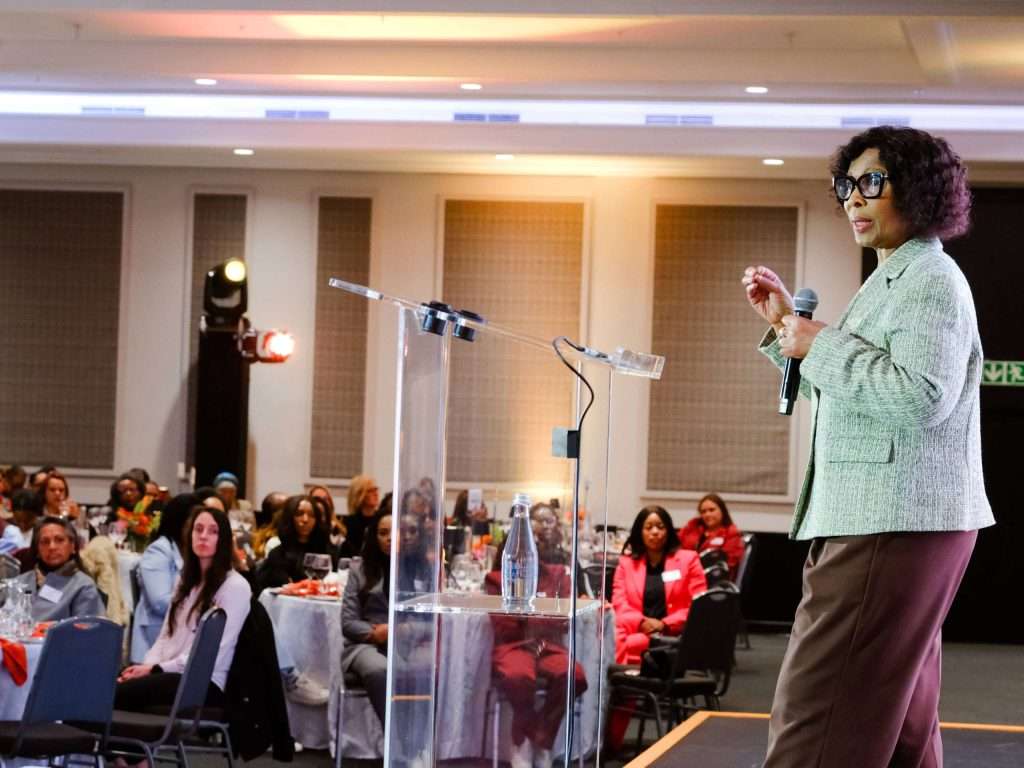
A room full of women would once have been unthinkable. Nonkululeko Gobodo, pioneering business leader, entrepreneur, author, CEO of Awakened Global and Chancellor of Walter Sisulu University, reflected on just how much that picture has changed during her keynote at the 2026 Executive Communities Women’s Dinner.
Speaking to a room overflowing with CHROs, CFOs and CIOs, Nonkululeko drew on her own journey as South Africa’s first Black female chartered accountant to reflect on what it meant to build a career in spaces where were often the exception rather than the norm.
“I was promoted to CFO at age 29, the first woman on Exco. I had never seen an Exco, so I had to figure that one out myself. I, however, had no consciousness of the fact that I was different because I was a woman. It had never occurred to me that there were things I couldn’t do because I was a woman.”
That certainty was not always something she had to consciously build. Her early career experiences, however, quickly exposed her to the different expectations placed on women in professional environments and the choices women are often forced to make to navigate them.
“Others read the room, they read the organisation, and they realise that the only way to survive is to act like a man and be like a man. We all have masculine energy. Dig down and find that masculine energy. These are the kinds of decisions we make because, of course, we all crave safety.”
“Most of us walk into these spaces that were designed by men. They don't take into account that one day women will be walking around here as well. And because we're different, we need different things. That was not taken into account.”
Find your power
Yet the answer, she suggested, is not to wait for women to feel completely ready before they claim their space. Confidence and presence can be built through the very experiences that initially test them.
“You start somewhere. At this point, you’re young and you don’t really know who you are. Knowing who you are isn’t something that happens just like that; it’s something you discover as you progress. I would say, use every opportunity to find yourself.”
“Make sure that you are visible, work hard, do your work well, knock on those doors, build those relationships because you need mentors, and you need sponsors.”
Nonkululeko also addressed the double standards that continue to shape perceptions of women in leadership, where qualities celebrated in men can attract criticism when demonstrated by women.
“The reality of the situation is that there are double standards in these environments. If you are that powerful, strong leader, they give you names. And then when you show your feminine self, they also give you names.”
For her, the answer is not to abandon either strength or femininity, but to develop the self-awareness to lead in a way that feels authentic and effective.
“You have to bring your authentic self to the workplace. They will accept you when you bring your authentic self. But if you compromise and fit in that box, they will never respect you. You can never bring out your best when you're trying to fit into a box.”
“One of the most important things is knowing your strengths because, beyond our qualifications and experience, we all have natural gifts to bring. Whenever you’re doing something that speaks to your natural abilities, you will shine. You will thrive, and you will excel.”
The sisterhood effect
As more women move into positions of influence, Nonkululeko believes the opportunity is to turn individual achievement into collective power.
“The power of presence starts with the individual. It is only when there are a lot of us that we can say collectively that we have that power.”
“For a very long time, women were surviving in corporate. We always complain about the fact that women do not support one another and so on. Guys, we have to understand those women. They had to survive. They were focused on survival. But now that we have this critical mass, we’re no longer there. Let’s use this power that we have to support one another.”
“Let’s be more than just a shoulder to cry on, we have to open opportunities for other women. Something we’ve not been able to do effectively before. We’re doing it. But I’m talking about large scale now, because that’s the only way that we’re going to change the dynamics within corporate.”
And when women face resistance, she argued, they should not have to face it alone.
“We have to protect one another. We've seen too many women being attacked and, when they're attacked, there's no one to protect them. So we need this sisterhood now that is effective. As our voices are getting louder and more prominent in corporate spaces, they need to know that we don't touch women because we protect one another.”
It was a message that resonated beyond the keynote itself. In a room where senior women executives had brought their mentees with them, the idea of sisterhood was already being put into practice.
She concluded her keynote by reminding the women not to overlook that progress while acknowledging the work still ahead.
“There’s still a lot of work to be done but we’ve come a long way and we must celebrate successes as well. During our time, we never saw anything like what I’m seeing here today, a room filled with professional women. We didn’t exist. So we’ve come very far. Let’s celebrate and understand that, yes, it is a journey and a process to get there.”