
CHRO South Africa opened its first community conversation of the year with a dialogue that went straight to the heart of the profession. The session brought together two of the country’s most respected people and culture leaders to explore what it really takes to professionalise HR and rebuild trust at scale.
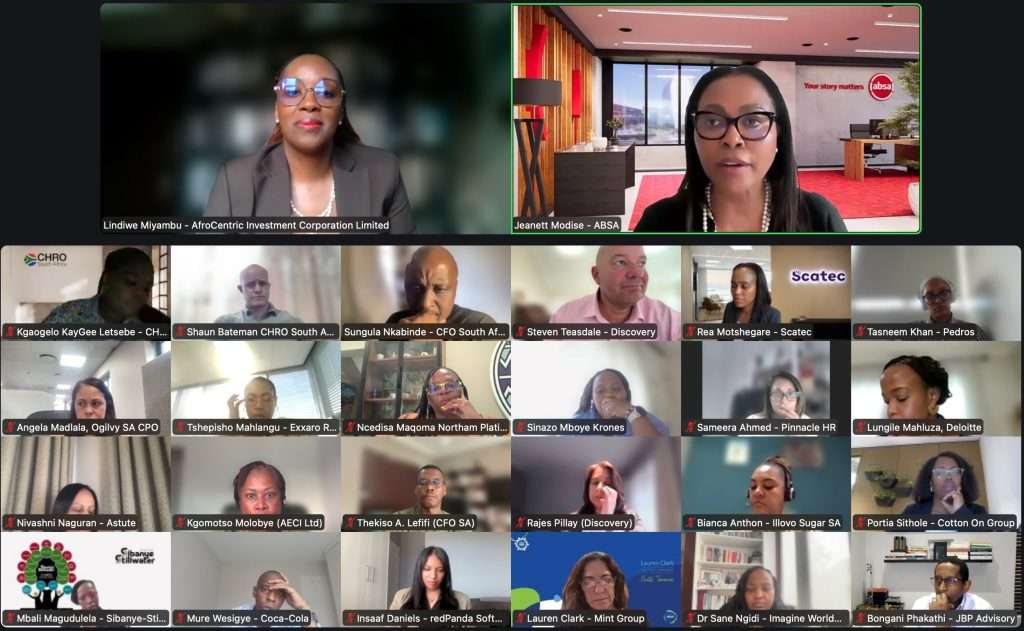
The conversation featured Lindiwe Miyambu, 2025 Public Sector CHRO of the Year and chief people and marketing officer at Afrocentric, and Jeanett Modise, 2025 CHRO of the Year and group chief human capital officer at Absa Group.
Lindiwe opened with a reality many senior HR leaders know well. When organisations decide HR needs fixing, the damage is often already deep.
“The one thing that has always surprised me is how much fixing was required compared to what they thought needed fixing,” she said. “This is usually caused by consistently saying HR is not doing what it’s supposed to do and consistently shutting HR out of decision-making. The realisation for me has always been how much fixing first needs to be done internally in the HR function.”
“In every role I’ve stepped into, the first job I do is focus on the actual HR team itself,” she said. “Building it up, building trust, winning them over, and making them remember what they are there for.”
At Afrocentric, where she is currently in her third month, this work is familiar.
“I’m going through a process of healing the HR team, putting them back together, aligning them around a people strategy,” she said. “There’s the seat, but more importantly, there’s the impact. Our voice and our influence around the table has to be won back.”
Jeanett shared her experience, from when she joined Absa in 2023 where the organisation previously had a number of CHRO changes over a short period.
“I took a step back and realised the most important thing was to ensure the HR team is aligned around a common strategy and the value expected from an HR function. The CHRO needs to ensure that they build a strong team and together they can deliver on the strategy, and not just one individual.”
Listening changes the conversation
She explained that her early focus was listening and observing while engaging with all key stakeholders including the board, executive team, as well as the senior leadership teams across the group. It was important to keep in mind that organisations are not the same and therefore the CHRO’s approach required an understanding of the background context, key challenges and successes in order to determine the way forward.
“I realised very quickly there are good people in the organisation,” Jeanett said. Good people also need the right environment to bring their best.”
“HR is a critical component of the business – our people are the business, and HR is in a position to create value through people and culture. On the other hand, you will not just be given the trust. You earn their trust through impact and influence,” she said. “It’s not about the title but the consistency of delivery and the value creation. In fact we should not be talking about the seat in 2026…”
Asked how she builds trust in practice, Lindiwe described listening as an important discipline. “Every Wednesday morning until 12, I create a listening space. Anyone at any level can book, whether face to face or on Teams.”
“This matters because I do not want to only hear the organised employee voice or the union voice. I want to also hear the person who simply says they need to talk to me. I’ve had people say they’ve been struggling with something for six months, and it gets resolved because someone finally listened.”
She warned how easily leaders can lose this connection. “The system is demanding,” she said. “Exco demands you, the board demands you, so you have to be deliberate about protecting employee voice.”
Jeanett described a similar shift on the value of listening to inform a shared strategy, structure, building trust and a solid team to work with.
“We had to start by creating clarity around a common strategy,” she said. “I partnered with the chief people officer in presenting the HR strategy to the business/function executive teams. I wanted to ensure that we are solving the right problems, with the right strategies, obtaining their further input and validation. This resulted in full buy-in and commitment for execution as the HR team, board, exco and senior leaders had been part of the process.”
“We repositioned human capital in the organisation as a value creator through the people strategy, efficiency and optimisation while challenging the status quo for the benefit of the people and our organisation. We had invested in HR technology, but value only comes when HR, leaders and employees all understand and use the solutions and data. The visibility changed conversations, and leaders could see what was happening and make informed decisions,” said Jeanett.
Bongani Phakathi, founder & director of JBP Advisory, stressed the value of empowering leaders at all levels to truly listen, stating, “We must be careful that as CPOs we don’t monopolise listening. Let’s teach others to listen. Let’s not just provide fish, but teach them to fish.”
When reflecting on balancing accessibility and strategic focus, Sana-Ullah Bray, group executive for human capital at Sanlam Group shared, “I think in the first year or two, I also spent a lot of time with almost everybody, with an open door policy. Everybody could come and go, but then there was the element of prioritisation. It is also about allowing your direct reports to have that trust in them, to know that they are the subject matter experts and let them run with it, then the executive can focus on some of the more high-level strategic deliverables. With everything that is going on, including AI, talent and culture, and how we take that forward. I do think the balance of being accessible to staff and focussing on the board & exco strategic deliverables is the trickiest part of it all."
With the discussion opened to the HR executives in the audience, one question reflected on the role of the CEO and executive team in enabling meaningful people change.
Trust is a team effort
Kgomotso Molobye, vice president for human capital: mining at AECI asked about Lindiwe and Jeanett’s experience working with the CEO and executive team, noting that the type of work they did was highly transformative and required real courage. She highlighted that leadership support is critical, as the executives’ view of the impact of people in the organisation greatly influences how far they are willing to partner and walk the road with HR.
As both Jeanett and Lindiwe reflected, they confirmed that no CHRO transformation succeeds in isolation.
“If there’s one thing I’ve learnt over and over again, it’s that I cannot afford not to invest time and energy in executive relationships. I do a very quick scan to understand where the noise will come from and I stick close to those people,” stated Lindiwe.
“The person who causes the most noise must have my number on the speed dial. I want to be the first to know when something goes wrong, because if my team is scared to come to me, I can’t manage that stakeholder and our credibility suffers. Our role is not just to go to the people who are easy, but to be closest to the ones who challenge us. We tend to disengage from the people who are never satisfied, but those are exactly the people we need to be closest to. If we win them over, they often become our strongest advocates.”
Crucially, she emphasised that hierarchy should never become a barrier. According to her, creating an environment where teams feel safe to flag problems early allows the CHRO to actively manage stakeholders and maintain confidence at the top.
Building on this, Jeanett noted that the CHRO role extends far beyond HR, as it requires managing upwards, sideways and downwards simultaneously.
“As a CHRO, you don’t earn recognition by asking for it. You earn it through how you work, how you engage and the impact you deliver,” said Jeanett. “Leaders must be held accountable for people, performance and culture in addition to financial outcomes. That includes all levels of leadership – the board by shareholders, exco including the CHRO. If leadership isn’t accountable for people, performance and culture, you can’t have sustainable results and a great place to work.”
“We work with and through the leaders, enabled by human capital as they are leading and managing people, developing talent and driving culture as chief culture officers. This is integrated in how we reward and recognise leaders as part of business performance.”
As the conversation drew to a close, attention turned inward to the HR teams themselves. Noting people and organisation as a critical and scarce skill, Reabetswe Motshegare, HR director at Scatec sub-Saharan Africa, asked what is being done to help their teams look forward to another challenging and demanding year. This was asked as it was clear that the people function continues to be a critical business driver, operating under sustained pressure and growing complexity.
“Human capital must also look after human capital,” Jeanett responded. “When an organisation goes through a challenging season, the leaders and human capital themselves also need care. We need to constantly invest in team and capability development, wellbeing, and ensuring people understand the impact of the work they do. That pride and confidence energises the team to take on another challenging year.”
Lindiwe continued, stating, “What teams need also depends on where they are in their journey. Right now, my team needs direction, guidance, and protection. We’re running a ten-kilometre race, but we’re only at the 500-metre mark. My role is to help them focus on the next 500 metres, and then the next. The greatest compliment a leader can receive is seeing a team thrive even after you’ve left, that’s the mark of sustainable development.”
Bahle Goba-Matsho, the lead organisational development & talent management at Sanlam then added, “It is very important to understand where your team is and be deliberate about setting the right tone and support.”