
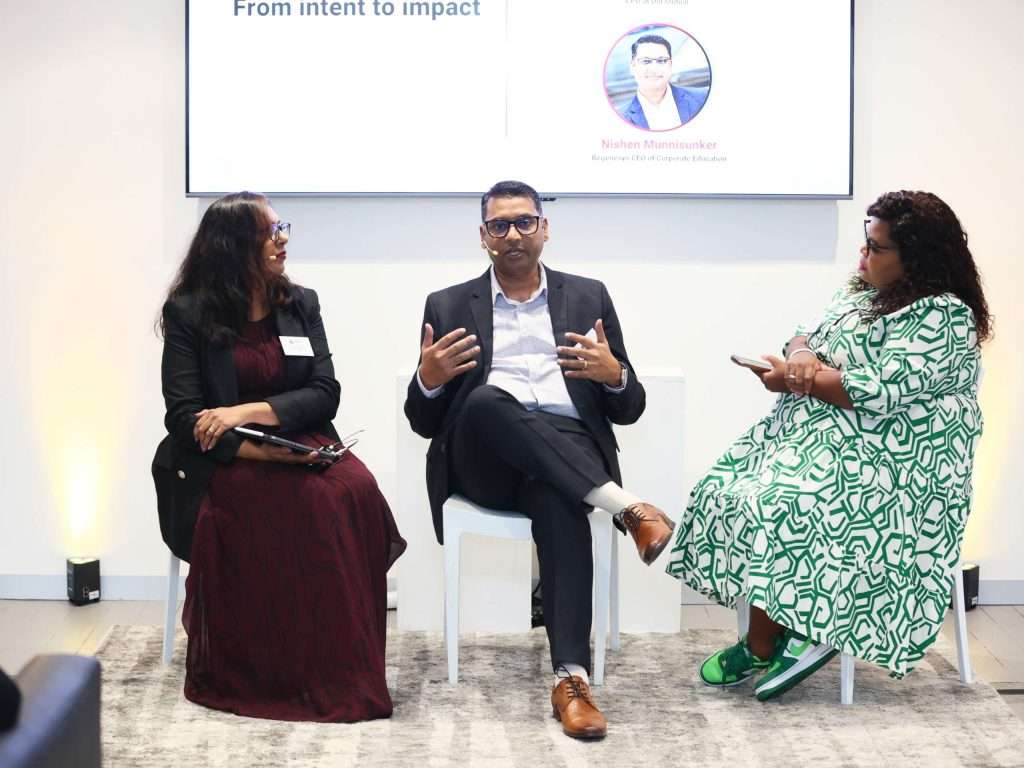
At the heart of this year’s Radical Inclusion Summit, a powerful fireside chat between Old Mutual CPO Anusuya Govender and Regenesys Corporate Education CEO Nishen Munnisunker lit up the room, challenging what inclusion truly means.
For Nishen, the conversation around inclusion isn’t simply about representation but more about rewiring behaviour so thoroughly that inclusive thinking becomes second nature.
“Radical inclusion is about changing the behaviour so that it actually becomes part of the behaviour,” he said. “You normalise the nuances, and that’s what radical inclusion is all about: normalising that it’s part of the processes, part of the culture. You wake up and you do it without thinking about it because it’s just something that’s part of the values of the organisation, of the strategy of the organisation, and of the direction that you’re heading in, which is then enabled by the entire organisation itself.”
He stressed that inclusion shouldn’t exist in silos or as a standalone HR initiative. Instead, it should be so embedded that it “isn’t a second thought”.
“If you're looking to embed behaviour, it is something that’s consistently repeated. It should be part of your policies and part of your values. So you start identifying the right talent to come in who will already start to think and align to the values that you’re looking for, and you identify that early on, and start bringing that into the organisation.”
He also noted the importance of leadership alignment, explaining that vision without unity can derail change efforts.
“Change happens from the top. If your leadership isn’t part of the change, the change isn’t going to happen. The big problem is practising one thing, and you end up envisioning something else, so those two will never come together. There will never be that collaboration or that union because you will have the leadership in one direction and the organisation going in a different direction.”
Both believe inclusion shouldn’t be a standalone HR initiative, as Anusuya also highlighted that DEIB has moved far beyond that at Old Mutual.
All about impact
“We stopped doing awareness training a long time ago. What we’ve done is embed DEIB as part of everything we do around human capital, how we recruit, how we develop people, how we think about psychological safety, culture, line manager capability, inclusion, and creating those safe spaces for belonging.”
“DEIB is deeply rooted in our values. So when we think about DEI, we think about it not just in terms of employees but also the customers we serve. It’s the communities we impact. Employees resonate with that because it connects to a higher purpose, and if we think of generations that we’re employing into the organisation, such is meaningful.”
“We talk about this all the time, but do we connect our DEIB initiatives to our values, to strategic intention, to our customer value chain, to the societies we’re impacting? I think that’s when employees feel a deep connection to how we’re driving change.”
Anusuya also highlighted how Old Mutual tracks accountability and inclusion through tangible metrics.
“Accountability is huge for us. What we do through our culture transformation journey is use three key metrics that drive how we do business from our culture and organisational perspective. It’s diversity and inclusion, psychological safety, and inclusive leadership.”
That commitment to accountability, she said, shifts people’s engagement and behaviour. “It starts to drive a very different behaviour when the people you’re talking to are motivated by something that’s different, and I think those are some of the practical things we just talk about regarding how we really shift what we think is systemic change.”
Equal opportunities
According to her, as workplaces evolve, inclusion strategies must also adapt to new modes of working, and she urged leaders to be more creative in shaping inclusive systems.
“The two things in my mind that prevent us from moving DEIB strategies or prevent the momentum we require around progress are, one, buy-in from top leadership. Without it, it’s hard to have the resources and momentum to drive those initiatives. And two: cultural change. The ability for an organisation to be ready to adopt change is huge.”
“So, it’s probably incumbent on our top leadership to make sure they’re driving the right agenda with the board and making sure that meaningful change continues to be top of the agenda.”
Nishen concluded the discussion with a reframing of what equality in the workplace truly means.
“There’s a misconception that equality means somebody that was previously disadvantaged should get the job. I was talking to the CEO of a technology company the other day, and what she said to me is: equality is about people having the equal opportunity to apply for the job. The person that gets the job is the one that’s most competent for the job itself.”
He continued, “If you look at it from that perspective, you’ll always say that whatever the business makes or achieves at the end of the day is due to DEIB because people were given an equal opportunity to apply for that particular position, and I think that’s the way we need to start shaping and directing ourselves towards inclusion.”