
Post-Covid, there really is no definite answer as to what works best for organisations when navigating Hybrid 3.0, says panel at CHRO Solutions Summit.
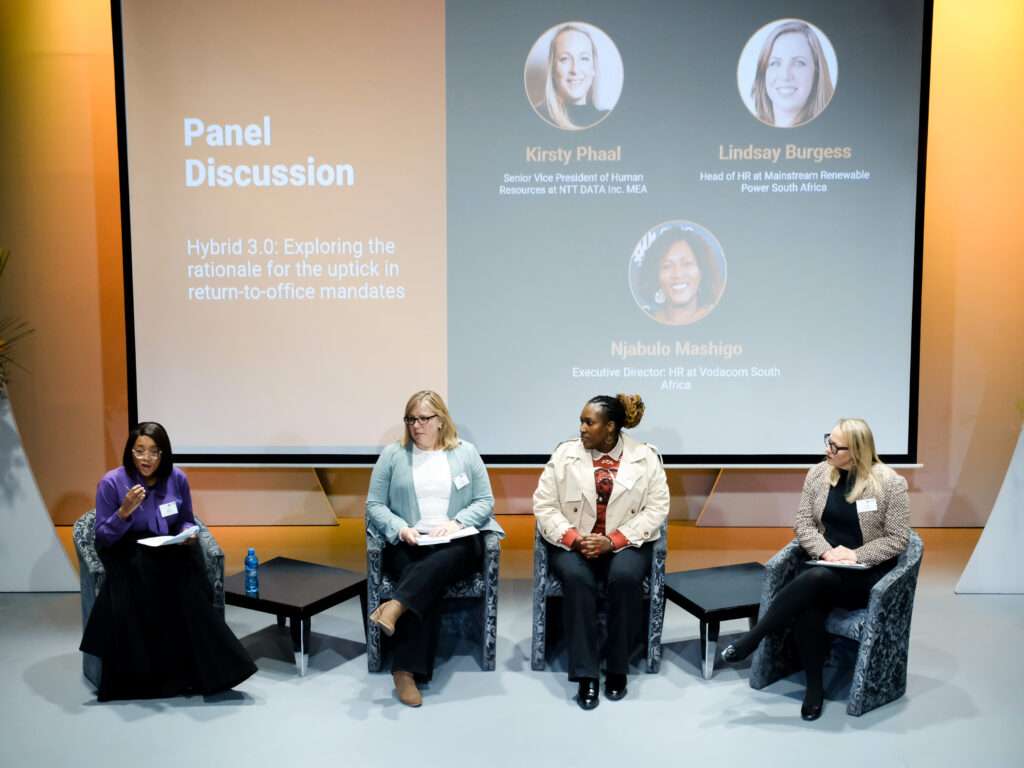
There is no one-size-fits-all solution when it comes to the crucial pain point experienced by CHROs globally: the return-to-office mandates and their effects on employee morale, organisational culture and workplace flexibility, said a panel who discussed “Hybrid 3.0” at the recently held CHRO Solutions Summit at The Venue in Melrose Business Precinct.
Kirsty Phaal, senior vice president of HR at Dimension Data, Lindsay Burgess, head of HR at Mainstream Renewable Power South Africa, and Njabulo Mashigo, executive director of HR at Vodacom South Africa, participated in the panel discussion.

Lindsay shared that her organisation adapted smoothly to remote work during Covid-19 and developed innovative strategies to encourage employees to return to the office.
“Our employees frequently travelled, so we were accustomed to having people out of the office. When Covid-19 hit, the transition was easy. We successfully completed two wind farms and another major project entirely remotely, which boosted our confidence in this approach. However, when it was time to return to the office, we faced the challenge of asking employees who live far from the office to come in, reducing the significant flexibility they had grown used to,” she explained.
She added that beyond working from home, the organisation also has flexible working hours, “People are free to do things during working hours as long as it doesn’t interfere with their output and deadlines.”
This, of course, is not done without caution, she says, “It’s not a bums-on-seats issue, but we are mindful that others may slip into old, unproductive habits and in such cases we do have measures in place to bring people back to the office full-time if they are consistently not meeting their deliverables.”

This was entirely different for Njabulo, who, together with the mobile communications company’s leadership, had to make the tough decision to have the people leaders in the business return to the office full time while other divisions maintained a hybrid status quo.
This was due to a few challenges in terms of the business and market challenges, which have required more hands on deck.
It created a bit of controversy within the business, she explained, adding that people leaders argued how impossible it is to lead from the office when employees work flexibly location-wise, “We had to keep open communication lines and explain that our plan is to keep employees empowered re flexibility, but also be very transparent about the state of the business and the reasoning for the return-to-work mandate.”
This helped with the rationale and the team is now well-adjusted to being at the office full-time, she concluded.

A reality that one can’t help but notice, adds Kirsty, is the fact that employers are directly and indirectly mandating people back to the office, and to an extent people are starting to dress more formally and reverting to the traditional approaches to working from the office.
“Hybrid is never going to be what it was during Covid and as with any change management, there will always be casualties when employers introduce a return-to-work mandate, but there won’t be a crisis,” she says.
For her, the bigger challenge now is how to get employees who were comfortable in a fully remote environment to buy into returning to work.
“I think the best way to handle this is to change the organisational structure to a skills-based organisation versus a traditional hierarchical one. People are keen on plugging into different projects/functions. They don’t want to be constrained into one area and so one has to be very intentional about how they are shaped. Working from home or the office has a significant impact one way or the other,” she concluded.