
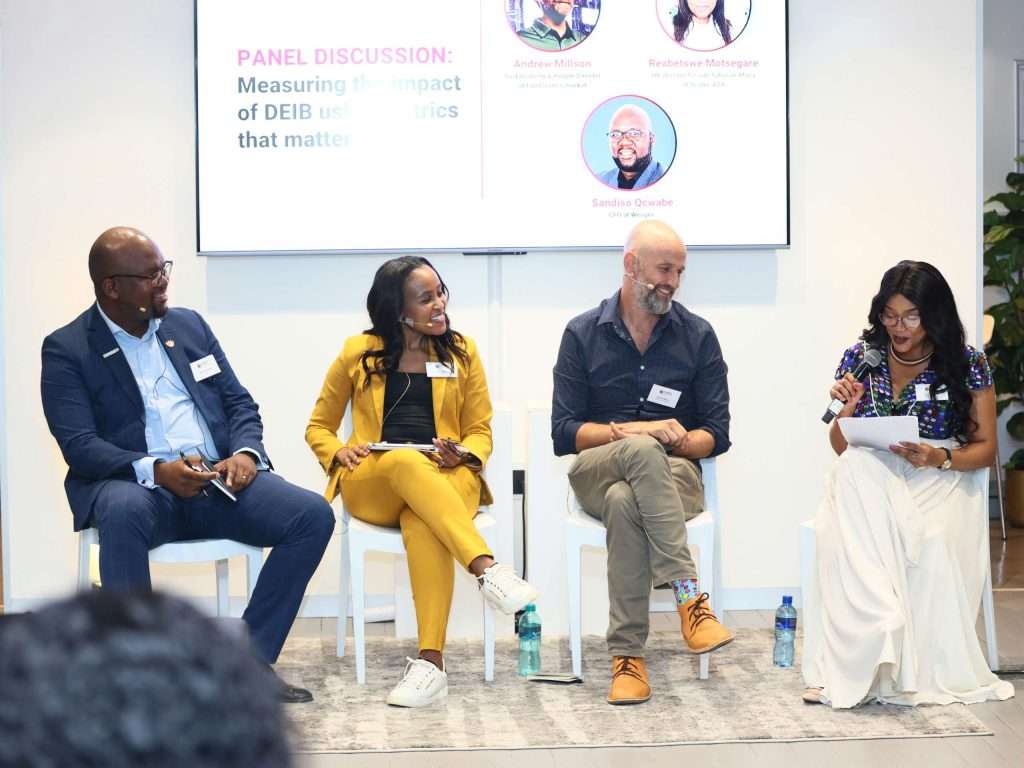
The CHRO South Africa Radical Inclusion Summit recently hosted a powerful panel discussion that delved into the crucial aspects of truly embedding company values into daily operations and effectively measuring the often overlooked concept of belonging.
This engaging conversation featured insightful contributions from Andrew Milson, sustainability & people director at Food Lover’s Market, Reabetswe Motshegare, HR director at Scatec ASA, and Wesgro CFO, Sandiso Gcwabe.
Andrew opened the panel speaking about the importance of understanding the lived realities of employees. He shared an example of their ‘Love My Journey’ programme, which involves one-on-one interviews to understand the context of employees’ lives, including those living in poverty. “We have those conversations with people to really understand the brutality of how hard it is for them to live in their lives,” he explained, stressing the need for sincerity and a shift from head to heart within leadership. “It’s wonderful hearing from people how this programme has shifted them.”
He expressed his frustration with comments dismissing the struggles of others, and shared the importance of recognising potential beyond formal education. “One of our key topics that we speak about is don’t confuse a lack of education with the lack of talent. We need to identify talent but also work to nurture and develop a person.”
Sandiso, as a CFO, identified how a purely numbers-driven approach overlooks the intrinsic value created by fostering a positive and inclusive culture. “If we only look at metrics from a numbers perspective, we don’t understand that the true value we create lies in some of these things we look at when we want to cut budgets. So the role of the CFO is to understand the numbers behind the value and make sure that the decisions that get taken are the decisions that drive that value.”
He captured the critical link between valuing people and achieving long-term sustainability and value creation.
Belonging fundamental
“We are a knowledge organisation, so our people are our biggest asset. We provide consultancy services. If we neglect our people in the short term, we may have a perception that we’re creating value, but in the long term, it’s not sustainable. Your biggest asset in a specific project would leave at the wrong time, and then you would destroy value by taking a financial decision that might seem to make financial sense, but in the long term, it is destroying value. So we need to understand the true drivers of value and make sure we measure those and report metrics that are like a mirror to the organisation.”
According to Reabetswe, despite focusing on metrics like employment equity targets and gender representation, failing to measure the fundamental feeling of belonging can be disadvantageous as it directly impacts retention. “Up until that time we measure belonging, then maybe we’re retention, and maybe the retention will improve. So that’s why measuring belonging is so important.”
She shared her personal approach to measuring belonging within her team, which goes beyond traditional engagement surveys. “So my personal measurement is when I check in with the teams, and I ask them to tell me about their head and heart.”
Self-awareness key
She recounted an instance where an employee openly admitted they didn’t want to be there, highlighting the power of creating a safe space for vulnerability. “Had I continued with that meeting, it would have just been presentism. Now that person is even willing to work on a Saturday because they feel like they belong in this team. At the time that they were not at their best, I said it’s okay, and today they want to do the work. So that’s my personal way of measuring, in addition to the employee engagement surveys that we do.”
Reabetswe further then brought a critical and often unspoken issue to the forefront, referencing an article on corporate bullying. “Limited research shows that 70 percent of those bullied leave their jobs and that 68 percent of the 70 percent of victims are female employees who are bullied by other women in authority,” she read.
She shared her personal discomfort and self-reflection upon reading this and the need for self-awareness among leaders, particularly women in HR roles who are meant to foster positive environments.
“Sometimes, without self-awareness, without self-reflection, we will be making people leave without noticing that it is us leaders, and, most importantly, the same HR people that are supposed to create the right environment for people.”
She urged for open dialogue about these “ugly parts” that often go unaddressed for DEIB to be implemented impactfully.